
Crude Oil Dewaxing vs. Diesel Dewaxing: Process Differences
Written By: Mr.Ran
Senior Petrochemical & Waste Oil Recycling Engineer
Deeply involved in the design, manufacturing, and optimization of various waste oil recycling and petrochemical equipment, delivering practical and efficient solutions for clients worldwide.
Petroleum refining is a complicated set of single chemical and physical steps of turning crude oil into useable products starting from a wellhead. One of the more important and useful steps of the oil refining process is called dewaxing. If the long-chained paraffins are left untouched they can solidify at low temperature which can impede the performance and flow of the products used…. In the case of dewaxing, the term dewaxing can refer to oil dewaxing which is dewaxing of crude oil and diesel dewaxing which is dewaxing of diesel.
Both dewaxing processes crude and diesel are done to solve the issues associated with dewaxing, there is more than meets the eye. Their scale, purpose, primary processing techniques and procedures, and location in the refinery flow these are all extremely different. The differences in these are important to optimize the operations of the refinery and meet high specifications of the products from the refinery, especially of the product’s cold flow properties.
Part 1: The Concepts of Crude Oil Dewaxing and Diesel Dewaxing
1. Crude Oil Dewaxing
The phrase “crude oil dewaxing” can be defined in multiple ways. In a broader sense, however, it involves the separation of the less critical wax components in relation to the total processing of heaviest fractions. Crude oil dewaxing in its entirety, however, is less common. More appropriately, the term describes the dewaxing of heavy fractions obtained from crude oil, more specifically, base oils (lubricating oil base stocks) and heavy vacuum gas oils (HVGO) intended to make value added products like lubricants. The wax content in these streams significantly raises the pour point of the lubricant, rendering it ineffective in colder climates. Therefore, dewaxing of the base oil fraction is a necessary step in the production of lube oil.
2. Diesel Dewaxing (Middle Distillate)
Dewaxing diesel fuel, or middle distillate dewaxing, is a process specially applied to the diesel fuel fraction, a middle distillate product. The main purpose is to ensure the final diesel fuel fulfills the important “cold flow specifications,” Cloud Point (CP), Pour Point (PP), and Cold Filter Plugging Point (CFPP). During winter months, the diesel fuel containing wax, particularly normal paraffins, is likely to crystallize and precipitate at a particular temperature. This means the diesel may clog fuel filters and lines, causing the engine to fail. Thus, dewaxing is an important step when it comes to producing winter-grade and premium quality diesel fuel especially when it’s cold outside.
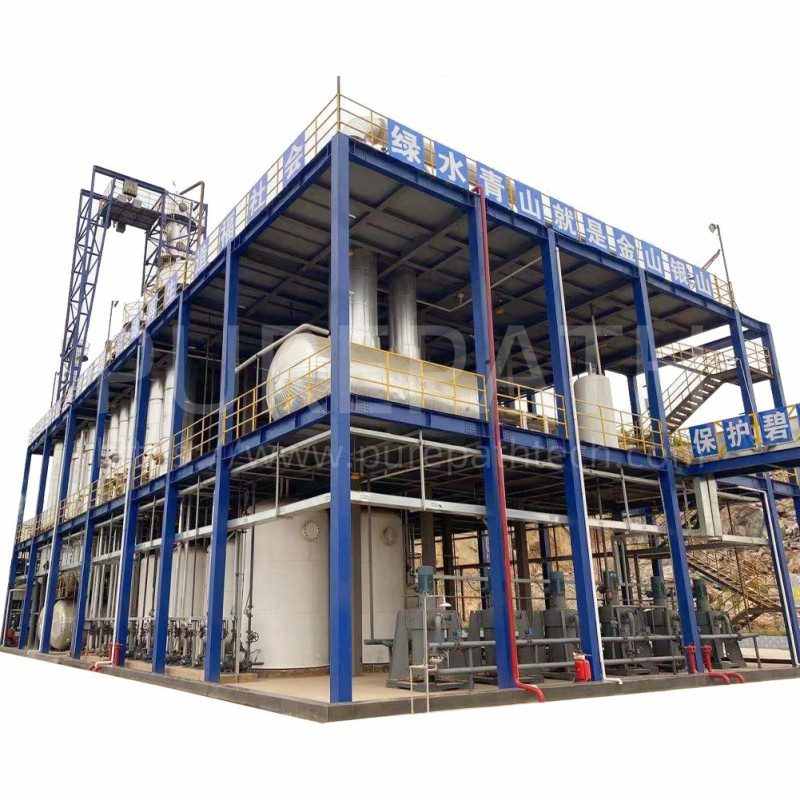
Part 2: Comparative Analysis Between Crude Oil Dewaxing and Diesel Dewaxing
| Feature | Crude Oil Dewaxing | Diesel Dewaxing |
| Treated Object (Feedstock) | Heavy Crude fractions like Heavy Vacuum Gas Oil (HVGO) and Deasphalted Oil (DAO) | Middle Distillates like Diesel and sometimes other fractions of Kerosene and Jet Fuel |
| Refinery Location | Downstream of Vacuum Distillation and often integrated with Hydroprocessing units (for catalytic methods). | Within the Distillate Hydrotreating/Hydrocracking complex, or a standalone unit dedicated to the distillates. |
| Primary Objective | To produce Lube Oil Base Stocks with low Pour Point and high Viscosity Index (VI). | To produce Diesel Fuel with the specific Cold Flow Properties (low Cloud Point and CFPP) needed for certain climates. |
| Wax to be Removed | Heavy long-chain n-paraffins dominating the solidifying fraction of a derrick crude oil. | Long-chain n-paraffins in the middle distillate boiling range. |
| Core Process Methodologies | Solvent Dewaxing, a method of physical separation, applied to wax and a solvent (MEK/Toluene) in a chilled and filtered solution. Crystallization.2. Catalytic Dewaxing: a conversion of wax (hydroisomerization and/or hydrocracking). | Catalytic Dewaxing (Hydroisomerization): A conversion of n-paraffins to branched paraffins (isomers) with lower pour/cloud points. Diesel yield is maximized by minimizing the cracking process. |
| Significance of Treatment | Determines base oil’s quality (Group I, II, III) and capability of formulating high-performance engine lubricants. | Critical for the purpose of construction and domestic use of fuel in winter region. |
As can be seen from the table, the dewaxing step in the petroleum refining process has multiple functions associated with various product streams. For instance, crude oil dewaxing is a must for the derivation of Group I, II, and III base oils, while dewaxing of diesel is necessary for meeting the fuel requirements, like EN 590 for winter-grade diesel.
Conclusion
Despite both dewaxing of crude oil and diesel dewaxing attempts to improve low-temperature fluidity, their technology pathways, process positions, and operational objectives are quite different. The dewaxing of crude oil focuses on retaining lubricant “high-performance” and dewaxing of high-molecular-weight waxes, which are then used to produce base oils. On the other hand, diesel dewaxing is a downstream refining process aimed at improving the cold flow behavior of diesel fuels by catalytic modification and/or the use of additives.
Relatively, petroleum refining dewaxing enables refineries to optimize their energy mismatches, product quality standards, and seasonal fuel adaptability. Currently, the integration of dewaxing and diesel dewaxing processes within refineries provides lubricant base oils and transport fuels that outperform the rest under all other conditions.