

Is Re-refined Base Oil Safe for Engines? Fuel Consumption & Performance Impact
Written By: Mr.Ran
Senior Petrochemical & Waste Oil Recycling Engineer
Deeply involved in the design, manufacturing, and optimization of various waste oil recycling and petrochemical equipment, delivering practical and efficient solutions for clients worldwide.
With the advent of a global circular economy, waste oil to base oil conversion has become a key industrial operation. But for end-users, who range from fleet managers to industrial maintenance engineers, there is often doubt that converting to recycled lube will have an effect on mechanical performance, namely, fuel consumption. This article evaluates the technical properties of Re-refined Base Oil (RRBO) and its effects on internal combustion engine efficiency.

What is Re-Refined Base Oil (RRBO)?
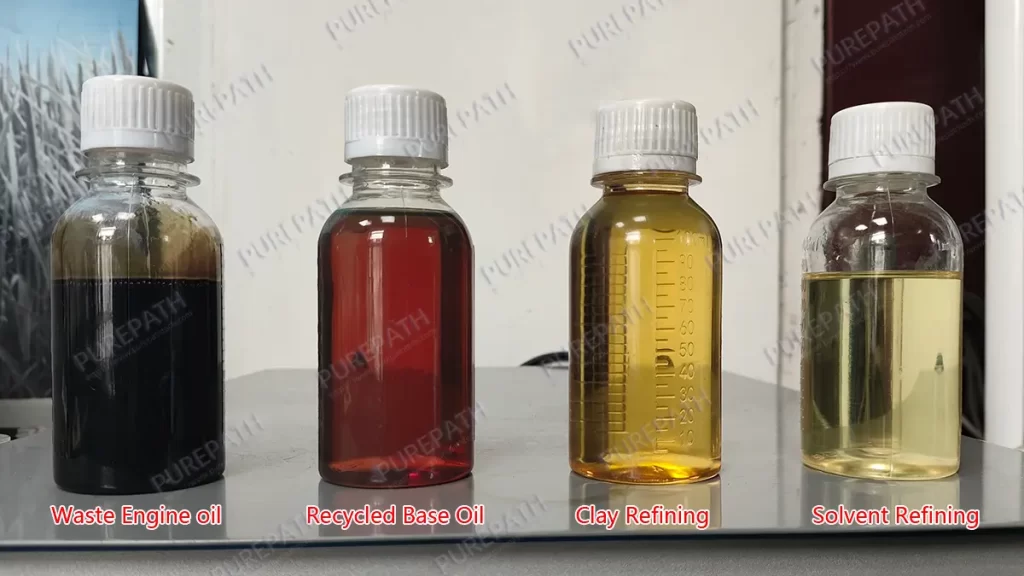
There is a need to make a differentiation between “recycled oil” and “re-refined oil”. In general, recycled oil accounts for treated used oils that undergo basic filtering of larger particulates —often as low-grade fuel. An oil that is done at a modern waste oil re-refining plant goes through an elaborate chemical change.
This process involves methods such as vacuum distillation and hydrotreating, which will remove oxidation products, heavy metals, and degraded additives at a molecular level. The resulting base stock is chemically the same as virgin base oil refined from crude petroleum. As the oil molecule of base oil itself does not wear out (only contaminates), a process called Re-refining was performed, which puts the oil back to its original or even better state.
What Elements Impact the Fuel Consumption?
The fuel usage in the engine depends mainly on overcoming internal friction and parasitic drag. The latter two depend on particular physical characteristics of the lubricating fluid, irrespective of where it comes from.
1. Viscosity and Fluid Drag
Viscosity is the most significant factor affecting fuel economy. The oil that isn’t too viscous is easier and more efficient to get around the engine as compared to a high viscosity oil, and reduces the work that needs to be done by the pistons and moving bearings. Advancements in oil chemistry have contributed to meeting SAE (Society of Automotive Engineers) J300 standards. Re-refined 0W-20 oil still has not reached the level of a virgin 0W-20 oil in its kinematic viscosity at temperatures of both 40°C and 100°C. Consequently, the fluid drag remains identical.
2. Viscosity Index (VI) Stability
The Viscosity Index tells how good an oil is at not thinning out at high temperatures and not thickening out at low temperatures. High-quality RRBOs often perform well on VI stability because the feedstock has already undergone thousands of thermal cycles in an engine, providing a “stress test” for the most stable molecules. This keeps the oil at the optimal film thickness, reducing friction when the engine is warming up, which is when fuel consumption is at its worst.
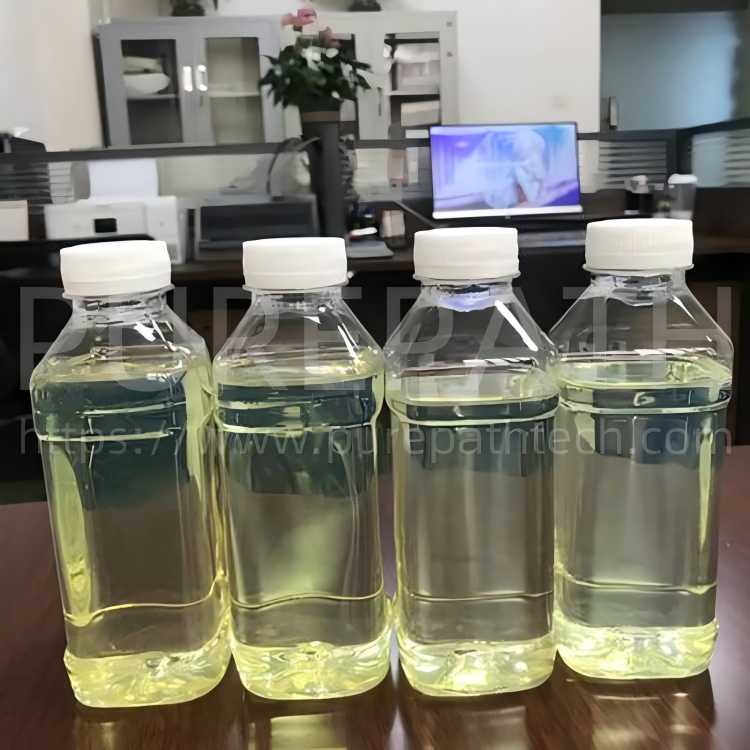
Comparative Performance of Re-refined and Virgin Base Oil
The following data outlines the parity between high-quality re-refined base stocks and virgin base stocks in terms of parameters that influence fuel efficiency.
| Property | Re-Refined Base Oil (Group II) | Virgin Base Oil (Group II) | Impact on Fuel Economy |
| Kinematic Viscosity (100°C) | 5.2 – 5.4 cSt | 5.2 – 5.4 cSt | Direct (Drag) |
| Viscosity Index | 105 – 115 | 100 – 110 | Indirect (Temperature stability) |
| NOACK Volatility | 12% – 13% | 13% – 15% | High (Oil thickening prevention) |
| Sulfur Content | < 300 ppm | < 300 ppm | Neutral |
Due to its lower NOACK volatility, the hydrotreated re-refined base oil often has different benefits. Once oil goes through volatilization, i.e., evaporates, the rest of the oil gets thicker, increasing the viscosity, and also the fuel consumption does. RRBO processed through advanced hydrofinishing minimizes this thickening effect over the duration of the
Is Re-Refined Oil Safe for Engines?
The safety and reliability of a lubricant are determined by its ability to meet performance specifications set by international bodies. Is re-refined oil safe for engines? The answer depends on certification.
API and ILSAC Standards
Engine manufacturers require oils to meet American Petroleum Institute (API) and International Lubricant Standardization and Approval Committee (ILSAC) standards. To receive the API “Starbust” or “Donut” seal, a re-refined lubricant must pass the same rigorous engine tests as virgin oil. These tests include:
- Sequence VI (Fuel Economy Test): Measures the oil’s ability to reduce fuel consumption compared to a reference oil.
- Sequence VIII (Bearing Weight Loss): Evaluates corrosion protection.
- Sequence IIIH (Oxidation and Deposits): Tests high-temperature stability.
Should an RRBO-derived engine oil become approved for use as API SP or ILSAC GF-6 standards, it will have been officially recognized as being both efficient and safe for modern engines, particularly GDI and turbocharged models.
The Role of the Waste Oil Re-Refining Plant
The quality of the final base oil is a direct result of the technology utilized in the waste oil re-refining plant. Modern facilities use a multi-stage process:
- Dehydration: Removal of water and light hydrocarbons.
- Solvent Extraction or Vacuum Distillation: Separating the base oil from heavy polymers, additives, and dirt.
- Hydrotreating/Hydrofinishing: Using hydrogen at high pressure and temperature with catalysts to saturate aromatics and remove remaining impurities like sulfur and nitrogen.
The stringent processing involved here guarantees that the conversion process produces base oils of Groups II and even III standards. The base oils at such a high standard are necessary for the preparation of low viscosity oils (0W-8 or 0W-16), which are suitable for use in hybrid and efficient automobiles.
Why is Perceived Increasing in Fuel Consumption?
When end-users report increased fuel consumption following an oil change, the cause is rarely the recycled nature of the oil. Technical investigations usually identify three primary reasons:
- Application Problem: The customer might have used a viscosity grade that exceeds the Original Equipment Manufacturer’s (OEM) recommendations. For example, the use of a 10W-40 motor oil in an engine intended for 5W-20 will significantly impact fuel economy because of the increased resistance internally.
- Additive Package Performance: The base stock (either new or reclaimed) forms the building blocks of a lubricant, while the additive package contains the friction modifiers. In the case of a cheap lubricant with poor additives, there will be higher friction.
- Other Factors: Variations in fuel quality, tire inflation, temperatures, or driver behavior usually occur around the time of an oil change. This creates an illusion that the kind of lubricant affects fuel efficiency.
ESG and Economic Implications
Utilizing RRBO provides significant environmental advantages without compromising mechanical efficiency.The creation of base oil from waste oil consumes roughly 50-80% less energy than producing it through the refining of crude oil. In regard to organizations concentrating on the ESG framework, re-refining of lubricants can be considered a measurable way of cutting down Scope 3 carbon emissions.
- Carbon Footprint: The re-refining of one gallon of used oil can avoid the emission of several kilograms of CO2 as opposed to the extraction and refining of new oil.
- Conservation of Resources: Crude oil is wasted at a rate of 42 gallons per 2.5 quarts of high-quality virgin base oil, while only 1 gallon of used oil will create the same 2.5 quarts of re-refined base oil.
From the technical perspective, a re-refined base oil will not consume more fuel. When waste oil is passed through an efficient waste oil re-refining plant, the process of converting it into base oil will produce a lubricating oil that satisfies all the international criteria of viscosity, purity, and stability.
As for the question “Is re-refined oil safe for engines?”, according to the API and OEM, safety and effectiveness of this type of oil will be preserved in the case the oil fulfills all the requirements of performance categories. Consumers can change to re-refined oil while retaining the same MPG performance as in the case of traditional petroleum oil.
Frequently Asked Questions (FAQ)
Q1: Is re-refined oil safe for engines with turbochargers?
A1: Yes. Re-refined oils that meet API SP standards are tested specifically for high-temperature deposit control and pre-ignition prevention in turbocharged engines.
Q2: Why do some people believe recycled oil is lower quality?
A2: This is an historical leftover from early recycling methods that only used basic filtration. Modern re-refining technology uses molecular distillation and hydrofinishing to ensure the product is equal to virgin oil.
Q3: Does using RRBO affect the oil change interval?
A3: No. If the oil meets the required OEM specifications, the drain interval remains exactly as specified in the vehicle owner’s manual.
Q4: Can re-refined oil be mixed with virgin oil?
A4: Yes. RRBO and virgin base oils are completely miscible and compatible, provided they share the same viscosity grade and API service category.