
Re-refined vs. Virgin Base Oil: Technical and Performance Comparison
Written By: Mr.Ran
Senior Petrochemical & Waste Oil Recycling Engineer
Deeply involved in the design, manufacturing, and optimization of various waste oil recycling and petrochemical equipment, delivering practical and efficient solutions for clients worldwide.
The world’s lubricants industry is in the midst of a structural transition, driven by corporate ESG mandates and regulatory decarbonisation targets. The core of this transition is the selection of the basic raw materials: virgin base oil (VBO) versus re-refined base oil (RRBO). Both fluids are used to develop finished lubricants capable of meeting the same international performance specifications, but their extraction methods, thermodynamics of processing, environmental lifecycle and supply chain mechanics are fundamentally different.
Core Definitions and Technological Processing Linkages
To evaluate the operational equivalency of these baseline fluids, it is necessary to define their chemical origins and the industrial processing sequences required to stabilize their molecular structures.
What is Virgin Base Oil (VBO)?
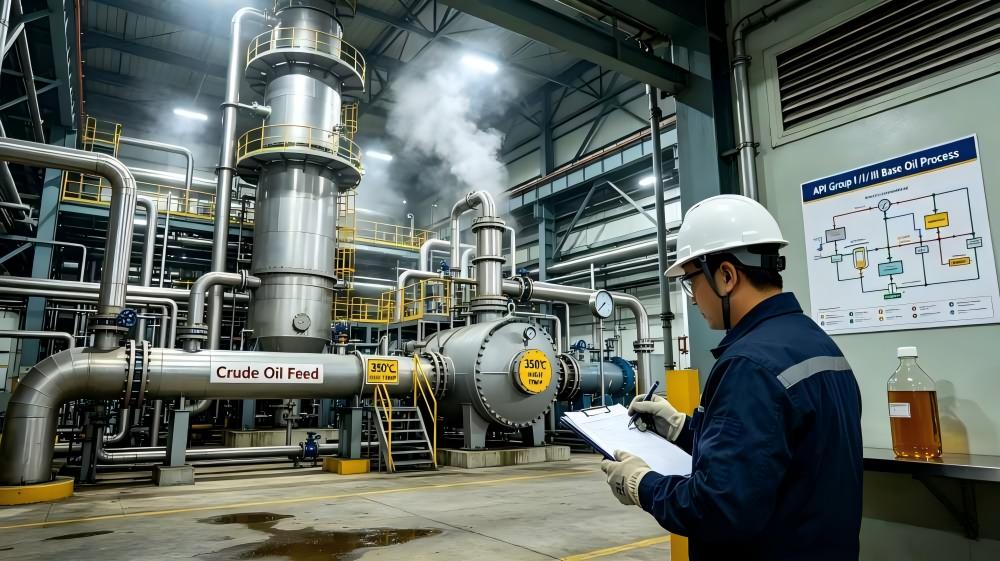
Virgin base oil is a hydrocarbon fluid obtained directly from crude oil (petroleum, of fossil origin) through conventional geological extraction and complex refinery processes. So the manufacturing infrastructure needed for VBO is the refining chain downstream in sequence:
- Atmospheric and Vacuum Distillation: By adjusting pressure variables, crude oil is separated into different boiling point fractions to obtain the heavy distillate core.
- Solvent Extraction or Hydrocracking: High-pressure hydrocracking uses hydrogen gas at temperatures above 350°C and pressures above 15 MPa to break complex bonds in aromatics and heteroatoms and convert low-quality hydrocarbons to saturated paraffinic structures.
- Hydroisomerization Dewaxing: This is a catalytic process that converts the linear n-paraffins to branched iso-paraffins, changing the crystallisation point to improve low temperature fluidity and pour point.
- Hydrofinishing: A final catalytic saturation step removes residual trace olefins and reactive polar compounds to maximise thermal and chemical stability.
The base stocks are classified as Group I (solvent-refined), Group II (hydroprocessed) or Group III (severe hydrocracked/hydroisomerized) baseline stocks according to American Petroleum Institute (API) specifications. VBO is a limited, non-renewable resource associated with universal petrochemical mining statistics.
What is Re-refined Base Oil (RRBO)?
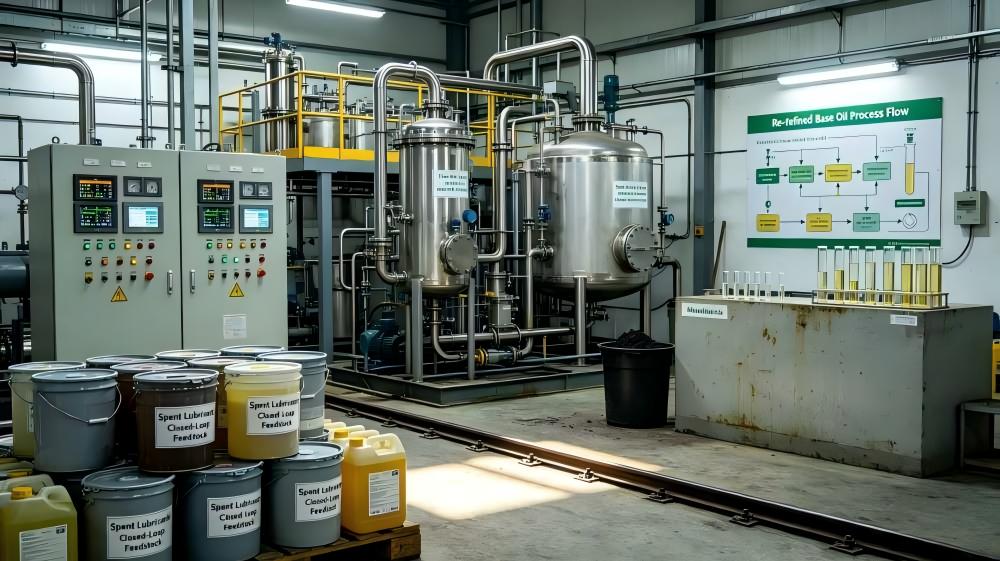
Re-refined base oil is a premium synthetic or mineral equivalent baseline stock generated by utilizing used lubricants (spent motor oil, industrial gear fluids) as a closed-loop chemical feedstock. It is critical to differentiate authentic industrial re-refining from rudimentary oil recycling or filtration:
- Oil Recycling / Laundering: This process simply passes the used oil through mechanical filtration or basic dehydration units to remove coarse particulate matter and free water. The fluid so formed contains dissolved contaminants and degraded chemical additives. It is usually used as a low-grade industrial fuel oil.
- Chemical Re-refining: In this advanced chemical engineering process, all performance-degrading additives, combustion by-products, oxidation polymers and metallic debris are stripped away at the molecular level, resulting in a highly purified hydrocarbon base stock.
The sequence of structural processing in advanced RRBO is:
- Dehydration and Light Ends Removal: Flash distillation removes water, dissolved fuel fractions and volatile solvents under low vacuum.
- High-Vacuum Distillation: Dried oil is fed into a thin-film or wiped-film evaporator operating under high vacuum to separate the core lubricant base stock from heavy metals, polymeric additives and asphalt flux residues.
- Severe Hydrotreating (Hydrofinishing): The fractionated core is subjected to high-pressure catalytic hydrotreating. The organosulfur compounds, nitrogen species and chlorinated paraffins are then cracked by addition of hydrogen at high temperature. This process saturates any remaining aromatic ring structures.
The end product consists predominantly of API Group II or Group II+ baseline oils, which possess chemical profiles functionally equivalent to virgin petrochemical outputs.
Technical Performance and Comparative Dimensions
The table below outlines the core technical, chemical, and environmental parameters distinguishing virgin base oil from re-refined base oil based on contemporary industrial refinery data.
| Comparative Parameter | Virgin Base Oil (VBO) | Re-refined Base Oil (RRBO) |
| Primary Feedstock Source | Geologically extracted crude petroleum | Recovered and consolidated spent lubricants |
| Resource Characterization | Depletable, non-renewable resource | Fully circular, continuous renewable material |
| Refinery Process Energy Demand | High (~2,000 to 2,500 MJ per barrel equivalent) | Low (~500 to 800 MJ per barrel equivalent) |
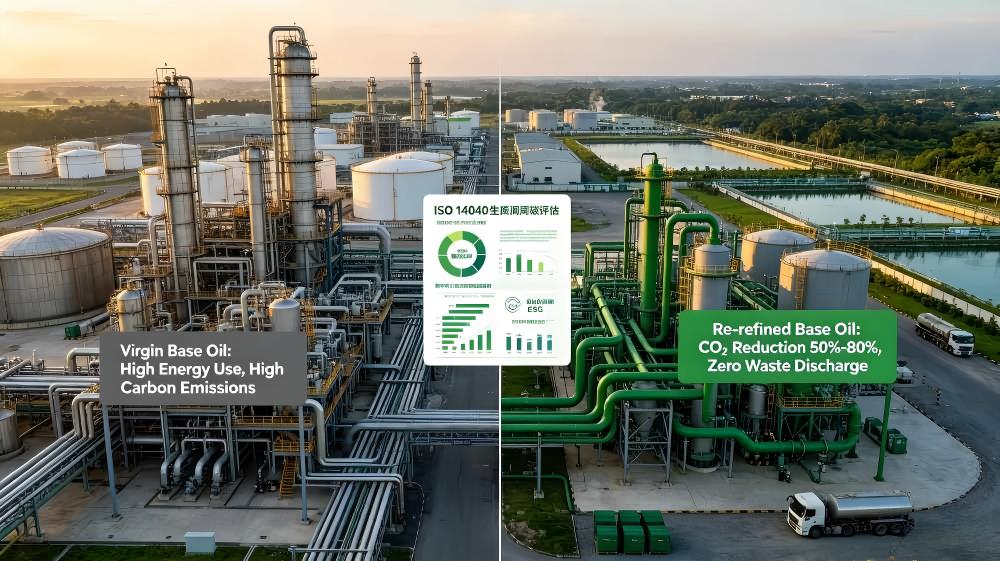
| Greenhouse Gas (GHG) Profile | Baseline standard carbon footprint | 50% to 80% reduction in total CO2 equivalents |
| API Classification Capability | Groups I, II, III, IV, and V | Predominantly Groups II and II+ (Emerging Group III) |
| Saturates Content (Group II) | Minimum 90% (Typically 95% – 99%) | Minimum 90% (Typically 96% – 98%) |
| Sulfur Concentration | Less than or equal to 0.03 wt% | Less than or equal to 0.03 wt% |
| Viscosity Index (VI) | 80 to 120+ depending on group designation | 100 to 115 (Highly stable molecular variance) |
Solving Industry Assumptions: Molecular Stability and Quality Metrics
In the industrial procurement arena, there has long been a debate as to whether the reprocessing of hydrocarbon feedstocks would jeopardise the structural integrity of the finished lubricant.
Hydrocarbon Shear Breakdown
Stable paraffinic, naphthenic or aromatic hydrocarbon chains build the basic chemical structure of a lubricant base stock. These hydrocarbon molecules do not experience wear, shear or permanent structural breakages during the mechanical operations within an internal combustion engine or an industrial gearbox.
The degradation noted in used oil is limited to the exhaustion of the additive package (such as zinc dialkyldithiophosphates, calcium sulfonates, and polymeric viscosity index improvers) and the build-up of foreign contaminants (such as carbon soot, water, unburnt fuel and microscopic iron wear particles).
A spent fluid subjected to high-vacuum distillation with severe catalytic hydrotreating removes all degraded additives and contaminants. Virgin structures are chemically indistinguishable from the rest of the baseline molecules of hydrocarbons.
OEM and Institutional Approvals
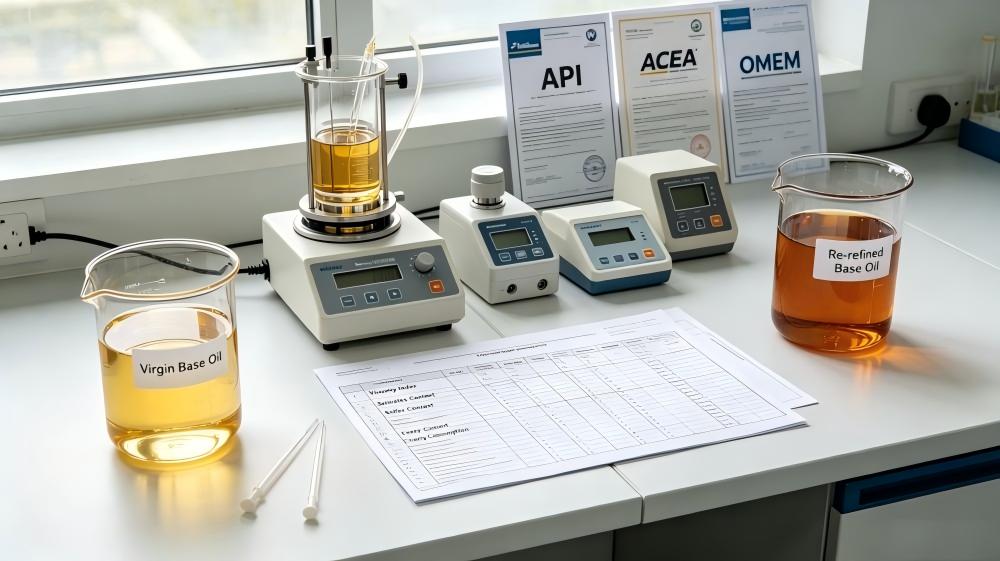
Modern RRBO processing facilities consistently produce output parameters that meet the stringent specifications set by the API (American Petroleum Institute), ACEA (European Automobile Manufacturers Association), and SAE (Society of Automotive Engineers).
Major automotive and industrial OEMs such as General Motors (dexos specifications), Volkswagen, Mercedes-Benz and Cummins approve formulations with high percentages of certified re-refined Group II base stocks. The approvals indicate that RRBO formulations possess operational performance profiles equivalent to 100% VBO lubricants concerning oxidation induction time, Noack volatility, boundary layer wear protection and deposit control properties.
Quantitative Environmental and Life Cycle Assessment (LCA) Impact
From a quantitative sustainability standpoint, substituting VBO with RRBO addresses two critical environmental problems: the mitigation of hazardous waste and the reduction of industrial carbon outputs.
Hazardous Waste Prevention
Improper disposal of used automotive and industrial lubricants can have serious environmental impacts. It is estimated that 1 litre of used engine oil not collected can pollute up to 1,000,000 litres of fresh water and form a surface film which prevents the transport of dissolved oxygen. Re-refining infrastructure captures this hazardous waste stream and reintroduces it to the chemical supply chain, eliminating terrestrial and aquatic ecotoxicity hazards.
Carbon Footprint Reductions
Life Cycle Assessments (LCAs) executed under ISO 14040/44 standards show that the production of Re-refined Base Oil yields significant energy and carbon savings compared to Virgin Base Oil:
- Energy Savings: Processing pre-refined hydrocarbons into RRBO requires up to 60% less energy than cracking and reforming crude oil structures into VBO.
- Carbon Reduction: Every metric ton of VBO replaced by RRBO prevents the release of approximately 1.5 to 2.3 metric tons of CO2 equivalents into the atmosphere. This reduction supports corporate scope 3 emissions targets and national net-zero decarbonization strategies.
Strategic Industry Outlook and Supply Integration
The commercial outlook of the global base oil market suggests the growing integration of the VBO and RRBO supply chains. While VBO is still critical to meeting the large volumetric needs of global industrial manufacturing and ultra-low viscosity Group III and Group IV synthetic formulations, RRBO has become a strategic imperative.
Regulatory bodies, such as the European Union’s Circular Economy Action Plan and updated green public procurement policies in North America, are increasingly requiring minimum percentages of post-consumer recycled (PCR) content in finished lubricants. Consequently, commercial lubricant blenderies are deploying hybrid formulation tactics to blend certified API Group II RRBO with premium VBO to optimise cost structures, satisfy mechanical compliance, and meet corporate ESG carbon-reduction mandates. The technical method to achieve a circular chemical economy, without compromising mechanical efficiency or equipment longevity, is to purchase certified re-refined base oils.