

Waste Oil to Diesel: How to Reduce Sulfur from 5000 ppm to 10 ppm
Written By: Mr.Ran
Senior Petrochemical & Waste Oil Recycling Engineer
Deeply involved in the design, manufacturing, and optimization of various waste oil recycling and petrochemical equipment, delivering practical and efficient solutions for clients worldwide.
In my years of handling industrial waste oil refinery configurations, plus managing the hydroprocessing units, one question keeps popping up, mostly from plant investors and project developers: can we get to Euro VI or Tier 4 sulfur compliance using “regular” acid–clay treatment or low-pressure catalytic cracking? The short, definitive engineering answer is really no. Because when you process severely contaminated feedstocks—like waste lubrication oils, scrap tire pyrolysis oils, or mixed plastic recycling chemical streams—the initial sulfur level tends to sit around 5,000 ppm. And then to pull that down to a strict 10 ppm ultra-low sulfur diesel target (ULSD), you need a tough multi-step chemical engineering solution, not just one conventional trick.
Traditional non-hydrogen technologies are chemically incapable of breaking down sterically hindered organosulfur rings. Achieving a steady 10 ppm output requires a capital-intensive combination of thermal separation, protective stabilization, and high-severity hydrodesulfurization process diesel technologies. This guide details the exact chemical, thermodynamic, and mechanical parameters necessary to successfully execute this deep desulfurization matrix.
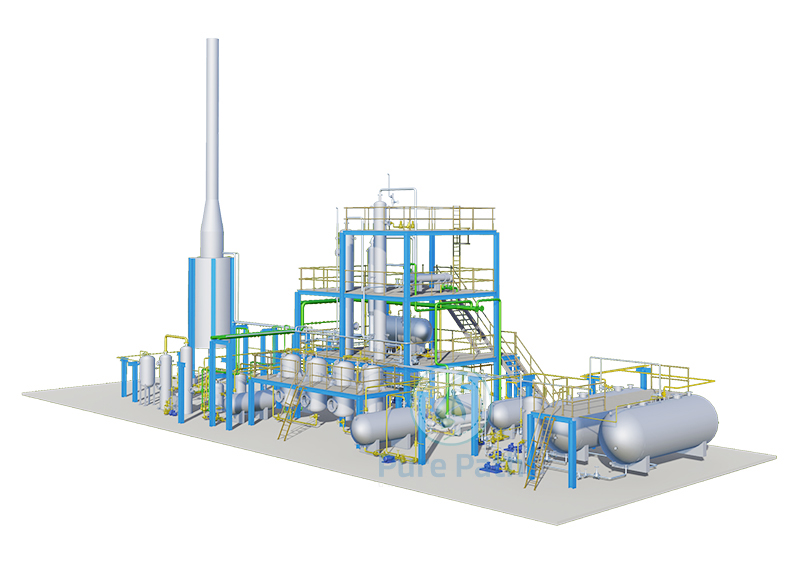
Phase 1: Pre-treatment – Protecting the Catalyst from Poisoning
Before exposing the waste oil to specialized catalyst surfaces, the raw feedstock really needs to go through an intensive separation step. The raw waste lube oil, together with pyrolysis liquids, can carry fairly high levels of water, solids, and chlorine, which is often linked to halogenated additives or PVC contamination, plus dissolved organometallic complexes like zinc, phosphorus, calcium, lead, and magnesium.
If this unrefined stream directly enters a hydroprocessing reactor, these contaminants cause immediate and irreversible catalyst deactivation. Metals deposit straight onto the catalyst active sites, sort of blocking the pore mouths, while chlorine ends up making ammonium chloride salts that start fouling the downstream heat exchangers, and then it also brings on severe stress corrosion cracking. Therefore, an optimized waste oil distillation column design is mandatory.
To execute this, the waste lube oil recycling technology must implement a thin-film evaporator (TFE) or a multi-stage vacuum distillation column operating under strict absolute pressures of 1 to 5 kPa. This thermal separation cuts out the volatile light ends and leaves behind the non-volatile heavy metals and polymeric asphaltenes in the bottom residue.
Following distillation, the intermediate diesel fraction—which still typically exhibits a sulfur concentration between 3,000 and 4,000 ppm—is passed through a designated reactor guard bed. This guard bed is packed with low-surface-area, high-pore-volume sacrificial materials or macroporous alumina catalysts optimized for demetallization (HDM) and dechlorination. The guard bed acts as a physical and chemical filter, ensuring that the downstream deep desulfurization catalyst maintains a viable commercial lifespan.
Phase 2: High-Pressure Hydrodesulfurization (HDS) – The 10 ppm Breakthrough
The primary chemical transformation occurs inside the fixed-bed hydroprocessing reactor. At sulfur levels above 500 ppm, aliphatic sulfur compounds such as mercaptans (they are basically thiol groups), sulfides, and disulfides can be readily cleaved through standard hydrogenolysis at moderate operating severities. The reaction mechanism kind of proceeds by splitting the carbon-sulfur bond, and then hydrogenating those formed hydrocarbon radicals to saturation:
R-S-R’+2H2→R-H+R’-H+H2S
Yet, going from several hundred ppm down into that 10 ppm threshold really needs the destruction of extremely refractory aromatic sulfur compounds. Mostly these come as thiophene derivatives, and in particular benzothiophenes, often called BTs, and also dibenzothiophenes, DBTs.
The most stubborn molecules encountered in pyrolysis oil upgrading to diesel are sterically hindered structures like 4,6-dimethyldibenzothiophene (4,6-DMDBT). The methyl groups at the 4 and 6 positions physically shield the sulfur atom from interacting with the active metal sites on the catalyst.
To overcome this steric hindrance, the reaction must proceed through an initial aromatic hydrogenation (HYD) pathway to saturate one of the phenyl rings, which realigns the molecular geometry and allows access to the sulfur atom. This pathway requires significantly higher hydrogen partial pressures and optimized catalytic properties.
Catalyst Selection & Comparative Operating Conditions
Achieving ultra-low sulfur boundaries shifts the choice of active metals. As regards conventional desulfurization, the Co-Mo catalyst supported on γ-Al2O3 can be employed, as it provides high selectivity towards the process of DDS due to C-S bond breaking without a large consumption of hydrogen.
For deep desulfurization down to 10 ppm, a Nickel-Molybdenum (Ni-Mo) catalyst or a stacked-bed configuration with Co-Mo followed by Ni-Mo is needed. Nickel improves the hydrogenation (HYD) path to a large extent for cracking 4,6-DMDBT molecules.
| Operating Parameter | Standard Desulfurization (500 ppm Target) | Deep Desulfurization (10 ppm Target) |
| Primary Catalyst Type | Co-Mo / γ-Al2O3 | High-Activity Ni-Mo / Modified Zeolite Support |
| Total Reactor Pressure | 3.0 – 4.5 MPa | 6.5 – 8.5 MPa |
| Hydrogen Partial Pressure | > 2.5 MPa | > 5.5 MPa |
| Reaction Temperature | 320°C – 350°C | 340°C – 380°C |
| Liquid Hourly Space Velocity (LHSV) | 1.5 – 2.5 h−1 | 0.5 – 1.0 h−1 |
| Hydrogen-to-Oil Ratio | 300 – 400 Nm3/m3 | 600 – 800 Nm3/m3 |
To sustain these kinetic rates, the Liquid Hourly Space Velocity (LHSV) must be reduced below 1.0 h−1 to increase the residence time of the heavy aromatics over the active catalyst sites.
The temperature should not exceed 390°C; temperatures above this limit result in problems regarding thermodynamic equilibrium conditions, which become favorable for reverse reaction (hydrogen sulfide reacts with olefin to form secondary mercaptan) and faster rates of catalyst coke formation.
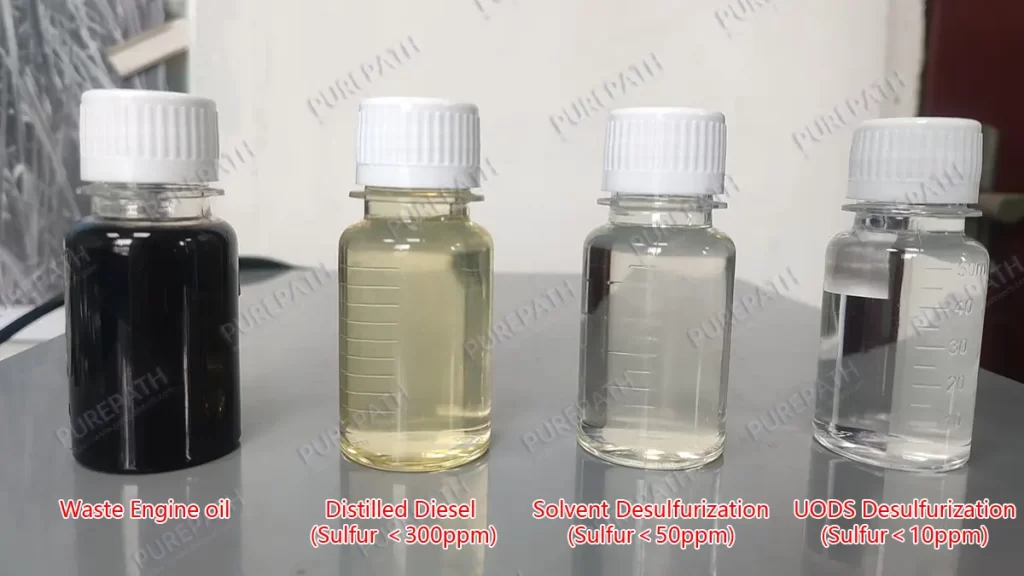
Phase 3: Stripping & Tail-End Adsorption (The Safety Net)
The effluent leaving the hydroprocessing reactor consists of a biphasic mixture of desulfurized hydrocarbons, unreacted hydrogen, light hydrocarbon gases (C1–C4), and high concentrations of gaseous hydrogen sulfide (H2S). This mixture undergoes sequential cooling and high-pressure/low-pressure gas-liquid separation.
The separated liquid diesel stream contains substantial amounts of dissolved H2S gas. If not properly stripped, this residual dissolved gas will re-evolve as volatile sulfur during storage, causing flash point failures and pushing the measured total sulfur content above the 10 ppm specification.
The stabilized liquid is routed into a steam or nitrogen reboiled distillation fractionator (stripper column). The stripping medium enters at the bottom of the column, passing counter-current to the descending diesel stream to strip out the light components and dissolved acidic gases:
Diesel (with dissolved H2S)+Stripping Gas→Stripped Diesel+Off-Gas (H2S, C1-C4)
For critical commercial applications where feedstock sulfur levels change, in a way that is a bit surprising, adding a post-reactor polishing step really acts as that essential safety net. If you integrate a reactive adsorption loop or run a fixed-bed polisher loaded with copper or zinc impregnated zeolites, you can selectively capture trace heterocyclic compounds through chemisorption, and importantly, without hydrogen use. So this second barrier kind of ensures the final output keeps matching the ultra-low sulfur diesel criteria, drawn from waste engine oil parameters, even when you hit process upsets or when the feedstock shifts around.
Operational Challenges: Capex, Opex, and Environmental Compliance
Constructing a plant capable of executing this deep desulfurization involves substantial capital expenditure (Capex) and operating expenditure (Opex) considerations, which dictate the economic viability of a waste oil to diesel plant cost evaluation.
1. Metallurgical Requirements & Capex
High temperature operations in the process stream with high H2S concentration at a temperature range of 380°C and pressure range of 8.5 MPa will require sophisticated metallurgical techniques to avoid HTHA and sulfidic corrosion. The reactor should be made out of thick-walled chrome molybdenum steels (e.g., 2.25Cr-1Mo) and internally cladded with stabilizing austenitic stainless steels (Grade 321 or 347 SS). High-pressure hydrogen makeup and recycle compressors add significantly to the initial capital footprint.
2. Hydrogen Balance & Opex
Achieving a 10 ppm target requires high hydrogen-to-oil ratios to maintain necessary hydrogen partial pressures across the catalyst bed. The process exhibits a high rate of chemical hydrogen consumption due to the concurrent saturation of aromatic rings. A reliable source of high-purity makeup hydrogen (via steam methane reforming or water electrolysis) is a vital operational cost variable.
3. Environmental Mitigation and Sulfur Recovery
The sour off-gases generated from the stripping column cannot be vented or flared directly due to strict environmental limits on sulfur dioxide (SO2) emissions. The facility must incorporate an amine absorption unit to selectively scrub H2S from the fuel gas lines. The concentrated acid gas stream is then directed to a modular Claus sulfur recovery unit or a specialized biological oxidation unit to convert hazardous H2S into inert elemental sulfur blocks, establishing a closed-loop, environmentally compliant process.
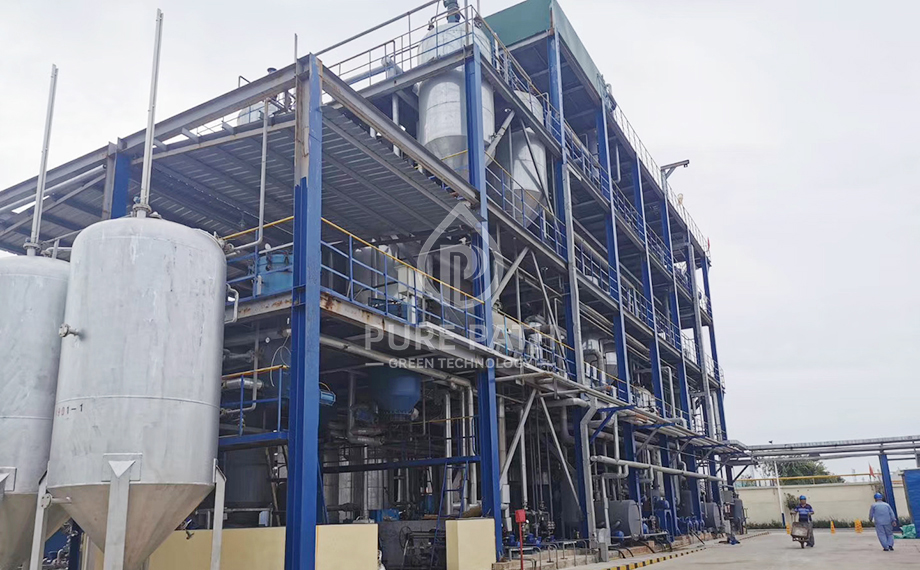
Conclusion & Technical Consultation
Transforming a highly contaminated, 5,000 ppm sulfur waste stream into a 10 ppm ultra-low sulfur diesel fuel is a precise thermodynamic and kinetic process. Success depends on rigorous feed preparation via vacuum fractionation, a high-severity Ni-Mo catalytic reaction path operating at elevated hydrogen partial pressures, and strict control over effluent stripping mechanics.
Our engineering team specializes in the calculation, scale-up, and commissioning of commercial-scale hydroprocessing units and automated separation systems. For detailed mass balances, catalyst life cycle modeling, or an explicit mechanical quote tailored to your specific feedstock assay, please contact our technical group to initiate a formal engineering consultation.