

What Determines the Capacity of a Crude Oil Refinery?
Written By: Mr.Ran
Senior Petrochemical & Waste Oil Recycling Engineer
Deeply involved in the design, manufacturing, and optimization of various waste oil recycling and petrochemical equipment, delivering practical and efficient solutions for clients worldwide.
The production capacity of an oil refinery is usually expressed in “barrels per day” (BPD), but the feed capacity of each unit varies. The crude distillation unit (CDU) is the foundation of the refinery’s capacity, while downstream units, crude properties, utilities, equipment limitations, and operating conditions jointly determine the actual crude processing volume of the refinery.
How Does CDU Capacity Determine Refinery Capacity?
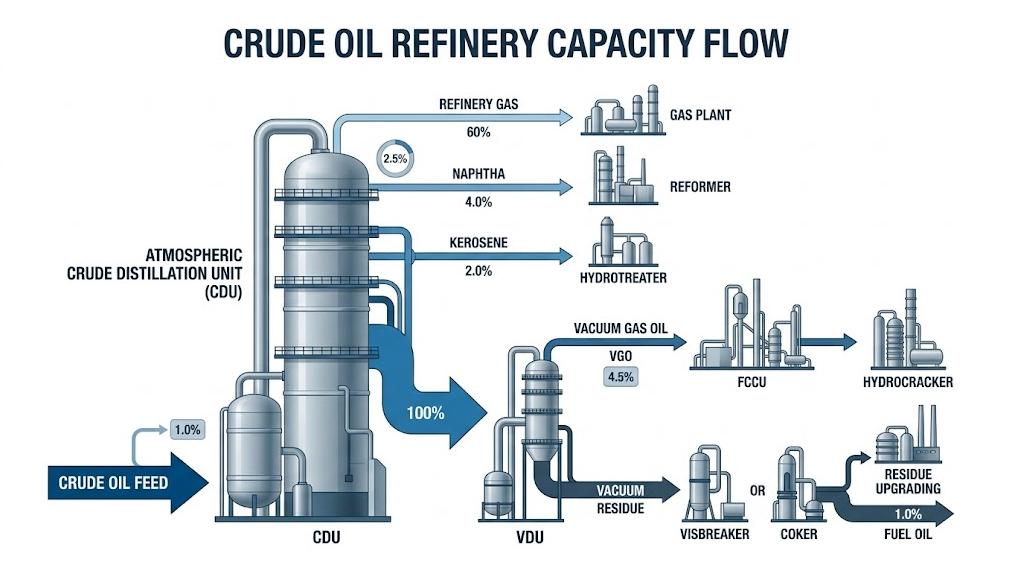
The crude distillation unit (CDU) is typically the benchmark for measuring the production capacity of an oil refinery. The CDU receives crude oil and separates it into different fractions for processing by subsequent units. Therefore, what is referred to as a “100,000 barrels per day” or “200,000 barrels per day” production capacity by an oil refinery is usually based mainly on its designed processing capacity.
However, the nominal capacity needs to be understood in the context of specific parameters. Oil refineries usually distinguish between “stream-day capacity” (the processing capacity of the unit under ideal operating conditions) and “calendar-day capacity” (which takes into account normal shutdowns and maintenance periods).
Therefore, the nominal production capacity of an oil refinery is not equivalent to its average daily crude oil processing volume.
How Do Downstream Units Limit Refinery Throughput?
After the crude oil leaves the constant pressure and vacuum distillation unit (CDU), the process configuration of the refinery begins to determine its overall processing capacity. Depending on the specific configuration, different streams will be sent to vacuum distillation units (VDU), fluidized catalytic cracking units, hydrocracking, coking, hydrotreating unit, etc. The processing capacity of these units may not match that of the CDU.
For example, a refinery might be equipped with a CDU that can process 100,000 barrels of crude oil per day. However, after increasing the crude oil processing volume, a certain downstream unit may become a bottleneck. Even if the CDU feed is increased, it may not necessarily increase the refinery’s output of finished oil.
Therefore, the actual production capacity of a refinery not only depends on how much crude oil the CDU can process, but also on whether the downstream units can accept the additional feed. The bottleneck location may also change with variations in crude oil properties, product demands, and operating conditions.
How Does Crude Oil Quality Affect Refinery Capacity?
The processing capacity of an oil refinery is closely related to the properties of the crude oil. For a refinery designed with a specific combination of crude oils, if the raw materials undergo significant changes, the actual processing capacity may be lower than the designed level.
The properties of crude oil, such as its API gravity, sulfur content, metal content, and residue oil yield, all affect the load of each processing unit. For example, heavier or higher-sulfur crude oil will increase the load of units such as vacuum distillation, hydrogenation, hydrogen production, sulfur recovery, and residue oil conversion. Once one of these systems reaches its operational limit, even if the CDU still has spare capacity, the overall processing capacity of the refinery will be limited.
Therefore, for different types of crude oil, a processing capacity of 100,000 barrels per day does not necessarily correspond to the same actual operating target.
What Equipment Can Become a Refinery Bottleneck?
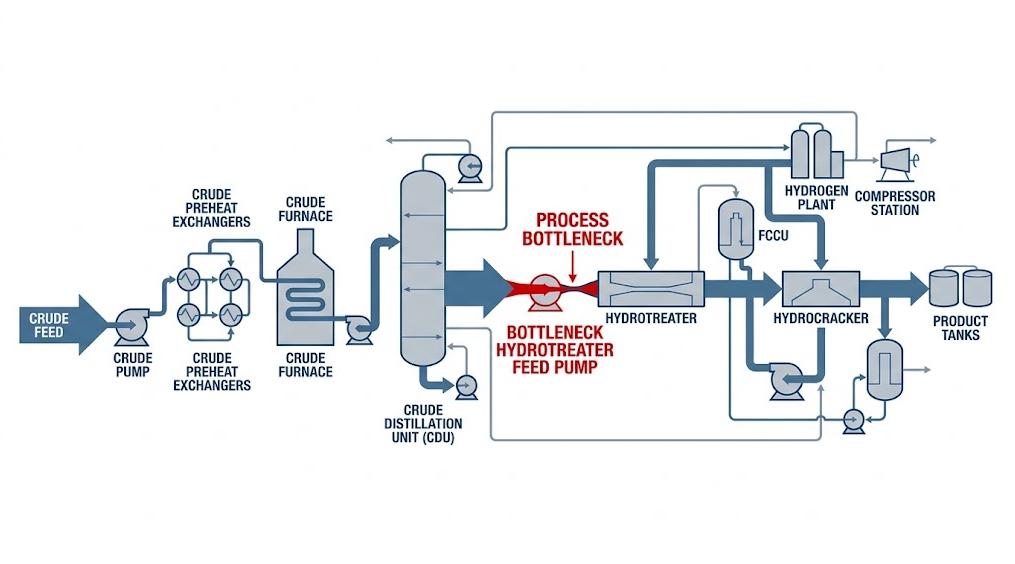
The bottlenecks in an oil refinery do not necessarily come from large-scale process units; auxiliary equipment and utility services can also limit the overall processing capacity.
Common constraints include:
- Heating furnace
- Pumps and compressors
- Heat exchangers and preheating systems
- Process piping and fluid hydraulic conditions
- Hydrogen supply
- Steam generation
- Cooling water supply
- Crude oil handling and storage system
This is particularly important when implementing “de-bottlenecking” renovations in a refinery. Increasing the feed rate of a certain unit may make other limitations in the process flow more prominent.
For example, the CDU may still have spare capacity, but the crude oil feed heater, pumps, heat exchange network, or downstream units may not be able to handle a higher load. Even if the bottleneck exists in a smaller piece of equipment, it may still limit the processing capacity of the entire refining system.
Why Actual Refinery Throughput Can Be Lower Than Capacity
The actual production volume of the oil refinery is lower than the nominal capacity, which does not mean that its design capacity is insufficient. Both planned and unplanned operating conditions can affect the actual processing volume.
Maintenance and repair may cause the unit to temporarily shut down, and equipment failures will reduce the available capacity; the supply of crude oil, the quality of feedstock, market conditions, product specifications, and restrictions of downstream units will also affect the load of the refinery.
Therefore, “refinery capacity” and “refinery processing volume” are two different concepts. Capacity refers to the processing capacity designed or available for the refinery under specific conditions, while processing volume is the actual processing volume completed during a specific period.
What Does It Take to Increase Refinery Capacity?
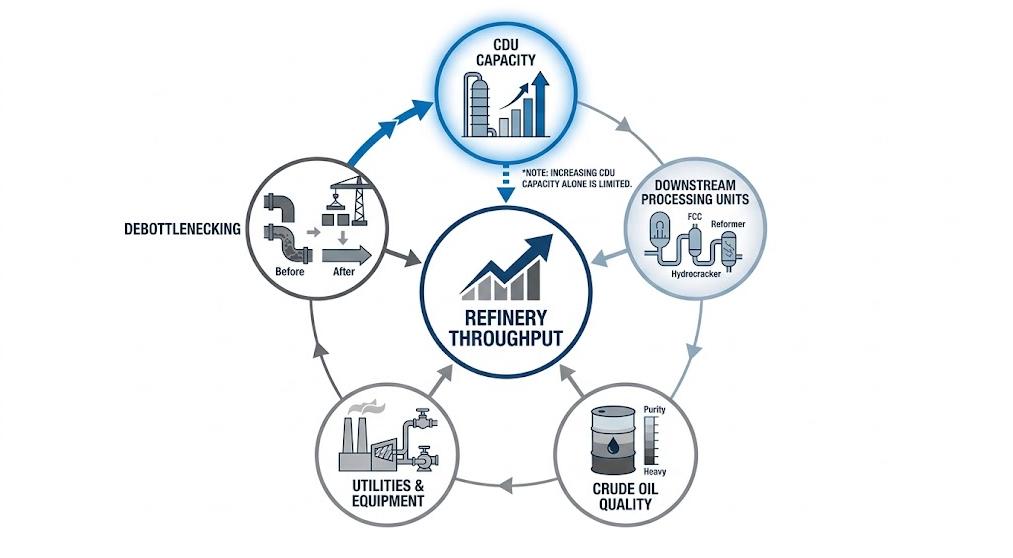
To increase the production capacity of an oil refinery, the first step should be to identify the actual bottlenecks, rather than simply expanding the constant-pressure and vacuum distillation unit (CDU). Capacity expansion usually requires the assessment of the following aspects:
- CDU capacity – Does the crude oil processing capacity limit the overall processing volume?
- Downstream units – Can the vacuum distillation (VDU), catalytic cracking (FCC), hydrocracking, coking, and hydrogenation processing units handle the new feedstock?
- Crude oil characteristics – Does the target crude oil require additional pretreatment, hydrogen, or residue conversion capacity?
- Utilities and equipment – Do the heating furnaces, compressors, pumps, heat exchangers, steam, and cooling water systems have sufficient reserves?
- De-bottlenecking requirements – Can the existing equipment meet the incremental demand through retrofitting, or does it require additional processing capacity?
For new oil refineries and expansion projects, the entire process system should be comprehensively evaluated, rather than focusing solely on a single unit. PurePath provides solutions for refining processes and equipment such as constant-pressure and vacuum distillation, hydrocracking, catalytic reforming, and isomerization, which can be configured for the refinery based on the target crude oil, processing volume, and downstream processing requirements.
The key point is: Increasing the CDU capacity does not necessarily increase the total processing capacity of the refinery. The bottleneck should be identified first, and then either de-bottlenecking renovations, equipment upgrades, or additional processing capacity should be selected.