

Used Oil Feedstock Specification for Re-Refining
Written By: Mr.Ran
Senior Petrochemical & Waste Oil Recycling Engineer
Deeply involved in the design, manufacturing, and optimization of various waste oil recycling and petrochemical equipment, delivering practical and efficient solutions for clients worldwide.
The quality of used oil feedstock directly affects re-refining efficiency, product consistency, residue generation, and operating cost. Before used lubricating oil enters a commercial re-refining plant, operators need clear feedstock specifications and acceptance criteria to determine whether each batch is suitable for processing.
A used oil feedstock specification is not a universal pass/fail standard. Acceptable limits depend on the oil source, contamination profile, re-refining process, plant capacity, and target product. For commercial operators, the objective is not simply to identify oil that can be processed, but to determine whether it can be processed consistently and economically.
What Is a Used Oil Feedstock Specification?
A used oil feedstock specification is a set of physical, chemical, and traceability criteria used to evaluate incoming oil before re-refining.
A practical specification normally covers four areas:
- Oil composition: engine oil, hydraulic oil, gear oil, transmission fluid, or mixed lubricants
- Physical properties: water, sediment, viscosity, and volatile components
- Contaminants: ash, metals, sulfur, chlorine, fuel, and degraded additives
- Source and traceability: supplier, collection source, storage conditions, and batch history
The specification should be developed around the plant’s actual process and target product. Feedstock suitable for conventional oil recovery may require additional treatment before it can be used to produce higher-quality re-refined base oil. Therefore, there is no single specification that applies to every used oil re-refining plant.

Key Parameters in a Used Oil Feedstock Specification
The most useful waste oil feedstock specification connects each parameter with its potential effect on processing. These parameters are normally established through used oil testing before a batch is accepted for processing.
| Feedstock Parameter | Why It Matters | Potential Process Impact |
| Water | Increases separation and heating demand | Higher dehydration load |
| Sediment | Indicates suspended solids | Filtration and fouling |
| Ash | Indicates inorganic residue | Higher residue generation |
| Viscosity | Indicates feedstock composition | Process behavior variation |
| Flash point | Helps identify volatile contamination | Separation and safety considerations |
| Chlorine | May indicate problematic contamination | Corrosion or treatment requirements |
| Sulfur | Affects upgrading requirements | Additional treatment may be required |
| Metals | Can concentrate in heavy fractions | Catalyst and residue concerns |
| Fuel dilution | Changes feedstock composition | Yield and product-quality variation |
| Coolant/glycol | Can complicate separation | Additional pretreatment may be required |
These parameters should be evaluated together rather than individually. For example, two batches with similar water content may have very different processing economics if one contains substantially more sediment, ash, metals, or chlorine.
For this reason, PurePath recommends establishing project-specific used oil acceptance criteria based on feedstock source, process configuration, target product quality, and operating conditions.
Used Oil Feedstock Acceptance Criteria: Acceptable vs. Conditional
A practical used oil acceptance procedure should avoid a simple “usable or unusable” classification. A three-level system provides greater flexibility.
1. Acceptable Feedstock: The key characteristics fall within the plant’s established operating range. The batch can normally enter the standard process.
2. Conditional Feedstock: The oil may be processable, but one or more characteristics could increase dehydration, filtration, residue handling, energy consumption, or upgrading requirements.
3. Problematic Feedstock: The batch presents a significant process, quality, safety, or economic concern and should be segregated until further evaluation is completed.
This approach is particularly important when purchasing used oil by price per ton. A low-cost batch may generate higher downstream costs because of additional treatment requirements, lower recoverable product, or greater residue generation.

How Feedstock Quality Affects Re-Refining Yield and Base Oil Quality
Feedstock quality influences the relationship between feedstock input, recoverable products, and processing cost. For example:
High water content
→ greater dehydration requirement
→ higher heating and processing demand
High sediment or ash
→ greater solids and residue load
→ increased filtration and residue handling
High metals or degraded additives
→ greater concentration in heavy fractions
→ potentially higher treatment or disposal requirements
Variable feedstock composition
→ less stable operating conditions
→ greater variation in product quality
Consequently, plant operators should evaluate more than the amount of oil processed. Useful operating indicators include:
- recoverable product per ton of feedstock
- residue generated per ton
- energy consumption per ton
- treatment requirements
- final re-refined base oil quality
This makes feedstock quality a production and purchasing variable rather than simply a laboratory issue. For plants targeting base oil recovery, base oil yield should therefore be evaluated together with feedstock quality rather than treated as a fixed percentage.

Used Oil Feedstock Specification by Source
The quality of used oil varies according to its collection source and previous application.
1. Used Engine Oil
Used engine oil is a common re-refining feedstock, but may contain fuel dilution, soot, water, degraded additives, and wear metals.
2. Used Industrial Lubricants
Hydraulic oil, gear oil, compressor oil, and machinery lubricants may contain different additive systems and contamination profiles. Separating relatively consistent industrial streams can improve feedstock control.
3. Mixed Used Oil
Mixed collection streams provide supply flexibility but introduce greater variability. Oils with substantially different compositions or unknown contamination should be evaluated before being blended into a common feedstock.
For commercial plants, feedstock consistency can be as important as individual test results. A stable supplier with predictable oil composition can make process control and production planning easier.
How to Build a Used Oil Feedstock Acceptance Procedure
A practical feedstock quality control system can follow six steps:
1. Qualify the supplier: Record collection sources, typical oil types, storage conditions, and historical quality.
2. Identify each batch: Assign a batch number and record origin and quantity.
3. Collect a representative sample: The sample should represent the actual batch rather than only the surface of a storage tank.
4. Compare results with the feedstock specification: Evaluate key physical and chemical parameters against the plant’s established acceptance limits.
5. Classify the batch: Use acceptable, conditional, or problematic categories.
6. Maintain production traceability: Connect incoming feedstock quality with processing results, product yield, and final product quality.
Over time, this creates a plant-specific database that can identify which suppliers and feedstock types consistently deliver better processing results.
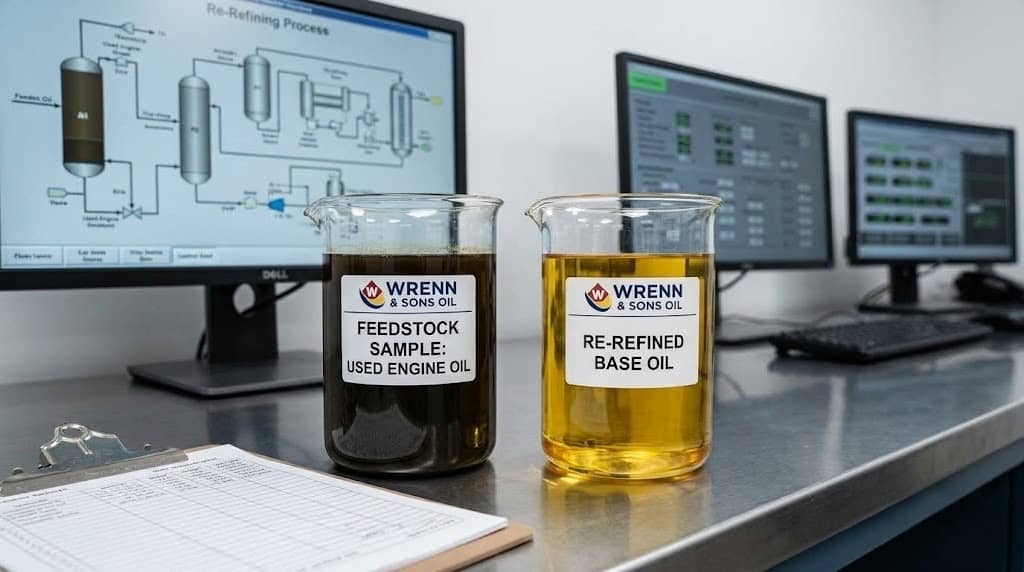
Feedstock Quality and Re-Refining Process Selection
Used oil feedstock quality should be considered when selecting the re-refining process.
| Feedstock Challenge | Potential Process Requirement |
| High water | Dehydration |
| High solids | Filtration/pretreatment |
| Volatile contamination | Vacuum separation |
| Thin film evaporator | Thin film evaporation |
| Poor color or oxidation products | Solvent extraction or adsorption |
| Higher sulfur | Hydrotreating |
| Higher-quality base oil target | Additional upgrading |
The relationship is not one-to-one. A particular contaminant does not automatically determine a single process. The appropriate configuration depends on the complete feedstock profile, desired recovery, target base oil quality, and plant capacity. This is why feedstock evaluation should be incorporated into plant design rather than performed only after equipment selection.
Used Oil Feedstock Specification Checklist
Before accepting a new used oil source, operators should confirm:
| Check | Key Question |
| Source | Where does the used oil originate? |
| Composition | Is it single-source or mixed? |
| Water | Is moisture within the plant’s operating range? |
| Sediment | Can the solids load be handled efficiently? |
| Ash | Could inorganic residue affect recovery? |
| Chlorine | Is additional treatment or corrosion control required? |
| Metals | Could contaminants increase residue or treatment demand? |
| Flash point | Is significant volatile contamination present? |
| Viscosity | Is the composition compatible with the process? |
| Traceability | Can the supplier and batch be documented? |
The best used oil feedstock is not necessarily the cheapest material available. It is the feedstock whose quality, consistency, recoverable value, and processing requirements match the plant’s process and target products.
A well-designed feedstock specification therefore becomes a practical production-control tool. It can help re-refining operators stabilize incoming raw materials, improve process consistency, control operating costs, and make more informed feedstock purchasing decisions.
FAQ
Q1: What is a good feedstock for used oil re-refining?
A good feedstock has consistent composition and contamination levels that are compatible with the plant’s process and target products.
Q2: What parameters should be included in a used oil feedstock specification?
Common parameters include water, sediment, ash, viscosity, flash point, sulfur, chlorine, metals, and other contaminants relevant to the selected process.
Q3: Can mixed used oils be used as re-refining feedstock?
Yes, mixed streams can potentially be processed, but their variability should be evaluated before blending and processing.
Q4: Does high water content make used oil unsuitable for re-refining?
Not necessarily. The impact depends on the plant’s dehydration capability and the economic effect of additional processing.
Q5: Why is feedstock consistency important for a re-refining plant?
Consistent feedstock helps stabilize operating conditions, product quality, recovery, and production planning.
Q6: Should feedstock specifications be the same for every re-refining plant?
No. Acceptance limits should be developed according to the feedstock source, process configuration, plant capacity, and target product specifications.