
How to Test Waste Engine Oil Before Recycling?
Written By: Mr.Ran
Senior Petrochemical & Waste Oil Recycling Engineer
Deeply involved in the design, manufacturing, and optimization of various waste oil recycling and petrochemical equipment, delivering practical and efficient solutions for clients worldwide.
Waste engine oil should not be sent directly into a recycling or re-refining system without first being characterized. Used engine oil can contain water, fuel, soot, wear metals, degraded additives, sediment, chlorine-containing contaminants, and other substances that significantly affect pretreatment requirements, distillation behavior, equipment loading, product yield, and final base oil quality.
For a waste oil recycling plant, incoming feedstock testing is therefore more than a laboratory quality-control step. It is an engineering decision tool that helps determine whether a batch should be accepted, pretreated, blended, held for further analysis, or rejected.
A practical testing strategy should answer three questions:
- What is actually contained in the waste engine oil?
- How will those contaminants affect the refining process?
- What pretreatment or refining conditions are required for this particular feedstock?
The most useful approach is to follow a complete sequence: representative sampling → visual inspection → laboratory testing → result interpretation → feedstock classification → process selection.
Why Test Waste Engine Oil Before Recycling?
Waste engine oil is not a uniform raw material. Its composition depends on the original lubricant, engine type, operating conditions, service interval, collection method, storage conditions, and whether other waste oils or chemicals have been mixed into the stream.
For example, two batches may both be described as “used motor oil,” while one contains relatively little water and sediment and another contains significant fuel dilution, coolant, sludge, or industrial contaminants. These differences directly affect refinery operation.
High water content increases the dehydration load and can interfere with vacuum operation. Excessive solids can accelerate filter loading and fouling. Fuel contamination can increase the volatile fraction and reduce flash point. High concentrations of metals and inorganic compounds can increase bottom residue and affect downstream treatment. Unexpected chlorine contamination can create serious corrosion and process-control concerns. Therefore, testing waste engine oil before recycling allows the recycler to understand the feedstock before committing it to the main process line.
What Should Be Tested in Waste Engine Oil?
A basic incoming inspection program should combine physical observation with laboratory analysis.
| Test Parameter | What It Indicates | Why It Matters to Refining |
| Water content | Free, emulsified, or dissolved water | Determines dehydration requirement |
| Sediment and insolubles | Soot, sludge, dirt and suspended solids | Indicates filtration and fouling risk |
| Kinematic viscosity | Fluid condition and composition | Helps identify dilution or severe degradation |
| Density | Bulk composition | Useful for rapid contamination screening |
| Flash point | Volatile components | Indicates fuel/solvent contamination and safety risk |
| TAN | Acidic degradation products | Indicates oil degradation and potential corrosion |
| Sulfur | Sulfur-containing compounds | Influences product quality and hydrotreatment requirements |
| Chlorine | Halogen contamination | Important for corrosion and downstream treatment |
| Metals | Wear and additive-derived elements | Affects residue, fouling and catalyst requirements |
| Ash | Inorganic material | Helps estimate non-combustible residue |
Not every batch necessarily requires the same testing depth. Routine suppliers may be managed through a screening program, while a new or questionable feedstock source should receive a more comprehensive analysis.
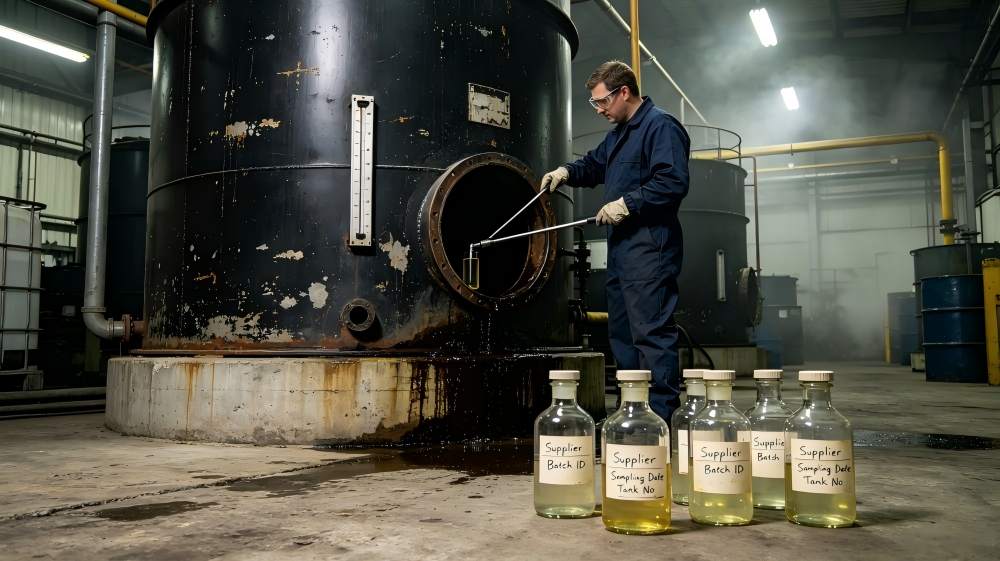
Step 1: Collect a Representative Waste Engine Oil Sample
Laboratory results are only useful if the sample represents the actual feedstock. This is particularly important for waste engine oil because contaminants do not necessarily remain uniformly distributed throughout a storage tank. Water and heavier solids can settle at the bottom, while lighter hydrocarbons may concentrate differently within the tank. A sample taken only from the surface can therefore provide a misleading picture.
Sampling From Storage Tanks
For larger storage tanks, sampling should consider the condition of the entire batch rather than relying on a single convenient point. Depending on tank design and operating procedures, the material may need to be circulated or mixed before representative sampling.
If stratification is suspected, samples from different levels can also be compared. The objective is to obtain a sample that represents the material that will actually be fed to the recycling system.
Use Clean, Dry Sample Containers
Containers should be clean, dry, properly sealed, and compatible with the testing program. Water introduced through a wet container can produce a false indication of feedstock moisture. Each sample should also have traceable information such as:
- Supplier or collection source
- Batch identification
- Sampling date
- Storage tank or vehicle
- Sample location
- Any known contamination history
This information becomes particularly valuable when laboratory results differ significantly between batches.
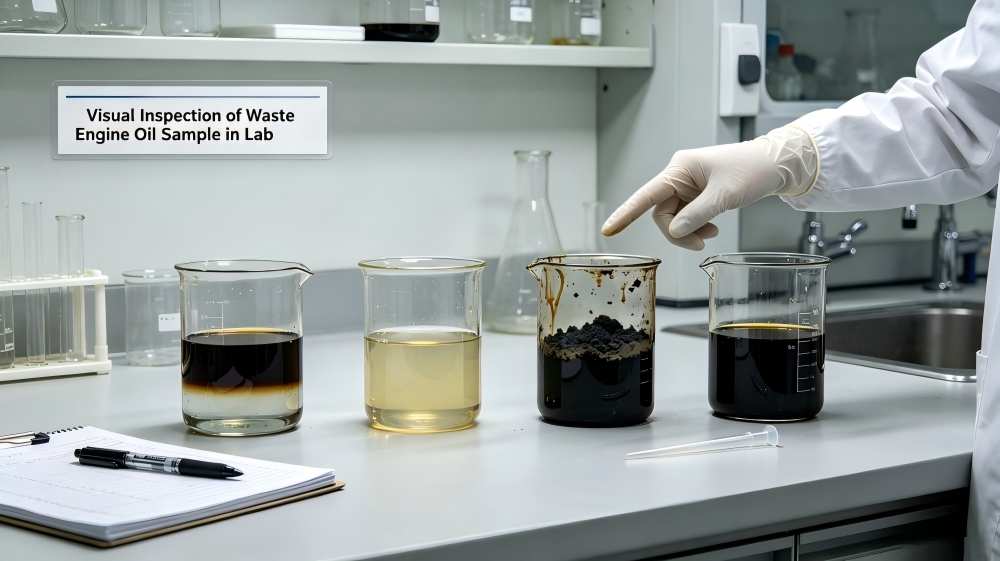
Step 2: Perform a Visual Inspection
Visual inspection is not a replacement for laboratory testing, but it is an inexpensive first screening step. The appearance of waste engine oil can reveal potential problems that warrant additional investigation.
Color
Waste engine oil is normally dark because of oxidation products, soot, degraded additives, and other contaminants. However, color alone cannot determine whether the oil is suitable for recycling.
Two batches with similar black coloration can have completely different water content, chlorine levels, metal concentrations, or fuel dilution. Therefore, use color as a screening observation, not as a feedstock acceptance criterion.
Water Separation
Look for visible water layers, emulsions, or unusual cloudiness. A distinct water layer at the bottom of a sample indicates free water, while a cloudy appearance may indicate dispersed or emulsified water.
The distinction matters because different forms of water may require different pretreatment conditions.
Sediment and Sludge
Allowing a sample to stand can reveal:
- Heavy sediment
- Carbonaceous particles
- Sludge
- Metallic particles
- Other insoluble material
A large amount of settled material suggests that filtration, settling, centrifugation, or another solids-removal step may be necessary before thermal processing.
Step 3: Measure Water Content
Water is one of the most important parameters to determine before waste engine oil enters a recycling system. Water may enter used engine oil through condensation, coolant leakage, rainwater intrusion during collection, improper storage, or mixing with other waste streams.
Excessive water can increase energy consumption because the water must be removed before effective oil distillation can occur. It can also contribute to foaming, corrosion and unstable vacuum operation.
How Is Water Content Tested?
Depending on the required accuracy and laboratory setup, water may be measured using methods such as Karl Fischer analysis or appropriate distillation-based procedures. The test should distinguish, where relevant, between:
- Free water
- Emulsified water
- Dissolved water
A simple visual check can identify obvious free water, but it cannot accurately quantify the total water content.
How Should the Result Be Interpreted?
There is no single water limit that is universally appropriate for every waste oil refinery. The acceptable feedstock condition depends on the plant’s pretreatment and dehydration design.
A useful engineering approach is: water result → dehydration requirement → energy load → operating condition. Rather than asking only whether the water level is “acceptable,” the recycler should ask how much dehydration capacity will be required to process the batch reliably.
Step 4: Test Kinematic Viscosity
Kinematic viscosity provides information about the physical condition and composition of the waste oil. A significant deviation from the expected viscosity range can indicate contamination or degradation.
Very low viscosity may suggest dilution with lighter hydrocarbons such as gasoline or diesel. Excessively high viscosity can be associated with oxidation, polymerization, concentrated heavy fractions, sludge, or other contamination.
Kinematic viscosity is commonly measured using standardized laboratory methods such as ASTM D445. However, viscosity should not be interpreted independently.
- For example: Low viscosity + low flash point may strongly suggest light-fuel contamination.
- By contrast: High viscosity + high insolubles may indicate severe degradation and a higher solids/fouling burden.
This illustrates an important principle in waste oil testing: The value of a single test increases when it is interpreted together with related parameters.
Step 5: Check Flash Point
Flash point is particularly useful when screening waste engine oil for light hydrocarbon contamination. Used engine oil may contain fuel as a result of fuel dilution during engine operation. It can also become contaminated with solvents or other volatile materials during collection.
A significantly reduced flash point can indicate an unusually high concentration of volatile components. This matters for two reasons: First, volatile components affect the safety characteristics of the feedstock; Second, they change the behavior of the material during heating and vacuum distillation.
A simplified interpretation is:
Low flash point → investigate light hydrocarbons → determine volatile fraction → adjust pretreatment/distillation strategy
Flash point testing should therefore be considered both a safety test and a process-characterization test.
Step 6: Measure Density
Density or specific gravity can be used as a rapid screening parameter for incoming waste oil. An unusual density may indicate:
- Water contamination
- Light hydrocarbon dilution
- Heavy oil contamination
- Mixing with other industrial oils
- Significant changes in feedstock composition
Density is particularly useful when combined with viscosity and flash point. For example, a batch with abnormal density, unusually low viscosity, and reduced flash point deserves further investigation for light-fraction contamination. Density by itself, however, should not be used to determine whether a batch is suitable for re-refining.
Step 7: Test Total Acid Number
Total Acid Number (TAN) measures the acidic constituents present in the oil and is commonly used to evaluate lubricant degradation. As engine oil operates under high temperature and oxidative conditions, the lubricant can develop oxidation products and acidic compounds.
A higher TAN can indicate greater degradation and may be associated with:
- Oxidation
- Acid formation
- Corrosive potential
- Severe service conditions
Methods such as ASTM D664 are commonly used for TAN determination. For waste oil recyclers, TAN should not be treated as a simple pass/fail parameter. Instead, it provides additional information about the history and condition of the feedstock.
A high TAN combined with high water, high insolubles, or significant metal contamination can indicate a more challenging feedstock than the TAN value alone would suggest.
Step 8: Analyze Insolubles, Sediment and Ash
Solids are among the most important contributors to fouling and equipment loading in waste oil processing.
1. Insolubles
Insoluble material may include:
- Soot
- Carbon particles
- Dirt
- Wear debris
- Oxidized lubricant components
- Sludge
High insolubles can increase filter loading and contribute to deposits on heat-transfer surfaces and evaporation equipment.
2. Sediment
Sediment represents heavier material that settles from the oil. A high sediment level indicates that upstream separation should be carefully considered before the feed reaches thermal equipment.
3. Ash
Ash represents inorganic, non-combustible material remaining after combustion-based testing. It can originate from:
- Metallic additives
- Wear metals
- Dirt
- Other inorganic contaminants
High ash generally indicates a greater inorganic burden and may contribute to heavy residue generation during refining. The practical relationship is:
High solids → greater pretreatment requirement → higher fouling potential → greater residue burden
Step 9: Test Sulfur and Chlorine
Sulfur and chlorine deserve particular attention when waste engine oil is being considered for industrial re-refining.
1. Sulfur
Sulfur may originate from the original crude-derived base oil, lubricant additives, fuel contamination, or mixed waste streams. Its importance depends on the intended final product and refining technology.
Higher sulfur content may increase the severity or cost of downstream treatment when low-sulfur products are required. Therefore, sulfur analysis helps determine whether the existing process configuration is appropriate for the feedstock and target product specification.
2. Chlorine
Chlorine is especially important because unexpected chlorinated contaminants can create significant process risks. Potential sources include:
- Chlorinated solvents
- Contaminated industrial waste
- Improperly segregated collection streams
High chlorine can contribute to corrosion and may create additional requirements for downstream treatment. If a batch contains unexpectedly high chlorine, it should not simply be blended into the normal feed stream to dilute the result. The source and concentration should first be investigated, with appropriate confirmatory analysis and process review.
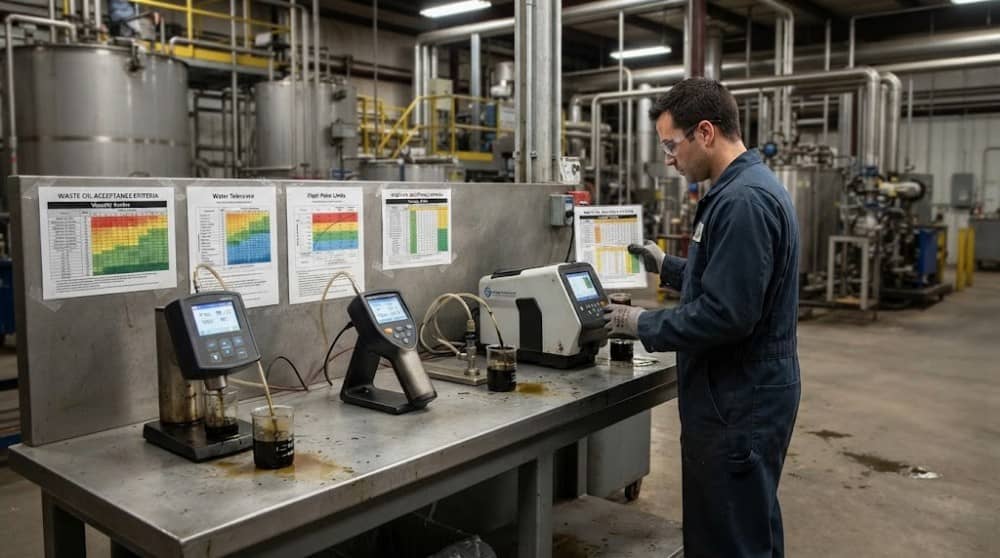
Step 10: Analyze Heavy Metals
Heavy-metal analysis provides important information about both engine wear and additive chemistry. Commonly analyzed elements include:
- Iron (Fe)
- Copper (Cu)
- Lead (Pb)
- Chromium (Cr)
- Nickel (Ni)
- Zinc (Zn)
- Calcium (Ca)
- Magnesium (Mg)
- Phosphorus (P)
- Silicon (Si)
These elements have different origins. Iron, copper, lead, chromium and nickel can indicate engine wear or contamination. Zinc, calcium, magnesium and phosphorus are often associated with lubricant additive systems.
ICP-based elemental analysis can provide a detailed contamination profile. The value of this analysis is not simply knowing that “metals are present.” The results can help engineers estimate:
metal loading → inorganic residue → pretreatment requirements → fouling risk → downstream treatment requirements
For processes involving catalysts, the elemental profile may also be important for catalyst protection and operating life.
Waste Engine Oil Testing Matrix
A practical laboratory program can be organized as follows:
| Parameter | Typical Test Approach | Main Information Obtained | Process Decision |
| Water | Karl Fischer / suitable water method | Moisture level | Dehydration requirement |
| Kinematic viscosity | ASTM D445 or equivalent | Physical condition | Dilution/degradation screening |
| Flash point | ASTM D92/D93 or applicable method | Volatile contamination | Safety and light-fraction assessment |
| Density | ASTM D1298/D4052 or equivalent | Bulk composition | Feedstock screening |
| TAN | ASTM D664 or equivalent | Acidity/degradation | Corrosion/process assessment |
| Sulfur | Applicable elemental method | Sulfur concentration | Product/treatment assessment |
| Chlorine | Applicable halogen method | Chlorinated contamination | Feedstock risk assessment |
| Metals | ICP-based analysis | Elemental contamination | Residue/catalyst assessment |
| Ash | Applicable ash method | Inorganic fraction | Residue estimation |
| Insolubles | Applicable solids method | Soot/sludge/insolubles | Filtration/fouling assessment |
The exact test package should be adapted to the feedstock source, plant configuration, target product, and applicable regulatory or product specifications.
How to Interpret Waste Engine Oil Test Results
The most important part of incoming feedstock analysis is not obtaining a laboratory report. It is converting the results into a process decision. For example:
| Test Result | Possible Cause | Refining Concern | Typical Response |
| High water | Condensation, coolant, rainwater | Higher dehydration load | Strengthen dehydration |
| Low viscosity | Fuel dilution or light hydrocarbons | Excess volatile fraction | Remove light components |
| High viscosity | Oxidation, polymerization, heavy material | Poor heat transfer/fouling | Improve pretreatment |
| Low flash point | Fuel or solvent contamination | Safety and distillation behavior | Investigate and remove light fraction |
| High insolubles | Soot, dirt, sludge | Filter loading/fouling | Solid separation |
| High chlorine | Chlorinated contamination | Corrosion/downstream treatment | Hold and investigate |
| High metals | Engine wear/additives | Residue and catalyst concerns | Evaluate pretreatment |
| High TAN | Oxidation/degradation | Corrosion/process severity | Adjust process evaluation |
This approach is much more useful than applying one universal “good oil/bad oil” threshold. A feedstock with high water but low chlorine may simply require more dehydration. A batch with low water but unexpectedly high chlorine may present a much greater process concern.
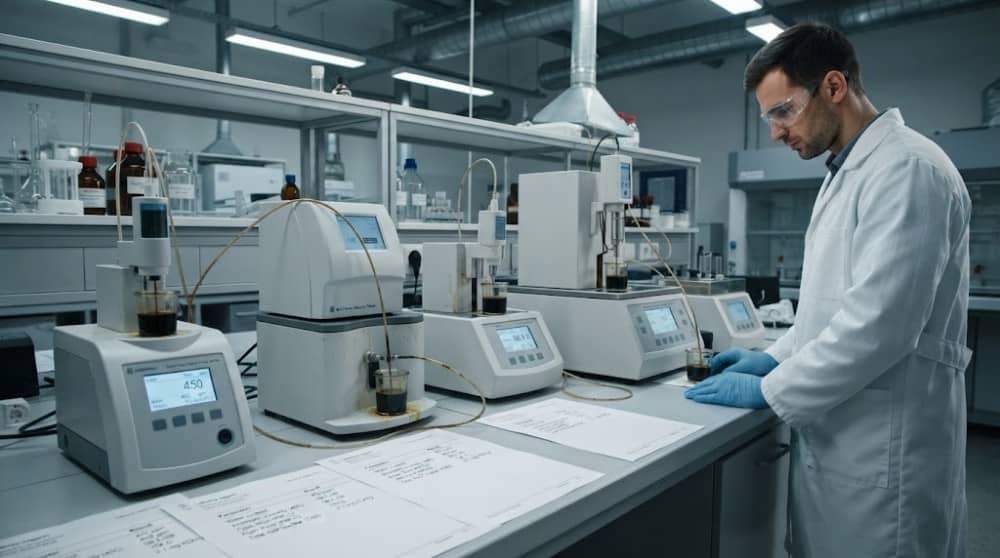
From Laboratory Results to Feedstock Acceptance
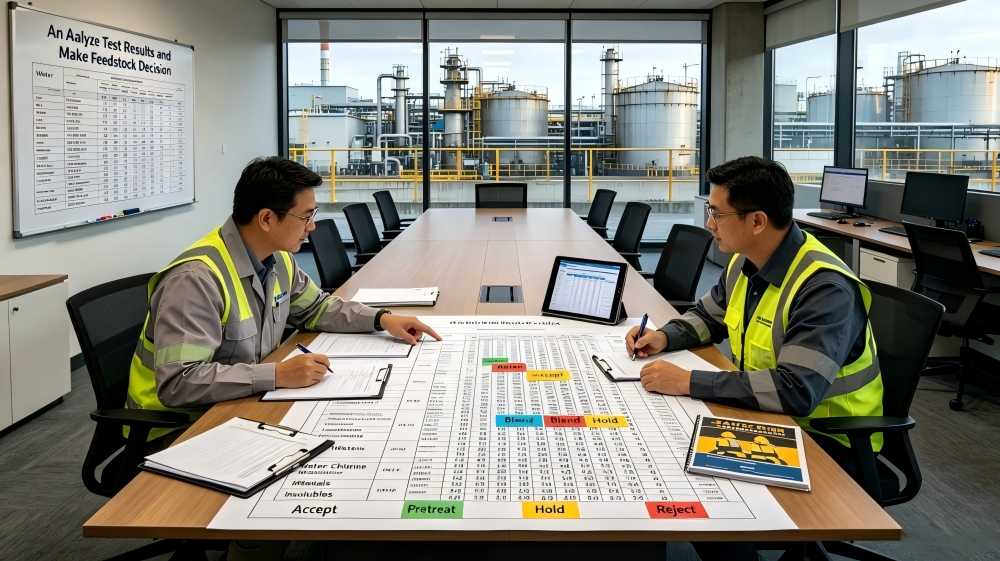
After testing, the recycler should convert the laboratory data into an operational decision. A practical framework is:
- Accept: The feedstock meets the plant’s predefined quality and safety requirements and can enter the normal pretreatment process.
- Pretreat: The feedstock is suitable for recycling but requires additional dehydration, filtration, settling, or light-fraction removal.
- Blend: A feedstock with a specific undesirable characteristic may potentially be blended with compatible material, but only when the resulting composition remains within the plant’s defined operating limits.
- Hold: Unexpected results require additional sampling, confirmatory testing, or investigation of the contamination source.
- Reject: The batch contains unacceptable or hazardous contaminants, or processing it would create disproportionate safety, environmental, or equipment risks.
This approach is preferable to making a simple decision based on one laboratory value.
How Test Results Affect Waste Engine Oil Recycling Process Selection
Feedstock testing should ultimately connect to process design. For example:
- High water content → Dehydration becomes a priority.
- High sediment and insolubles → Filtration and solids separation become more important.
- High light hydrocarbon content → Flash evaporation or appropriate light-fraction removal may be required.
- High metals and ash → Greater attention is required for pretreatment, residue management and fouling control.
- High sulfur or other contaminants → The downstream refining and product-treatment strategy may need to be evaluated.
Once the feedstock has been characterized, technologies such as vacuum distillation, wiped film evaporation, solvent extraction or hydrotreatment can be evaluated according to the feedstock and target product. This is why feedstock testing should ideally occur before finalizing process conditions or refinery configuration, rather than after the plant has already been designed around an assumed oil composition.
Can You Judge Waste Engine Oil Quality by Color Alone?
No. Color alone cannot determine whether waste engine oil is suitable for recycling.
Dark color may result from soot, oxidation products, additives and other contaminants, but it does not reveal water content, chlorine concentration, fuel dilution, metal concentration or other critical parameters.
A reliable assessment requires laboratory testing. Color is useful for identifying unusual batches and deciding whether additional investigation is warranted, but it should never replace analytical testing.
How Often Should Waste Engine Oil Be Tested?
Testing frequency should depend on feedstock variability and supplier history.
- New Supplier: A comprehensive characterization is recommended before regular purchasing or processing.
- New Feedstock Source: The first batches should receive more extensive testing because the contamination profile may differ from established sources.
- Established Supplier: Routine screening can be combined with periodic comprehensive analysis.
- Suspected Contamination: A full analysis should be performed whenever the appearance, odor, viscosity, flash point or other characteristics change unexpectedly.
- Mixed Batch: If oils from different sources are blended, testing should be performed on the resulting mixture rather than assuming that the properties of each original batch will simply average out.
The objective is to establish a feedstock quality-control system, not merely perform occasional laboratory tests.
Common Mistakes When Testing Waste Engine Oil
Mistake 1. Testing Only Water Content
Water is important, but it is only one part of the feedstock profile. A batch with acceptable water content may still contain excessive chlorine, fuel, metals or insolubles.
Mistake 2. Taking a Surface Sample
Stratification can cause water and solids to settle separately from the main oil phase. A non-representative sample can therefore produce misleading laboratory results.
Mistake 3. Judging Quality by Color
Black oil is not necessarily poor-quality feedstock, while visually acceptable oil is not necessarily clean.
Mistake 4. Ignoring Chlorine
Chlorine contamination may not be obvious from basic physical tests but can have significant implications for corrosion and downstream processing.
Mistake 5. Looking at Each Test Independently
The most useful information comes from relationships between test results. For example:
Low viscosity + low flash point is more informative than either result alone when investigating fuel dilution.
Mistake 6. Testing Without Connecting Results to Process Conditions
A laboratory report has limited value if nobody uses it to determine dehydration requirements, filtration needs, distillation strategy or downstream treatment.
Frequently Asked Questions
Q1. What tests should be performed on waste engine oil before recycling?
Test water content, viscosity, density, flash point, TAN, insolubles, ash, sulfur, chlorine, and metals. The exact testing requirements depend on feedstock quality and the recycling process.
Q2. How do you test water content in waste engine oil?
Water can be measured using Karl Fischer analysis or suitable distillation-based methods. Visual inspection can identify free water but cannot accurately measure total water content.
Q3. Why is flash point important when testing used engine oil?
Flash point helps identify fuel dilution and volatile contamination. A low flash point may indicate the need for additional light-fraction removal before refining.
Q4. Why should chlorine be tested in waste engine oil?
Chlorine can contribute to corrosion and downstream processing problems. High chlorine levels may require additional treatment or further investigation before refining.
Q5. How do test results affect waste engine oil recycling?
Test results determine the required pretreatment and refining conditions and whether the batch should be accepted, treated, blended, held, or rejected.
Q 6. Can mixed waste engine oils be tested and recycled together?
Yes, if the oils are compatible. The combined feedstock should be tested before recycling to confirm its water, contaminant, and processing characteristics.