
What Causes Dark Color in Re-Refined Base Oil?
Written By: Mr.Ran
Senior Petrochemical & Waste Oil Recycling Engineer
Deeply involved in the design, manufacturing, and optimization of various waste oil recycling and petrochemical equipment, delivering practical and efficient solutions for clients worldwide.
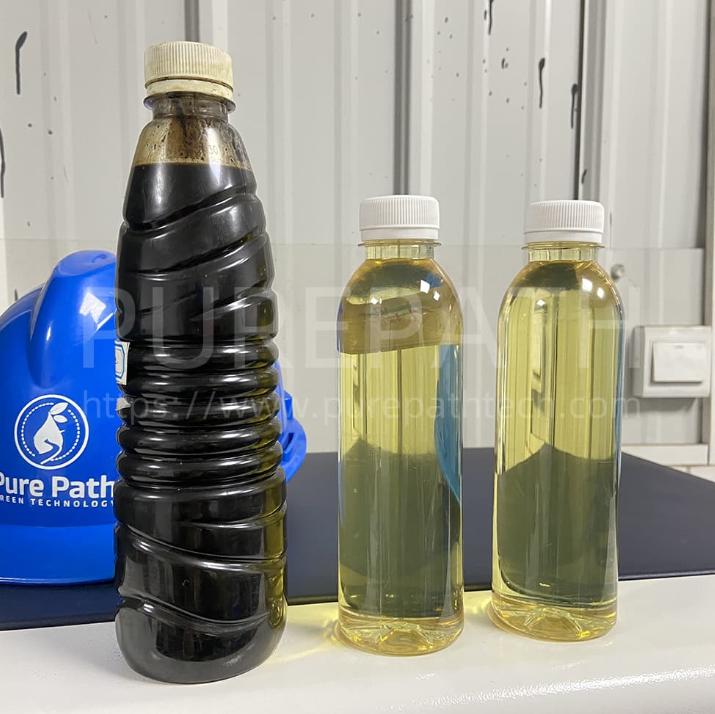
Dark color is a common quality issue for refined base oils, but it does not necessarily indicate a failure in the distillation process.
The final color is influenced by the raw material condition, residual impurities, thermal conditions, and the downstream purification effect. Identifying the source of the color is the first step in improving the quality of base oils.
Oxidation Products and Degraded Additives
Waste lubricating oil undergoes chemical changes during use. High temperatures, oxygen, moisture, and mechanical stress cause the lubricating oil and additives to gradually degrade.
The waste oil may contain:
- Oxidation products
- Degraded additives
- Lubricant deposits and polymers
- Heavy pollutants
Some substances are darker in color and may still be present in the lubricating oil fraction after further refining.
The more severe the degradation of the raw materials, the higher the requirements for subsequent purification.
Aromatic and Polar Compounds Remain After Distillation
Vacuum distillation mainly separates components based on their volatility and boiling range, effectively recovering the target lubricating oil fraction. However, it may not be able to remove all color-causing substances.
The recovered oil may still contain aromatic compounds, polar impurities, nitrogen-containing compounds, and some oxidation products. Therefore, even if the boiling range meets the requirements, the oil may still appear yellow or dark.
After the distillation process, further purification is usually necessary to improve the color and stability of the oil.
Excessive Thermal Stress During Processing
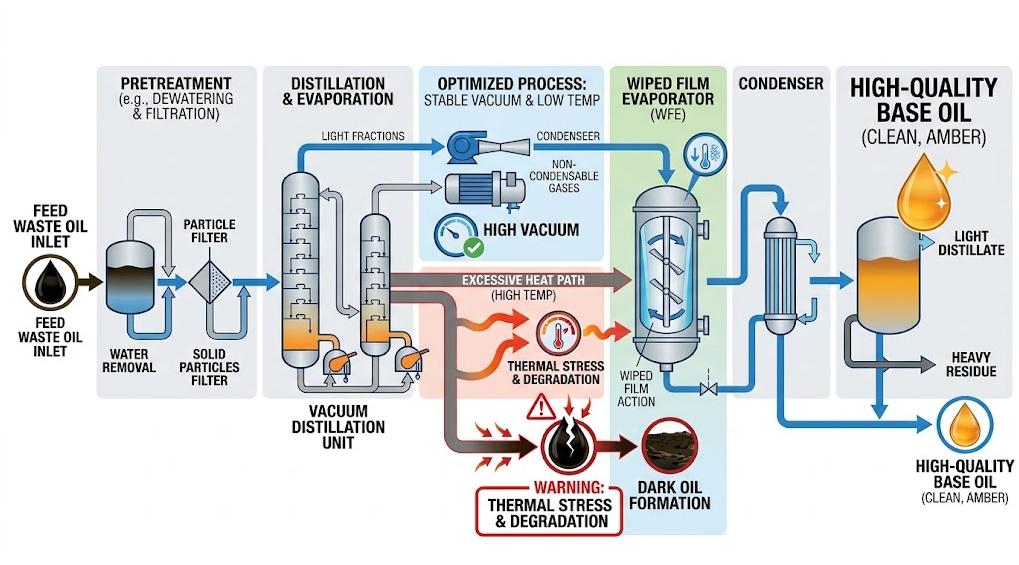
The refining process itself can also affect the color of the base oil.
Excessive temperature, unstable vacuum, excessively long residence time, or localized overheating can all cause thermal degradation, resulting in the formation of more unstable or colored compounds.
Therefore, increasing the heating temperature does not necessarily improve the color. Stable vacuum conditions can allow the lubricating oil components to evaporate at lower temperatures, reducing thermal stress.
During the inspection, the following should be checked:
- Vacuum pressure and stability
- Heating temperature
- Feed rate and residence time
- Condenser performance
Read more: Why Does the Vacuum Pressure Fluctuate in a Waste Oil Distillation Plant?
Insufficient Purification After Distillation
If the color of the distillate after vacuum distillation is still dark, it is necessary to check whether the downstream purification is sufficient.
Even if the target lubricating oil fraction has been recovered, the remaining aromatics, polar compounds and oxidation products may still affect the color. Solvent extraction can selectively remove some aromatics and polar impurities, improving the color, clarity and stability.
Compared with traditional clay treatment, a reasonable solvent extraction process can also reduce the oil loss caused by waste clay.
The degree of purification should be determined according to the characteristics of the raw materials and the specifications of the target base oil.
Hydrotreating Conditions or Catalyst Performance
This process reduces sulfur, nitrogen and oxygen-containing compounds through hydrogen and catalysts, thereby enhancing product stability.
The effect of hydrogenation treatment mainly depends on:
- Hydrogen pressure
- Reaction temperature
- Catalyst activity
- Raw material quality
A decrease in catalyst activity or unstable operating conditions may result in the residue of some impurities, affecting the final color.
Stable hydrogenation treatment requires appropriate raw material pre-treatment, active catalysts and reliable operating conditions.
How Can You Improve Re-Refined Base Oil Color?
Improving the color of base oil requires controlling the entire refining process rather than relying on a single processing step.
First, analyze the raw materials and control the main pollutants, then optimize vacuum distillation to reduce thermal stress while recovering the target lubricating oil fraction.
If the color of the distillate is still too dark, solvent extraction and other purification processes can be used to remove the remaining coloring substances. For products that require deep upgrading, hydrogenation treatment can further improve quality and stability.
Ultimately, each refining stage should be reasonably matched according to the characteristics of the raw materials and the specifications of the target product.
Re-Refine Waste Oil into Higher-Quality Base Oil with PurePath
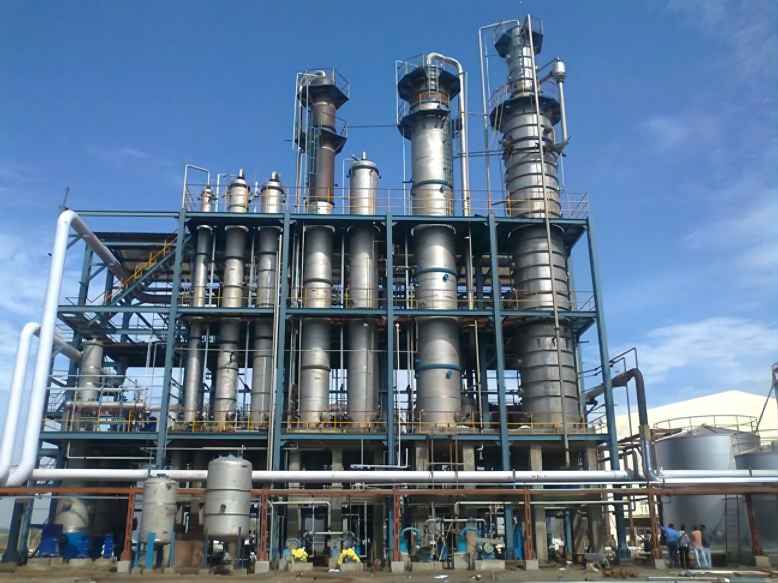
To produce high-quality recycled base oil stably, a complete refining process is required, not just a single distillation. The process should cover raw material pretreatment, recovery of lubricating oil fractions, impurity removal, and product upgrading.
PurePath offers an integrated waste oil regeneration refining solution, including:
- Pre-treatment: Removing moisture and solid contaminants
- Vacuum distillation and film evaporation: Recovering lubricating oil fractions
- Solvent extraction: Removing aromatics and polar impurities
- Hydrogenation treatment: Deep purification and improvement of base oil quality
The system can be configured according to the characteristics of the raw materials, production capacity, and target base oil specifications.
If you are looking for a solution for waste oil to base oil, please contact PurePath to discuss specific raw material and product requirements.