
Why Does the Vacuum Pressure Fluctuate in a Waste Oil Distillation Plant?
Written By: Mr.Ran
Senior Petrochemical & Waste Oil Recycling Engineer
Deeply involved in the design, manufacturing, and optimization of various waste oil recycling and petrochemical equipment, delivering practical and efficient solutions for clients worldwide.
In the waste oil distillation plant, a stable vacuum pressure is crucial for maintaining continuous evaporation and separation. Vacuum fluctuations can alter the boiling conditions, thereby affecting product quality, energy consumption, and recovery efficiency.
For medium-sized and large-scale plants, vacuum instability is usually not caused by a single component, but may be related to the vacuum system, condenser, evaporator, feed, pipelines, or pressure control system.
So, where should one start when investigating vacuum fluctuations?
Common Causes of Vacuum Pressure Fluctuation in Waste Oil Distillation
The following are the common causes of vacuum instability in industrial waste oil distillation equipment.
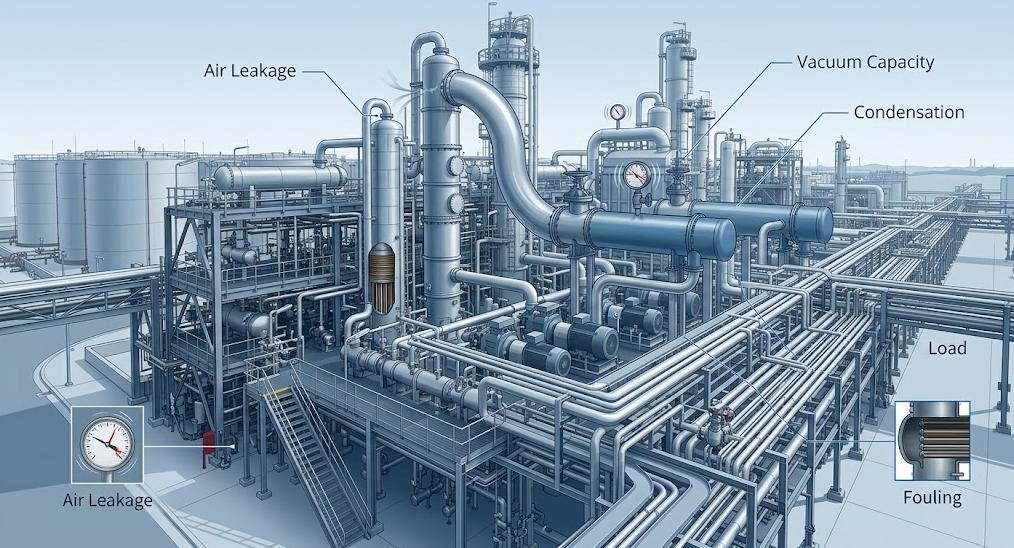
1. Air Leakage
The vacuum system must maintain a good seal. Air enters through flanges, valves, gaskets, mechanical seals or pipe connections, increasing the gas load and making it more difficult to maintain the designed vacuum level.
Typical symptoms:
- Vacuum does not reach the designed value;
- Vacuum gradually decreases;
- The vacuum equipment operates continuously, but the pressure remains unstable.
For large-scale equipment, even a small leak can affect the overall vacuum performance.
2. Insufficient Vacuum Capacity
Large-scale waste oil distillation equipment typically has a higher steam load than small intermittent devices, so the vacuum system requires sufficient capacity to handle non-condensable gases and residual steam.
Vacuum instability may be caused by the following reasons:
- Insufficient capacity of the vacuum equipment;
- Actual steam load exceeds the design conditions;
- Significant differences in operating conditions from the original design;
- Decline in the performance of the vacuum equipment.
It should be noted that a larger vacuum pump does not necessarily solve the problem. The vacuum capacity should be matched with the evaporator, condenser, pipelines, and actual processing capacity.
3. Condenser Performance
The condenser works in conjunction with the vacuum system.
If the efficiency of oil vapor condensation decreases, more vapor will enter the vacuum system, increasing the system load and potentially causing pressure fluctuations.
Check these factors:
| Item | What to Check |
| Cooling water | Temperature and flow |
| Heat-transfer surface | Fouling or deposits |
| Condenser capacity | Match with vapor load |
| Vapor outlet | Flow resistance or blockage |
During continuous industrial operation, as the processing volume increases, the problem of insufficient condensation capacity becomes more pronounced.
4. Feed Rate and Steam Load Changes
A rapid change in process load can also cause fluctuations in vacuum pressure.
For example:
Increase in feed rate → Increase in steam production → Increase in vacuum load → Pressure fluctuation
The composition of the feed is also important. The contents of light components, heavy hydrocarbons, moisture and contaminants in different waste oils vary, even if the feed rate remains constant, it may change the steam load.
Therefore, stable operation requires coordination of feed volume, heating rate, evaporator capacity, condenser capacity and vacuum capacity.
5. Fouling and Flow Resistance
Fouling is also a common cause of reduced vacuum performance.
The deposits may accumulate in:
- Evaporator
- Steam piping
- Condenser
- Vacuum piping
As scaling becomes more severe, the flow resistance increases and the steam removal efficiency decreases. Its manifestation might be that the pressure fluctuations gradually intensify rather than the equipment immediately malfunctioning.
This is particularly noteworthy for waste oils containing a large amount of reagents and contaminants.
Read more: How to Prevent Fouling in a Waste Oil Distillation Plant
6.Pressure Control and System Design
For large continuous waste oil distillation units, the vacuum stability also depends on the control system.
Pressure transmitters, control valves, automatic control logic, and pipeline design all affect the system’s response to process changes.
More importantly, the main equipment needs to be properly matched:
Evaporator + Condenser + Vacuum system + Pipelines + Control system = Stable vacuum
If a component has insufficient capacity or the system integration is unreasonable, even if each component operates normally individually, the entire unit may still experience vacuum fluctuations.
How to Troubleshoot a Vacuum Distillation Plant
When there is a fluctuation in the vacuum pressure, the following steps can be followed for system troubleshooting:
1. Check for air leakage: Inspect the flanges, valves, seals, gaskets, and vacuum piping for any leaks.
2. Check the vacuum system: Confirm whether the pump or ejector can provide the required vacuum capacity under actual process conditions.
3. Check the condenser: Inspect the cooling water status, heat exchange performance, and fouling conditions.
4. Check the process load: Compare the actual feed rate, feed characteristics, heating rate, and steam production with the design conditions.
5. Check the flow path: Inspect for any fouling or excessive flow resistance in the evaporator, steam piping, condenser, and vacuum piping.
6. Check the instruments and control system: Verify that the pressure transmitters, control valves, and automatic pressure control parameters are functioning properly.
Most importantly, when the vacuum pressure drops, do not simply increase the heating temperature. Excessive heating may lead to thermal cracking, coking, and unnecessary residues.
How to Maintain Stable Vacuum Pressure in Waste Oil Distillation
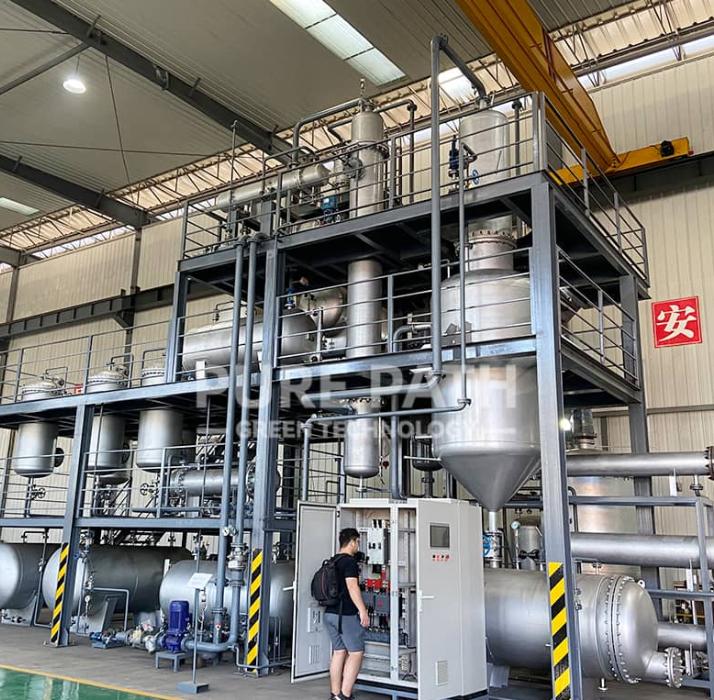
For medium-sized and large-scale waste oil distillation plant, vacuum stability should be taken into consideration during the design stage.
A reliable system should focus on the following aspects:
- Matching the vacuum capacity with the actual processing volume;
- The condenser capacity meeting the expected steam load;
- Reasonable flow resistance of steam and vacuum pipelines;
- Maintaining stable feed and heating conditions;
- Continuous monitoring of vacuum pressure;
- Formulating preventive cleaning and maintenance plans.
The goal is not only to achieve the required vacuum level, but also to maintain stability throughout the continuous operation process.
Conclusion: Keep Your Waste Oil Distillation Vacuum Stable
The fluctuations in vacuum pressure of the waste oil distillation plant are usually problems at the system level. Factors such as air leakage, vacuum capacity, condenser performance, process load, scaling, and pressure control can all cause instability in the vacuum.
For medium and large-scale waste oil recovery plants, stable vacuum levels depend on reasonable process design, equipment matching, and system integration. When these elements are coordinated and consistent, the unit can achieve more stable distillation, efficient operation, and reliable waste oil recovery.