
How Much Base Oil Can You Recover from 1 Ton of Used Engine Oil?
Written By: Mr.Ran
Senior Petrochemical & Waste Oil Recycling Engineer
Deeply involved in the design, manufacturing, and optimization of various waste oil recycling and petrochemical equipment, delivering practical and efficient solutions for clients worldwide.
Used engine oil is not simply a waste product. A significant portion of it consists of valuable lubricating hydrocarbons that can be recovered and converted into re-refined base oil. However, the amount of base oil obtained from one ton of used engine oil varies considerably depending on feedstock quality, contamination levels, process configuration, operating conditions, and the required quality of the finished product.
As a practical engineering estimate, a well-designed used oil re-refining process may achieve a base oil recovery rate in the range of approximately 70–85% under suitable feedstock and process conditions. This means that 1 ton (1,000 kg) of properly selected used engine oil could potentially produce roughly 700–850 kg of re-refined base oil. This range is illustrative rather than a universal guarantee; actual yield should be established through feedstock analysis and a complete process mass balance.
Understanding where the remaining material goes—and why recovery is not 100%—is essential when evaluating a used engine oil re-refining plant, estimating production capacity, or calculating project profitability.
How Much Base Oil Can Be Recovered from 1 Ton of Used Engine Oil?
The simplest way to estimate production is to multiply the feedstock quantity by the expected base oil yield. For example, if a re-refining process achieves an illustrative 80% base oil yield:
1,000 kg used engine oil × 80% = 800 kg re-refined base oil
Therefore, under these assumed conditions, one ton of used engine oil could produce approximately 800 kg of re-refined base oil.
However, the remaining 200 kg does not necessarily represent process inefficiency. Used engine oil contains much more than lubricating base oil. During its service life, it accumulates water, fuel dilution, degraded additives, oxidation products, soot, wear metals, dirt, sludge, and other contaminants. Some light hydrocarbons and heavy fractions may also be separated during processing.
A simplified material distribution can therefore look like this:
| Material Stream | Typical Role in Re-Refining |
| Used engine oil | Feedstock |
| Water and light components | Removed during pre-treatment/dehydration |
| Fuel/light hydrocarbon fraction | Recovered as a separate fraction where applicable |
| Lubricating oil fraction | Processed into re-refined base oil |
| Heavy residue and contaminants | Separated as residual material |
| Process losses | Small losses throughout the process |
The exact distribution depends on the composition of the feedstock and the configuration of the re-refining plant. The most important point is that used oil recovery rate and base oil yield should be evaluated through an actual mass balance rather than a fixed industry percentage.
What Is the Typical Used Oil to Base Oil Yield?
There is no single yield that applies to every used engine oil recycling project. A plant processing relatively clean lubricating oil with low water and sludge content can achieve a significantly different yield from a plant processing heavily contaminated mixed waste oil. A useful conceptual range is:
| Feedstock / Process Condition | Expected Yield Tendency |
| High water, sludge, and contamination | Lower |
| Mixed-quality used oil | Moderate |
| Well-sorted lubricating oil feedstock | Higher |
| Optimized vacuum re-refining process | Higher |
| Advanced purification and upgrading | Depends on product specification and process configuration |
For example, a project may target an illustrative 75–85% base oil recovery range, but this should not be interpreted as a guaranteed result for every feedstock.
Recovery Rate Is Not the Same as Product Quality
A critical distinction in used oil re-refining is the difference between how much oil is recovered and how valuable that recovered oil is. A process that maximizes material recovery without adequate purification may produce a larger quantity of lower-quality oil. In contrast, a process designed to produce higher-quality re-refined base oil may intentionally remove additional undesirable components.
Therefore, project evaluation should consider three separate indicators:
- Recovery: How much material is recovered?
- Quality: What specifications does the recovered base oil meet?
- Value: What is the commercial value of the finished product?
A slightly lower yield of higher-quality base oil can sometimes provide better overall economics than maximizing recovery at the expense of product quality.
Why Can’t 100% of Used Engine Oil Be Converted into Base Oil?
The assumption that 1 ton of used engine oil should produce 1 ton of base oil ignores the changes that occur during engine operation.
Engine oil is formulated primarily from base oil and additives. During service, it is exposed to high temperatures, oxidation, combustion by-products, mechanical wear, and contamination from the engine environment. As a result, the collected oil is a complex mixture rather than pure base oil.
1. Water
Water can enter used engine oil through condensation, cooling-system contamination, storage conditions, or other sources. Water needs to be removed because excessive moisture can:
- Increase energy consumption
- Affect vacuum system performance
- Promote corrosion
- Reduce processing stability
- Increase the load on downstream equipment
Efficient dehydration is therefore an important early stage of used oil re-refining.
2. Fuel and Light Hydrocarbons
Used engine oil may contain gasoline or diesel resulting from fuel dilution. These lighter components have different boiling characteristics from lubricating oil and can be separated during appropriate thermal and vacuum processing. They should not automatically be counted as base oil because their physical and chemical properties differ from the desired lubricating fraction.
3. Degraded Additives
Engine oils contain additive packages designed to provide properties such as:
- Detergency
- Dispersancy
- Anti-wear protection
- Oxidation resistance
- Corrosion protection
After extended operation, many additives become degraded or chemically altered. Their residues and degradation products must be separated rather than simply carried into the finished base oil.
4. Wear Metals and Solids
Used engine oil can contain particles originating from engine components, combustion, and the surrounding environment. Common contaminants may include:
- Iron
- Copper
- Aluminum
- Lead
- Carbon
- Soot
- Dust
- Fine metallic particles
Pre-treatment and filtration help protect downstream equipment and improve the efficiency of subsequent separation processes.
5. Heavy Residues
Oxidation products, carbonaceous material, additive residues, and other high-boiling contaminants may form a heavy fraction during vacuum processing. These materials cannot simply be converted into high-quality lubricating base oil and therefore contribute to the overall difference between feedstock weight and finished base oil output.
What Happens to 1 Ton of Used Engine Oil During Re-Refining?
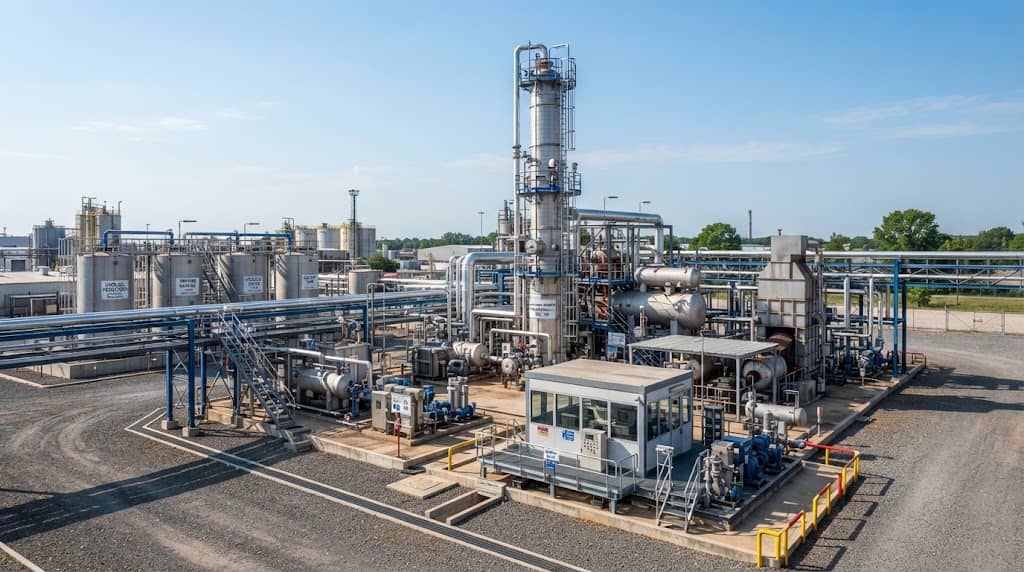
A modern used engine oil re-refining process generally uses multiple separation and purification stages rather than a single treatment step. A simplified process sequence is:
Used Engine Oil → Pre-Treatment → Dehydration → Vacuum Distillation → Wiped Film Evaporation → Deep Purification → Finished Base Oil
Each stage has a different purpose.
Step 1: Feedstock Collection and Pre-Treatment
Collected used oil is first inspected and prepared for processing. Pre-treatment may involve removing:
- Large particles
- Sludge
- Suspended solids
- Free water
- Other unwanted materials
Feedstock quality control is important because highly contaminated oil can increase the load on the entire plant.
Step 2: Dehydration
Water and certain light volatile components are removed before deeper thermal separation. Effective dehydration helps stabilize the downstream vacuum process and reduces the amount of energy required to process non-lubricating components.
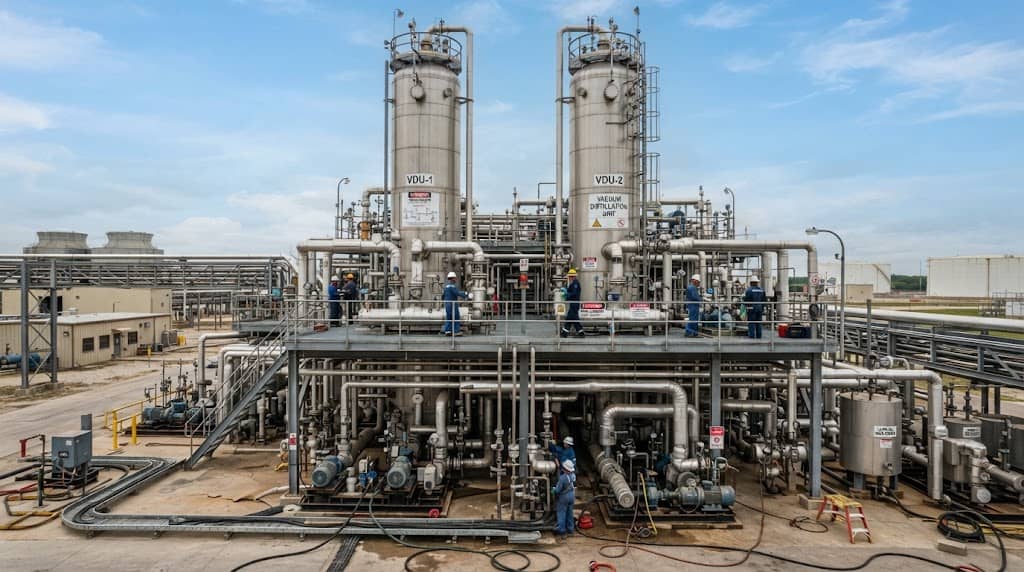
Step 3: Vacuum Distillation
Vacuum distillation is a core stage of used oil re-refining. By reducing system pressure, hydrocarbons can be separated at lower effective boiling temperatures than would be required under atmospheric conditions. This is important because excessive thermal exposure can promote degradation of the lubricating fraction. The process separates different boiling-range fractions and concentrates the valuable lubricating oil fraction for further treatment.
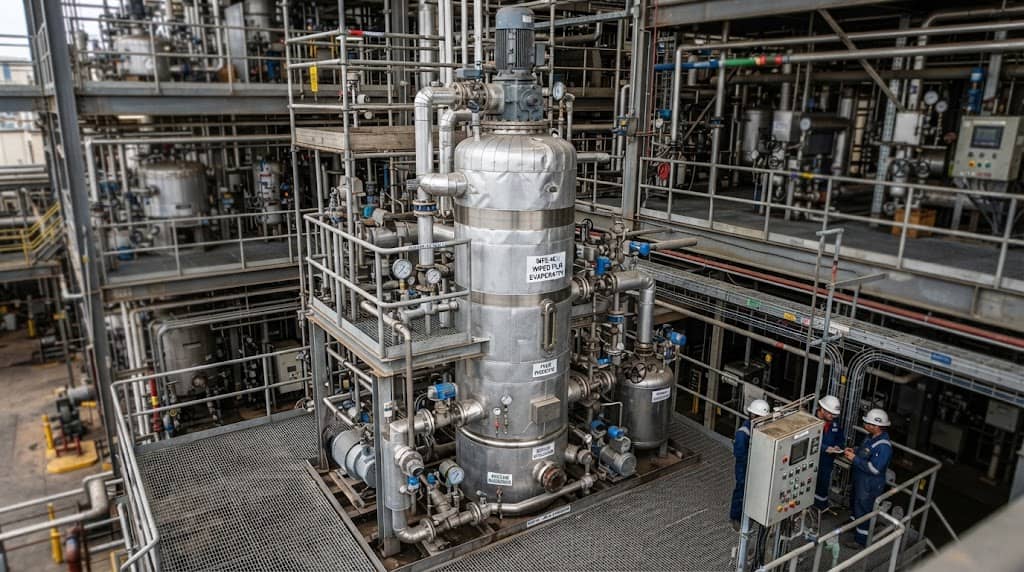
Step 4: Wiped Film Evaporation
Wiped film evaporation (WFE) can be used to recover high-boiling lubricating fractions under high-vacuum conditions. The rotating wiping system spreads the feed into a thin film across the heated surface. This improves heat transfer and reduces residence time compared with conventional bulk heating. For used oil re-refining, WFE can help separate valuable lube oil components from heavier residues while limiting unnecessary thermal exposure.
Step 5: Deep Purification
After the primary separation stages, additional treatment may be required to achieve the desired base oil specifications. Depending on the feedstock and target product, this may include technologies such as:
- Solvent extraction
- Hydrotreating
- Other finishing or upgrading processes
The objective is to remove undesirable compounds and improve properties such as color, odor, sulfur content, saturation, oxidation stability, and overall product quality.
Step 6: Finished Base Oil
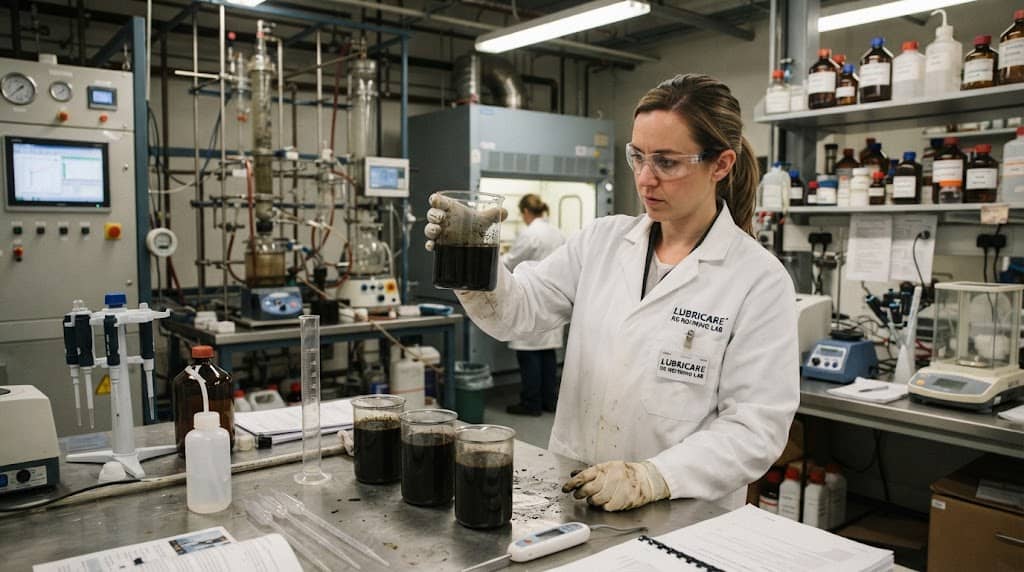
The final product is subjected to quality testing according to the target specification. Potential parameters include:
- Viscosity
- Viscosity index
- Flash point
- Sulfur
- Total acid number
- Color
- Carbon residue
- Oxidation stability
- Other relevant physical and chemical properties
Which Part of Used Engine Oil Becomes Base Oil?
The most valuable fraction for a re-refinery is the lubricating oil fraction. A simplified product distribution can be represented as follows:
| Fraction | Typical Destination |
| Water | Water treatment / controlled disposal |
| Light hydrocarbons | Light product or fuel fraction |
| Fuel-related fraction | Separate recovery stream where applicable |
| Lubricating oil fraction | Re-refined base oil |
| Heavy residue | Residual or downstream industrial application depending on composition |
| Solids and sludge | Controlled waste treatment |
This explains why the final base oil quantity is lower than the original feedstock quantity. The purpose of a re-refining plant is not simply to recover the maximum possible weight. It is to selectively recover the valuable lubricating fraction and upgrade it to a useful base oil product.
What Factors Affect Base Oil Recovery from Used Engine Oil?
The yield from one ton of used engine oil can vary substantially between projects. Several factors are particularly important.
1. Feedstock Quality
Feedstock composition is one of the strongest determinants of final yield. Important parameters include:
- Water content
- Sludge content
- Insoluble solids
- Fuel dilution
- Viscosity
- Ash
- Additive residues
- Metal contamination
- Heavy contaminant concentration
Two batches with the same weight can produce very different amounts of recoverable base oil. For this reason, a professional project evaluation should begin with representative feedstock sampling and laboratory analysis.
2. Lubricating Oil Fraction
Not all collected waste oil contains the same proportion of recoverable lubricating hydrocarbons. Used engine oil collected from different sources may contain different proportions of:
- Engine lubricants
- Hydraulic oils
- Gear oils
- Industrial oils
- Fuel
- Solvents
- Other petroleum products
Feedstock sorting can therefore have a direct impact on process performance and product yield.
3. Dehydration Efficiency
Water does not contribute to base oil production. If a feedstock contains significant moisture, part of the processing capacity is effectively being used to remove water rather than recover hydrocarbons. Efficient dehydration helps improve the overall process balance and protects downstream separation equipment.
4. Vacuum Distillation Efficiency
Vacuum distillation performance depends on several operating parameters, including:
- Vacuum level
- Temperature
- Feed rate
- Heat transfer
- Residence time
- Feed composition
Poorly controlled conditions can result in incomplete separation or unnecessary thermal degradation.
5. Wiped Film Evaporation Performance
When WFE is used, factors can influence the recovery of valuable high-boiling fractions as follows:
- Film thickness
- Heating temperature
- Feed rate
- Vacuum level
- Residence time
- Heat-transfer efficiency
6. Final Purification Technology
The final purification stage affects both product quality and overall material balance. For example, solvent extraction can selectively remove undesirable compounds from the lube oil fraction, while hydrotreating can further upgrade the product by reducing certain impurities and improving hydrocarbon quality.
The appropriate configuration depends on the desired base oil specification, feedstock characteristics, plant capacity, investment level, and operating requirements.
Does Higher Base Oil Yield Always Mean Better Re-Refining?
No. This is one of the most important considerations when evaluating a used oil re-refining plant. Suppose two processes produce:
- Process A: 85% recovery but lower-quality base oil
- Process B: 78% recovery but significantly higher-quality base oil
Process A is not automatically the better option.
The commercial value of the final product depends on its specifications and intended application. Additional purification may remove some material from the final base oil stream while substantially improving product quality. A proper project assessment should therefore optimize Yield, Quality, Energy Consumption, Operating Cost, and Product Value rather than focusing on yield alone.
How to Calculate Used Oil Re-Refining Yield
The basic base oil yield equation is straightforward:
Base Oil Yield (%) = Re-Refined Base Oil Output ÷ Used Oil Feedstock Input × 100
For example, if a plant processes 1,000 kg of used engine oil and produces 800 kg of re-refined base oil, then:
Base Oil Yield = 800 ÷ 1,000 × 100 = 80%
However, an accurate commercial calculation should use a complete mass balance covering every major inlet and outlet stream.
A project-level balance may include:
Feedstock = Water + Light Fraction + Base Oil + Heavy Residue + Other Losses
The sum of the output streams should be reconciled against the feedstock input. This approach provides a much more reliable basis for estimating plant performance than applying a standard yield percentage.
How Much Base Oil Can Different Plant Capacities Produce?
Plant capacity is normally expressed in tons per day (TPD). Using an illustrative 80% base oil yield, theoretical daily production can be estimated as follows:
| Used Oil Feed Capacity | Illustrative Yield | Estimated Base Oil Output |
| 10 TPD | 80% | 8 tons/day |
| 20 TPD | 80% | 16 tons/day |
| 50 TPD | 80% | 40 tons/day |
| 100 TPD | 80% | 80 tons/day |
| 200 TPD | 80% | 160 tons/day |
These figures are illustrative calculations, not guaranteed production values. Actual production depends on feedstock quality, operating hours, maintenance downtime, process configuration, product specifications, and the actual measured yield.
Annual Production Example
For a plant processing 50 tons/day, operating 300 days per year, with an illustrative 80% base oil yield:
50 × 300 × 80% = 12,000 tons/year
This means the plant could theoretically produce approximately 12,000 tons of re-refined base oil per year under the assumed conditions. For investment planning, however, actual operating availability and real feedstock performance should be used instead of relying on a theoretical calculation.
How Much Used Oil Is Needed to Produce 1 Ton of Base Oil?
The calculation can also be reversed.
If the expected base oil yield is 80%: Required Used Oil = Desired Base Oil Output ÷ Base Oil Yield
Therefore: 1 ton ÷ 80% = 1.25 tons of used oil
Under this illustrative assumption, approximately 1.25 tons of used oil would be required to produce 1 ton of re-refined base oil.
- At a 70% yield: 1 ÷ 0.70 = 1.43 tons
- At an 85% yield: 1 ÷ 0.85 = 1.18 tons
| Base Oil Yield | Used Oil Required for 1 Ton Base Oil |
| 70% | ~1.43 tons |
| 75% | ~1.33 tons |
| 80% | ~1.25 tons |
| 85% | ~1.18 tons |
These are mathematical examples. The actual feedstock requirement should be calculated from laboratory analysis and a project-specific process mass balance.
How Can You Increase Base Oil Recovery from Used Engine Oil?
Improving recovery does not necessarily mean simply increasing operating temperature or processing more feedstock. A better approach is to optimize the complete process.
- Improve Feedstock Selection: Separating suitable lubricating oil feedstocks from heavily contaminated or unsuitable waste streams can significantly improve process stability.
- Reduce Water and Solid Contamination: Effective collection, storage, filtration, and pre-treatment reduce the amount of non-hydrocarbon material entering the main process.
- Optimize Dehydration: Proper dehydration reduces the load on downstream vacuum and thermal systems.
- Optimize Vacuum Distillation: Temperature, vacuum level, feed rate, and residence time should be adjusted according to the actual feedstock characteristics.
- Maximize Recovery in WFE: Where wiped film evaporation is used, proper control of film thickness, feed rate, temperature, and vacuum can help recover valuable high-boiling lube oil fractions.
- Select Appropriate Purification Technology: Solvent extraction and hydrotreating have different functions and investment requirements. The appropriate option depends on the desired final base oil quality.
- Maintain a Complete Mass Balance: Regular monitoring of feed and product streams helps identify where material is being lost and provides a basis for process optimization.
What Is the Best Re-Refining Process for High Base Oil Recovery?
There is no universal process configuration that is optimal for every used engine oil feedstock. A typical advanced process may include:
| Process Stage | Main Function |
| Pre-treatment | Remove solids, sludge and unwanted contaminants |
| Dehydration | Remove water and light volatile components |
| Vacuum Distillation | Separate useful hydrocarbon fractions |
| Wiped Film Evaporation | Recover high-boiling lubricating fractions |
| Solvent Extraction | Remove selected undesirable compounds |
| Hydrotreating | Upgrade and stabilize the base oil |
| Finishing | Achieve the required final product specifications |
The final configuration should be selected according to:
- Feedstock composition
- Required capacity
- Target base oil grade
- Desired product quality
- Energy availability
- Investment budget
- Operating cost
- Local environmental requirements
For some projects, vacuum distillation and WFE may provide the required recovery and quality. Other projects targeting higher-quality Group II or advanced base oil products may require additional upgrading technologies.
The correct question is therefore not simply “Which technology gives the highest yield?”, but rather: “Which process configuration provides the required base oil quality and recovery at an economically viable operating cost?”
Frequently Asked Questions About Used Engine Oil Re-Refining Yield
Q1: What is the average used oil re-refining yield?
There is no universal average. Feedstock quality, water and sludge content, lube oil fraction, vacuum distillation efficiency, WFE performance, and final purification requirements all affect the actual yield.
Q2: Can 1 ton of used oil produce 1 ton of base oil?
Generally, no. Used engine oil contains water, fuel, degraded additives, metals, solids, and heavy residues that must be separated during re-refining.
Q3: What causes low base oil recovery?
High water content, excessive sludge, fuel dilution, heavy contamination, unsuitable feedstock, inefficient dehydration, poor vacuum separation, and inappropriate operating conditions can all reduce recovery.
Q4: Does water content affect used oil yield?
Yes. Water does not contribute to base oil production and increases the processing load. High moisture content can also affect energy consumption and downstream process stability.
Q5: What is the role of a wiped film evaporator in used oil re-refining?
A wiped film evaporator provides high-vacuum separation with a thin liquid film and relatively short residence time. It can help recover valuable high-boiling lubricating fractions while separating heavier residues.
Q6: Can used engine oil be converted into Group II base oil?
Potentially, yes, depending on feedstock quality and the process configuration. Producing higher-quality base oil may require additional purification or upgrading, such as solvent extraction and/or hydrotreating.