
Why Does Waste Oil Distillation Produce Too Much Sludge?
Written By: Mr.Ran
Senior Petrochemical & Waste Oil Recycling Engineer
Deeply involved in the design, manufacturing, and optimization of various waste oil recycling and petrochemical equipment, delivering practical and efficient solutions for clients worldwide.
During the waste oil distillation process, the presence of a small amount of residue is a normal phenomenon. Heavy hydrocarbons, ash, metals, degraded additives, and other substances that cannot be distilled will remain at the bottom of the distillation column.
However, if the sludge or residue produced by the waste oil distillation plant significantly exceeds expectations, it may be related to the raw materials, pre-treatment, or operating conditions.
Understanding the cause is crucial because excessive sludge will reduce the oil recovery rate, increase the risk of scaling, and raise the cleaning and operating costs.
Is Sludge Normal in Waste Oil Distillation?
The key is to distinguish between normal residues and excessive sludge.
The normal residues mainly depend on the composition of the raw materials. If the amount of sludge significantly increases, especially if it increases suddenly, it may indicate:
- Excessive solid or ash content in the raw materials
- Insufficient pre-treatment
- High proportion of heavy components
- Excessive heating or local overheating
- Unstable vacuum or improper operating conditions
Therefore, a high residue yield does not necessarily mean that there is a problem with the performance of the distillation equipment.
5 Reasons Why Sludge Production Is Too High
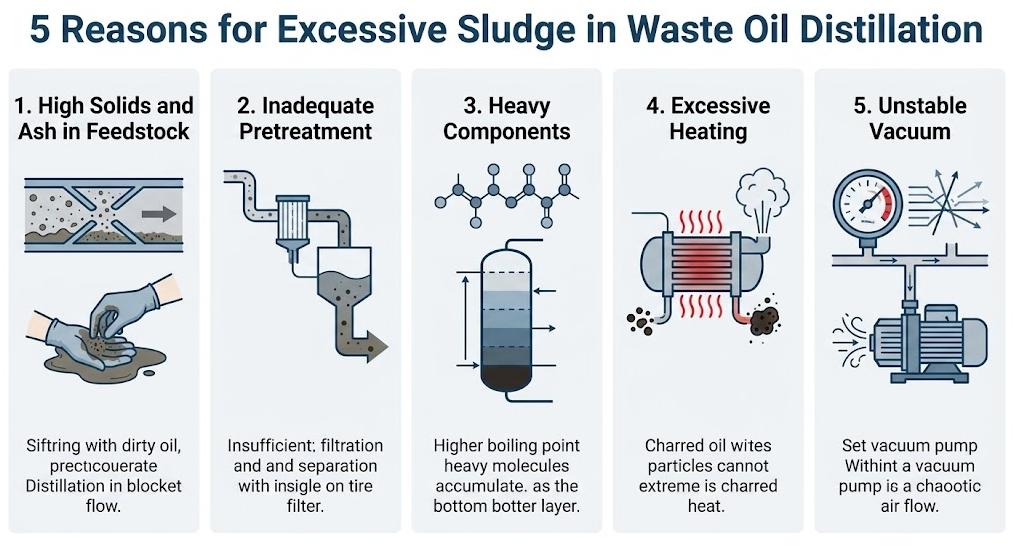
1. High Solids and Ash in Feedstock
The quality of the raw materials for waste oil directly affects the amount of residue produced.
It may contain dirt, carbon deposits, rust, metal particles, ash, and degraded additives. These substances usually cannot enter the target fraction and will eventually accumulate at the bottom of the reactor.
If there is a significant difference in the amount of sludge produced by different batches of waste oil, the raw materials should be checked first.
How to determine: Compare the ash, solids, and sediment contents of different batches of raw materials, as well as the corresponding residue production.
2. Inadequate Pretreatment
It is crucial to carry out thorough pre-treatment before the waste oil enters the main distillation system.
If the raw materials contain excessive moisture, solids, or other contaminants, they may cause scaling, coking, and unstable operation during heating and distillation.
Sending pre-treated insufficient waste oil directly to the distillation unit may increase the accumulation of sludge and the frequency of equipment cleaning.
How to identify: Compare the states before and after the pre-treatment such as filtration, precipitation, and dehydration of the raw materials. If there is still a large amount of solid residue after the treatment, it indicates that the pre-treatment may need improvement.
3. Poor Separation of Heavy Components
The composition of different waste oils varies significantly. Some raw materials contain a large amount of heavy hydrocarbons, oxidized oils, degraded additives, and other high-boiling substances.
These components are difficult to recover as effective fractions and usually remain at the bottom of the distillation process.
Therefore, a high residue rate does not necessarily indicate a problem with the equipment; it may just be a manifestation of the characteristics of the raw materials.
How to identify: Compare the residue rates of different raw material sources and analyze the residue components.
4. Excessive Heating or Local Overheating
High temperature does not necessarily increase the oil recovery rate.
Excessive operating temperature or local overheating may accelerate thermal degradation and coking, increase deposits, and make the residue heavier and more difficult to handle.
Vacuum distillation particularly requires reasonable control of temperature and vacuum degree.
How to identify: If the amount of sludge or coke significantly increases after raising the heating temperature, check whether the operating temperature has exceeded the reasonable range.
5. Unstable Vacuum or Operating Conditions
The vacuum conditions will affect the boiling and separation of waste oil.
Fluctuations in vacuum pressure will cause instability in distillation conditions. To compensate for the vacuum changes and increase the heating temperature, it may further aggravate scaling and the formation of heavy residues.
In addition, factors such as feed rate, heating rate, and residence time will also affect the separation effect.
How to identify: Check if the increase in residues occurs simultaneously with vacuum fluctuations, unstable temperatures, or changes in feed rate.
How Can You Find the Real Cause?
Instead of immediately changing the distillation temperature, check the problem systematically.
| What You Observe | Possible Cause |
| High ash or solids in residue | Poor-quality or highly contaminated feedstock |
| Large amounts of solids before distillation | Insufficient pretreatment |
| Residue increases with certain feedstock batches | Feedstock composition |
| Sludge increases after raising temperature | Overheating or coking |
| Vacuum fluctuates when residue increases | Vacuum or operating problem |
| Heat exchanger fouling develops quickly | Insufficient pretreatment or excessive thermal stress |
The key is to compare feedstock condition, operating data, and residue characteristics rather than looking at sludge volume alone.
How to Reduce Sludge Production
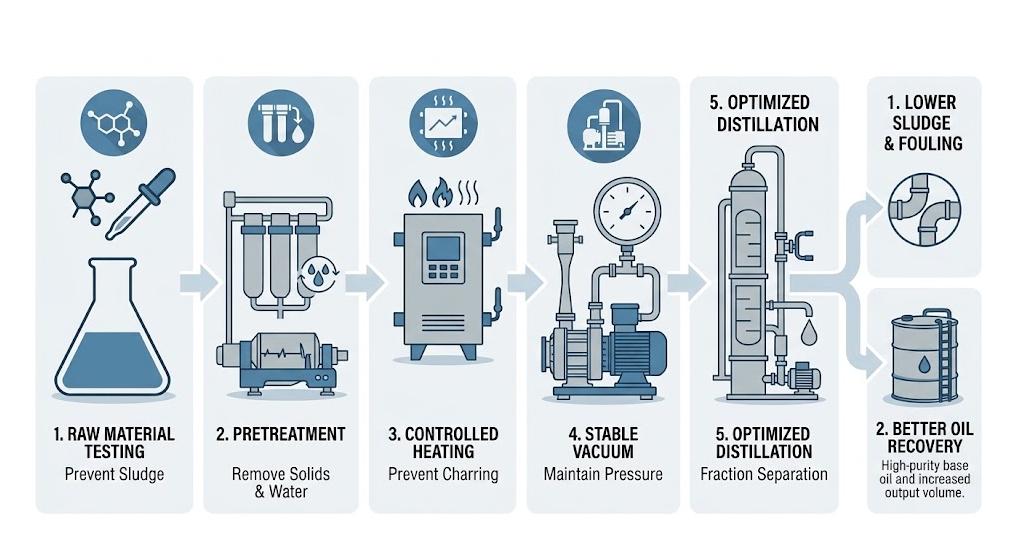
The following practical steps can help reduce unnecessary residues and scale formation:
1. First, test the raw materials.
Before designing or adjusting the process flow, check parameters such as moisture, solids, ash content, viscosity, and other related contaminants.
2. Improve pre-treatment.
Based on the characteristics of the raw materials, adopt appropriate pre-treatment methods such as filtration, sedimentation, dehydration, centrifugation, or others.
3. Optimize heating.
Avoid simply increasing the temperature to improve the recovery rate. Excessive temperature will lead to increased thermal degradation and coke formation.
4. Maintain a stable vacuum system.
A stable vacuum helps maintain predictable boiling and separation conditions.
5. Monitor residues.
Changes in the color, consistency, ash content, and quantity of residues can provide useful information about changes in the raw materials or operating conditions.
PurePath Solution
PurePath designs the waste oil re-refining system based on the characteristics of raw materials, pre-treatment requirements and the quality of target products.
Appropriate pre-treatment, heating control and stable vacuum operation help reduce excessive sludge, scaling and unnecessary oil loss.
Is the content of oil sludge or residue in your waste oil high? Please contact PurePath to discuss suitable process solutions.