
How to Prevent Fouling in a Waste Oil Distillation Plant?
Written By: Mr.Ran
Senior Petrochemical & Waste Oil Recycling Engineer
Deeply involved in the design, manufacturing, and optimization of various waste oil recycling and petrochemical equipment, delivering practical and efficient solutions for clients worldwide.
Scale formation is a common operational problem in waste oil distillation plants. Impurities such as oil sludge, degraded additives, metal pollutants, and carbonaceous materials in the waste oil will accumulate on the heating surfaces and within the process equipment during the distillation process. Research on the re-refining of waste lubricating oil also indicates that metals and other harmful compounds will accumulate during the refining process.
Improper control of scale formation can reduce heat transfer efficiency, increase energy consumption, limit flow rates, and increase the frequency of shutdowns for cleaning and maintenance. Therefore, scale prevention should start before the raw materials enter the distillation unit and should be integrated throughout process control, equipment design, and daily maintenance.
What Causes Fouling in Waste Oil Distillation Plants?
Heavy Contaminants in Waste Oil
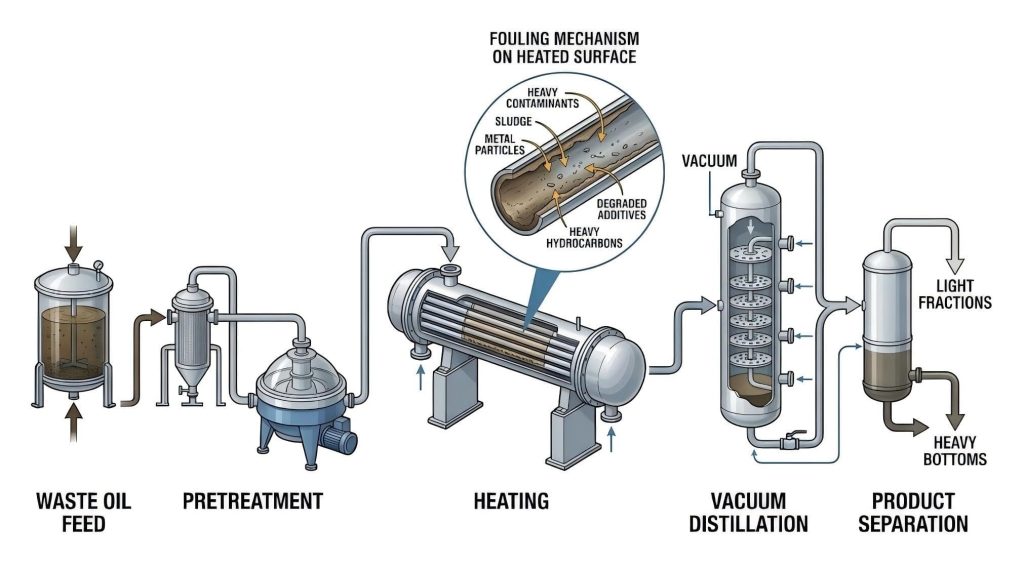
Waste oil is not a homogeneous raw material. It usually contains oil sludge, dirt, ash, degraded additives, metal particles and heavy hydrocarbons. During the distillation process, some pollutants will not vaporize along with the target oil fraction but will accumulate in the heavy residue.
Heavy metals and other pollutants will accumulate at the bottom of the distillation vessel during the re-refining of waste oil. When the removal of solid and heavy pollutants is insufficient, they are prone to accumulate on the surface of equipment and form scale.
High-Temperature Operation
Excessive operating temperature will increase the risks of thermal degradation, carbon deposition and coke formation. This is particularly evident when dealing with heavy waste oil fractions.
Vacuum distillation can lower the boiling points of hydrocarbons, reduce the thermal stress required for separation, and help limit cracking and coking during the re-refining process of waste oil.
Therefore, the distillation operation should not simply pursue higher temperatures, but should maintain an appropriate operating temperature under stable process conditions.
Poor Feedstock Pretreatment
Improper pre-treatment will also increase the risk of scaling. Water, sediment, suspended solids and other pollutants entering the distillation system will increase the load on heaters, heat exchangers and downstream equipment.
Appropriate pre-treatment such as sedimentation, filtration, dehydration, etc., can remove most of the unwanted substances before thermal treatment.
Where Does Fouling Usually Occur?
Heaters and Reboilers
The heater and reboiler are sensitive to scaling, and deposits are prone to form on the heat transfer surfaces. As the scaling layer thickens, the heat transfer efficiency decreases, and more energy is required to maintain the target temperature.
Heat Exchangers
Heat exchangers are prone to accumulate heavy oil components and contaminants. Scaling can increase thermal resistance and reduce heat transfer performance. As the heating load continues to increase, it becomes increasingly difficult to maintain the process temperature, which is usually a sign of aggravated scaling.
Distillation Columns and Piping
Scaling may occur at the bottom of the tower, pipelines, valves, condensers, and other locations where heavy distillates and residues are likely to accumulate.
For vacuum distillation systems, stable vacuum conditions are crucial. Industrial vacuum systems typically use steam ejectors, liquid ring vacuum pumps, or combined systems to maintain the required operating pressure.
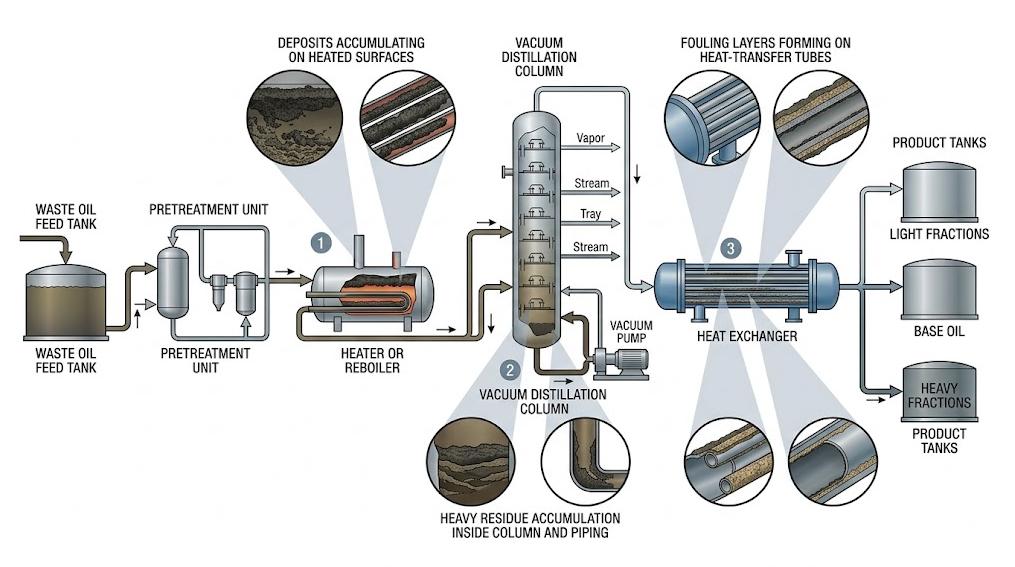
6 Ways to Prevent Fouling in Waste Oil Distillation
- Improve raw material pre-treatment: Before the waste oil enters the distillation device, it should be dehydrated, sedimented, suspended, and other contaminants removed. The cleaner the raw material, the lower the scaling load on downstream equipment.
- Control heating temperature: Avoid excessively high temperatures and localized overheating. Reasonable control of the heating rate can reduce thermal degradation and carbon deposition.
- Maintain stable vacuum conditions: Stable vacuum operation can complete the required separation at lower temperatures. Operators should monitor the vacuum pressure and promptly address abnormal fluctuations instead of compensating for unstable vacuum by increasing the heating temperature.
- Optimize heat transfer conditions: Appropriate heat transfer area, flow conditions, and equipment selection help improve energy efficiency and control scaling. Try to avoid excessively high heat transfer surface temperatures.
- Manage heavy distillates and residues: According to the process design, continuous or periodic removal of heavy distillates and distillation vessel residues is necessary. A large amount of residue remaining in the system for a long time increases the risk of sediment formation.
- Regularly monitor and clean equipment: Scaling prevention cannot replace equipment maintenance. Monitoring pressure drop, temperature difference, heating performance, and production capacity can help identify problems before scaling affects operation.
How Equipment Design Helps Reduce Fouling
Prevention of scaling should be considered during the engineering design stage rather than being addressed as a maintenance issue after the equipment is in operation.
A well-designed waste oil distillation unit should be equipped with a suitable pre-treatment system based on the characteristics of the raw materials. The heating equipment should provide sufficient heat while avoiding excessively high surface temperatures. The selection and size of the heat exchanger should be determined in combination with the properties and flow characteristics of the processed oil.
The vacuum system is also an important part of the device design. A stable and appropriate operating pressure can reduce the heat load during the distillation process. The system should also have an effective method for discharging heavy residues and be convenient for inspecting and cleaning key equipment.
Scaling control relies on the coordinated design of the pre-treatment, heating, vacuum, heat transfer, distillation and residue treatment systems, rather than a single device.
Signs That Your Waste Oil Distillation Plant Has a Fouling Problem
Operators should pay attention to the following changes in equipment performance:
- Increased energy consumption
- Extended heating time
- Decreased heat transfer efficiency
- Increased pressure drop
- Unstable operating temperature
- Reduced processing capacity
- Increased cleaning frequency
- Changes in product quality or distillation performance
The gradual decline in performance is just as important as sudden failures. Promptly identifying abnormalities and investigating the causes can help take corrective actions to prevent further fouling from affecting production.
To Summary
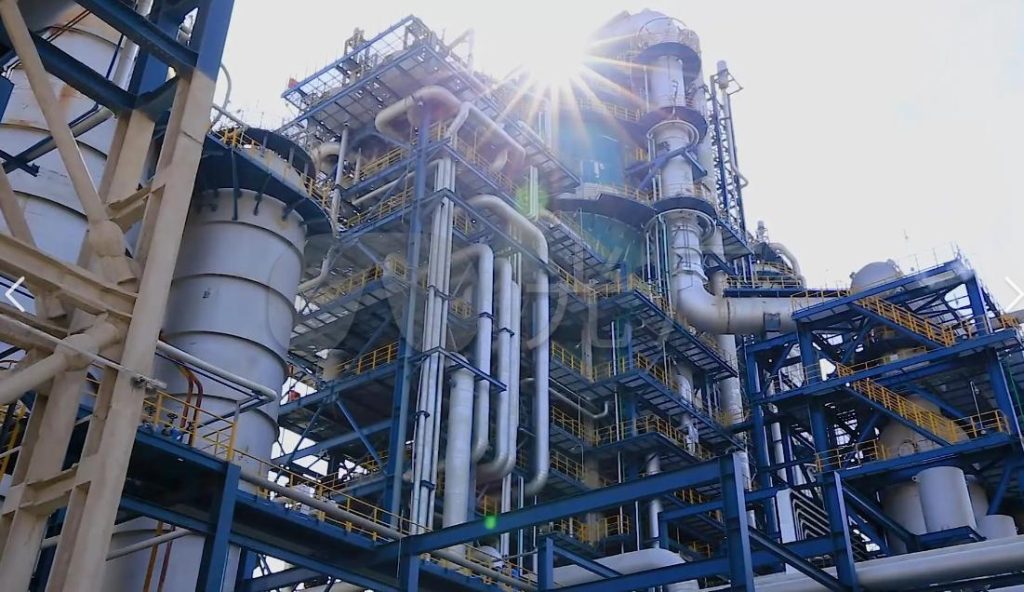
Effective raw material pre-treatment, controllable heating, stable vacuum, optimized heat transfer, timely residue removal and preventive maintenance all contribute to improving equipment reliability.
For new waste oil distillation projects, prevention of scaling should be considered during the engineering design stage. Reasonably combining process technology with equipment design can reduce maintenance requirements, improve energy efficiency, and support the long-term stable operation of the equipment.
PurePath can provide customized waste oil refining and distillation solutions based on the characteristics of the raw materials, processing capacity and product requirements. For new projects and factory upgrades, the engineering team can assist in evaluating the characteristics of the raw materials and developing appropriate refining plans.