
Why Is the Base Oil Yield Lower Than Expected? 5 Common Causes
Written By: Mr.Ran
Senior Petrochemical & Waste Oil Recycling Engineer
Deeply involved in the design, manufacturing, and optimization of various waste oil recycling and petrochemical equipment, delivering practical and efficient solutions for clients worldwide.
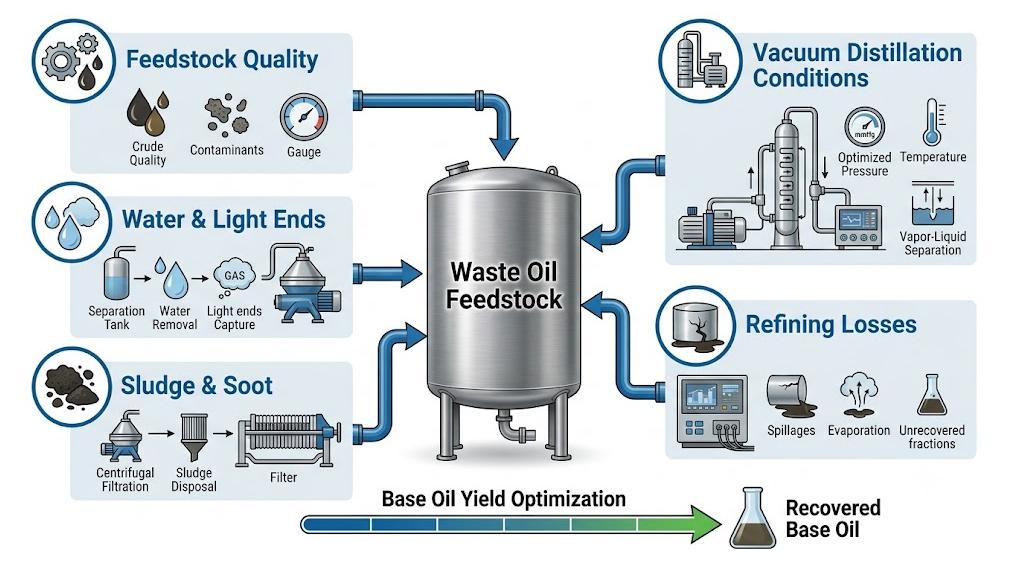
During the re-refining process of waste oil, the yield of base oil is often lower than expected. Besides the equipment performance, the actual recovery rate is also affected by the quality of raw materials, moisture, light components, heavy pollutants, vacuum conditions and refining losses.
Before replacing the equipment or increasing the operating temperature, it is necessary to determine the specific loss points of the oil product.
1. Poor Feedstock Quality
Different types of waste oil contain different components of recyclable lubricating oil. The compositions of raw materials such as waste engine oil, industrial lubricating oil, and hydraulic oil vary significantly.
Water, fuel dilution, sludge, ash, insoluble solids, degraded additives, and metal pollutants will reduce the content of recyclable base oil.
Therefore, one ton of waste oil is not equivalent to one ton of recyclable lubricating oil. When investigating the reasons for the low recovery rate of base oil, raw material analysis should be conducted first.
Read more: How Much Base Oil Can You Recover from 1 Ton of Used Engine Oil?
2. High Water and Light-End Content
Water and light hydrocarbons are also common reasons for the lower-than-expected yield of base oil.
In the initial stage of waste oil treatment, water, gasoline, diesel diluents, and other light components are removed first, followed by the recovery of lubricating oil fractions. These substances will increase the weight of the raw materials, but they will not enter the final base oil.
Therefore, even if two factories process the same amount of waste oil, if the content of water and light components in the raw materials is different, the yield will also be different. When evaluating the yield, the actual composition of the raw materials should be taken into account.
3. High Sludge, Soot and Additive Content
During the use process, waste engine oil accumulates soot, oxidation products, metal particles, degraded additives and other heavy pollutants.
These substances usually end up in the residue rather than being converted into recyclable base oil. When the content of sludge and heavy pollutants in the raw materials is high, the proportion of residue increases and the yield of base oil also decreases.
If the production of oil sludge in the factory suddenly increases, the problem may not come from the distillation equipment. One should also check whether the quality of the raw materials has changed.
4. Unstable Vacuum or Improper Distillation Conditions
Vacuum distillation is one of the key steps in the recovery of lubricating oil fractions from waste oil.
Stable vacuum conditions enable the evaporation of lubricating oil fractions at lower temperatures, reducing thermal stress. If the vacuum level fluctuates or the operating conditions are poor, a higher temperature is required to achieve the separation effect, increasing cracking and the generation of light products, and reducing the amount of base oil recovered.
Therefore, increasing the temperature does not necessarily improve the yield. When evaluating the yield, factors such as vacuum pressure, heating temperature, feed rate, residence time, condenser performance, and fraction cutting point should be comprehensively considered.
5. Oil Loss During the Refining or Purification Stage
The distillation yield does not equal the final base oil yield.
After distillation, further purification is usually required to remove chromophores, oxidation products, aromatics, and other impurities. Traditional refining methods may cause additional oil loss, for example, clay treatment may leave some base oil in the waste clay. Solvent extraction can reduce oil loss while improving the quality of the base oil.
Therefore, when evaluating the performance of a factory, attention should be paid to the material balance of the entire process, rather than just the distillation yield.
Quick Troubleshooting Guide
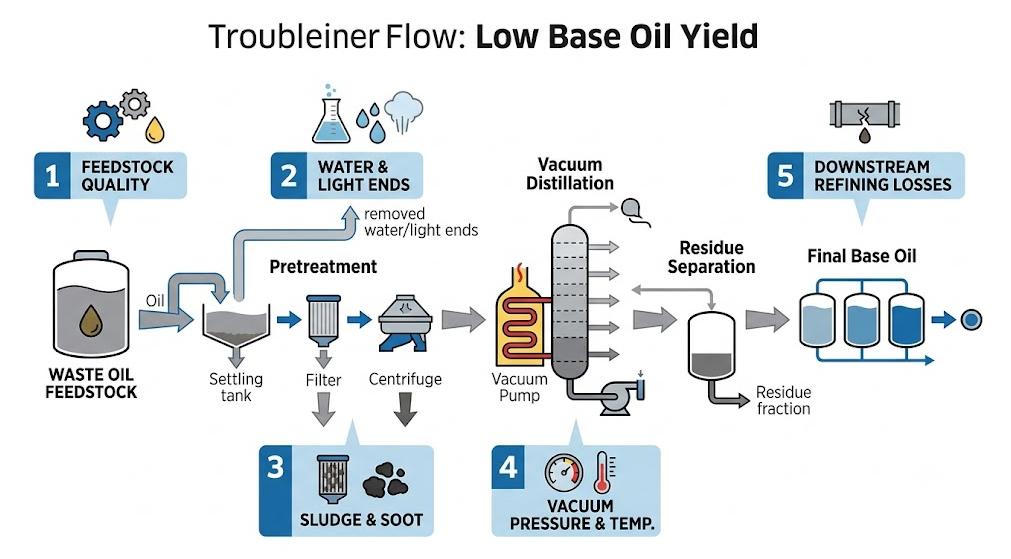
If your base oil yield is lower than expected, the following symptoms can help identify where the problem may be occurring in the waste oil re-refining process.
| Symptom | Possible Cause | What to Check |
| Yield suddenly drops | Feedstock composition changed | Water, sludge, fuel dilution |
| More residue than normal | High soot or additive content | Feedstock analysis |
| Yield drops after increasing temperature | Vacuum instability or thermal stress | Pressure and temperature |
| Large amount of oil in bottoms | Poor separation | Distillation conditions |
| Good distillation yield but low final yield | Downstream refining losses | Purification process |
How Can You Improve Base Oil Yield?
To increase the yield of base oil, the first step is to identify the loss points of the oil.
The key steps include:
- Analyzing the composition of the raw materials.
- Improving the pre-treatment to remove moisture and solid impurities.
- Maintaining stable vacuum distillation conditions.
- Optimizing temperature, feed rate, and residence time.
- Reducing oil loss in the downstream purification process.
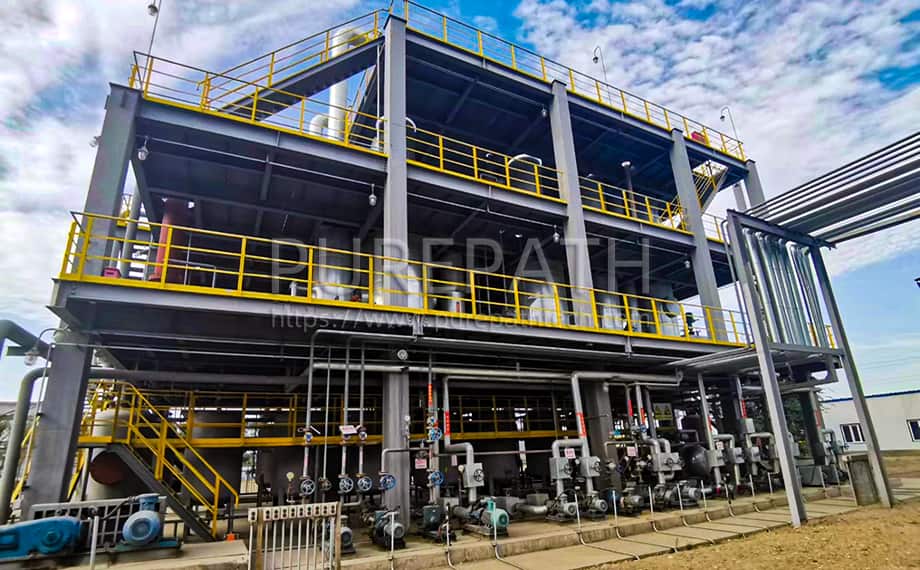
PurePath designs the waste oil to base oil plant based on the characteristics of the raw materials and the quality of the target product. It combines pre-treatment, continuous vacuum distillation, film evaporation, and downstream purification technologies.
A good process design is not simply about increasing the operating temperature, but rather improving the recovery rate of valuable lubricating oil fractions while maintaining stable operation and consistent base oil quality.