
Global Used Oil Recycling Market 2026: SAF Mandates & UCO Strategic Analysis
Written By: Mr.Ran
Senior Petrochemical & Waste Oil Recycling Engineer
Deeply involved in the design, manufacturing, and optimization of various waste oil recycling and petrochemical equipment, delivering practical and efficient solutions for clients worldwide.
The worldwide system of used oil recycling now functions as an essential part of international energy distribution after evolving from its original role as a municipal waste treatment system. The aviation sector has established strict decarbonization requirements, which will reach their full implementation by 2026, while re-refining technologies will become fully operational to convert used oils into high-value industrial feedstocks that include used cooking oil and used mineral oil. This analysis examines the market dynamics, regulatory frameworks, and technical progressions that define the field.
Part 1. Market Fundamentals and Demand Catalysts
The used oil recycling market value exists because renewable drop-in fuel production represents a driving force behind its development. Statistical projections for 2026 show that the recycling sector will grow at a compound annual growth rate (CAGR) above 5%, while the bio-feedstocks used for fuel production will experience double-digit growth.
The Impact of SAF Mandates
The Sustainable Aviation Fuel (SAF) market is the singular most significant driver of UCO demand. The ReFuelEU Aviation regulation requires EU airports to have fuel suppliers provide 2% of their fuel as SAF starting in 2025, with an increase to 6% by 2030. The mandatory blending requirements established in Singapore and Japan, which start at 1% for 2026, have resulted in a worldwide shortfall of available feedstock.
Carbon Economics and Pricing
The Carbon Border Adjustment Mechanism (CBAM), together with the EU Emissions Trading System (ETS) reforms have established carbon expenses as part of energy base pricing. The “Green Premium” assigned to used oil results from its ability to achieve significant GHG savings. UCO biofuel production does not compete with food security because it originates from used cooking oil, which results in higher regulatory compliance weightings according to RED II (Renewable Energy Directive).
Part 2. Technical Pathways: From Waste to High-Value Product
The industrial processing of used oil has shifted from basic filtration and heat-recovery burning toward advanced chemical conversion.
HEFA and HVO Production
The primary method used to transform UCO into transportation fuel is HEFA, which stands for Hydroprocessed Esters and Fatty Acids. The feedstock undergoes hydrodeoxygenation to eliminate oxygen atoms through its first stage, while the second stage involves isomerization to enhance the cold-flow characteristics of HVO, which stands for Hydrotreated Vegetable Oil. The year 2026 will see refineries use improved catalysts to process lower quality UCO that contains higher Free Fatty Acid (FFA) content without experiencing major yield losses.
Re-refining of Used Mineral Oil
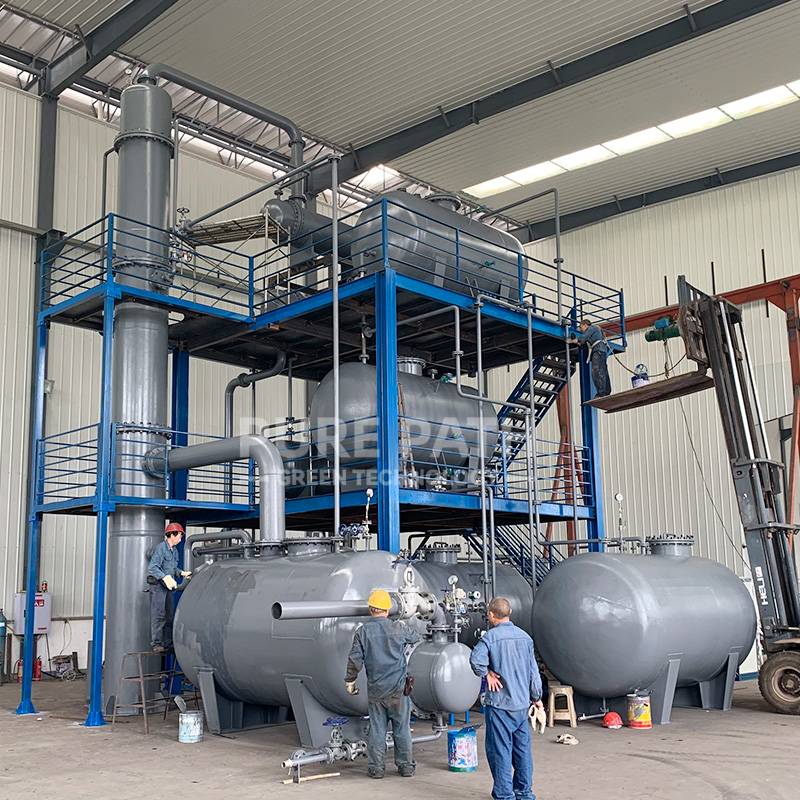
For the lubricants sector, re-refining serves as the primary circular economy strategy. Modern facilities utilize vacuum distillation followed by high-pressure hydrofinishing. This process removes heavy metals, additives, and oxidation products, returning the used mineral oil to its state as a base oil group II or group III. The chemical integrity of these re-refined oils is equivalent to virgin base oils, yet the energy consumption required for production is approximately 50% to 80% lower than refining crude oil.
Part 3. Feedstock Traceability and Compliance Infrastructure
As the market value of used oil increases, the risk of fraudulent activities—such as mislabeling virgin palm oil as UCO—has necessitated rigorous feedstock traceability protocols.
ISCC Plus Certification
The ISCC (International Sustainability and Carbon Certification) and ISCC Plus standards serve as the worldwide compliance standards that organizations need to meet. The 2026 certification audit process requires organizations to use digital documentation, which includes blockchain-based systems to confirm their Point of Origin in multiple regions.
The Role of China and Southeast Asia
China remains the world’s largest exporter of UCO. However, a significant shift occurred in early 2026 regarding export tax structures. Any reduction in export rebates for raw UCO incentivizes domestic processing into HVO or SAF. Consequently, European and North American buyers are increasingly investing in localized collection networks within Asia to secure long-term supply agreements.
Part 4. Competitive Landscape and Capital Expenditure
The market is characterized by a high degree of vertical integration. Major energy entities are no longer relying on third-party aggregators but are instead acquiring collection firms.
| Company | Key Strategic Focus (2026) | Primary Technology |
| Neste | Expanding Singapore and Rotterdam capacity | HEFA / NEXTBTL |
| EcoCeres | Strategic sourcing in Mainland China and Malaysia | HVO and SAF Refinement |
| TotalEnergies | Conversion of traditional refineries into Bio-refineries | Co-processing & HVO |
| Clean Harbors | Market leadership in North American Mineral Oil Re-refining | Vacuum Distillation / Hydrotreating |
The capital expenditure (CapEx) for a world-scale SAF refinery using UCO feedstock is estimated between $500 million and $1 billion, depending on the degree of pre-treatment required. The return on investment (ROI) depends on the bio-feedstock premium because this premium changes with the fluctuations of crude oil prices and carbon credit valuations.
Part 5. Strategic Challenges and Future Outlook
Despite the positive growth trajectory, the used oil recycling industry faces three primary structural challenges:
- Logistical Fragmentation: Unlike crude oil, which is extracted from concentrated points, used oil is generated at millions of decentralized points (restaurants, workshops). The cost of “last-mile” collection remains the largest operational expense.
- Feedstock Limits: There is a finite ceiling on UCO production. Industry analysts suggest that global UCO supply will be fully utilized by 2028, forcing the market toward alternative bio-feedstocks such as POME (Palm Oil Mill Effluent) or wood-based cellulosic materials.
- Regulatory Volatility: Changes in government subsidies or the definitions of “sustainable” materials can lead to rapid shifts in market liquidity.
The used oil recycling industry will become an essential component of the circular economy by 2026. The waste-disposal system has now transformed into a resource-recovery system. The energy industry of the late 2020s will see organizations become market leaders through their ability to manage international certification processes, achieve optimal hydroprocessing results, and maintain a consistent feedstock supply.