
Integrating a Waste Oil Distillation Machine into Existing Industrial Refineries: EPC Best Practices
Written By: Mr.Ran
Senior Petrochemical & Waste Oil Recycling Engineer
Deeply involved in the design, manufacturing, and optimization of various waste oil recycling and petrochemical equipment, delivering practical and efficient solutions for clients worldwide.
The global industry is currently under the dual pressures of raw material price fluctuations and environmental compliance. This has transformed hazardous waste management from a routine task into a crucial structural upgrade for enterprises. For medium and large industrial facilities, traditional disposal methods, such as outsourcing or direct incineration, are now imposing heavy financial and environmental burdens.
Introducing advanced waste oil distillation equipment in existing refineries or renovation projects of old plants (brownfield projects) is an effective way to solve this problem. However, renovating existing facilities to retrofit complex processing units is highly dependent on precise engineering, procurement, and construction (EPC) planning. This article will deeply explore the best engineering practices for seamlessly integrating large-capacity waste engine oil recovery systems into the existing refining system.
Defining the Dual Feedstock Spectrum: Motor Oils vs. Industrial Lubricants
One of the major challenges faced by industrial EPC projects is the diversity of raw materials. Unlike the simple petroleum fractions, waste industrial oil contains extremely complex chemical mixtures. Successful system integration begins with the clear classification and targeted pre-treatment of the following two main types of raw materials:
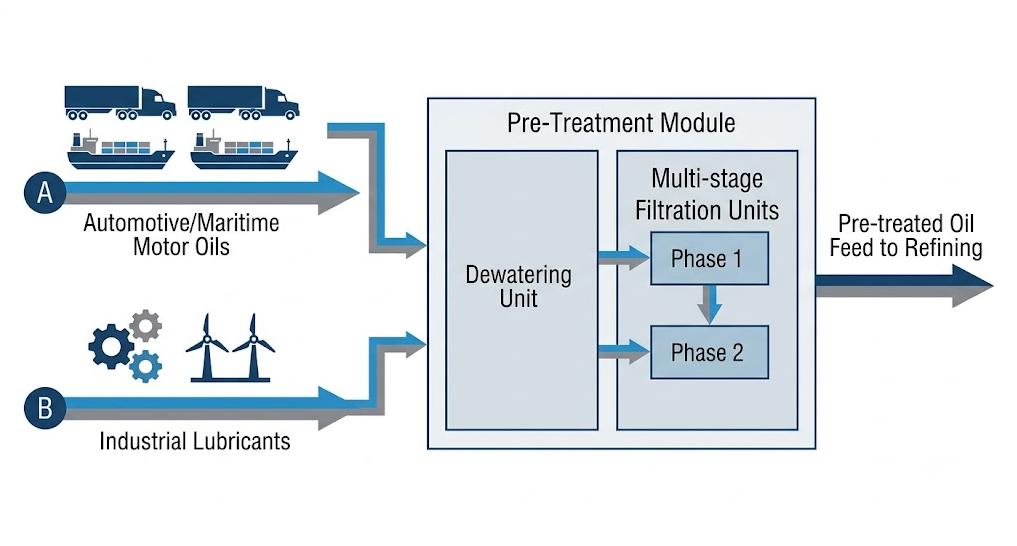
- Automotive & Maritime Waste Motor Oils
These come from commercial repair shops, 4S stores, truck fleets, and ship operations, covering used engine oil, transmission oil, and crankcase oil. Such raw materials typically contain high concentrations of carbon particles, water emulsions, unburned fuel, and heavy metal additives (such as ZDDP).
II. Industrial Lubricating Oils
Derived from heavy manufacturing industries, they include gear oil, hydraulic oil, transformer oil, compressor oil, and turbine oil. Their thermal degradation by-products and viscosity characteristics are significantly different from those of automotive oils.
EPC pre-treatment strategy: Before the materials enter the main distillation system, the EPC engineering design must incorporate a centralized dehydration module, multiple stages of coarse and fine filtration, as well as a catalytic metal removal unit, in order to completely prevent scaling in the downstream fractionation tower.
Core Engineering & Process Integration Points in Existing Refineries
When integrating the recycling device into the existing refinery, engineers need to focus on coordinating the thermal and process cycles of the following subsystems:
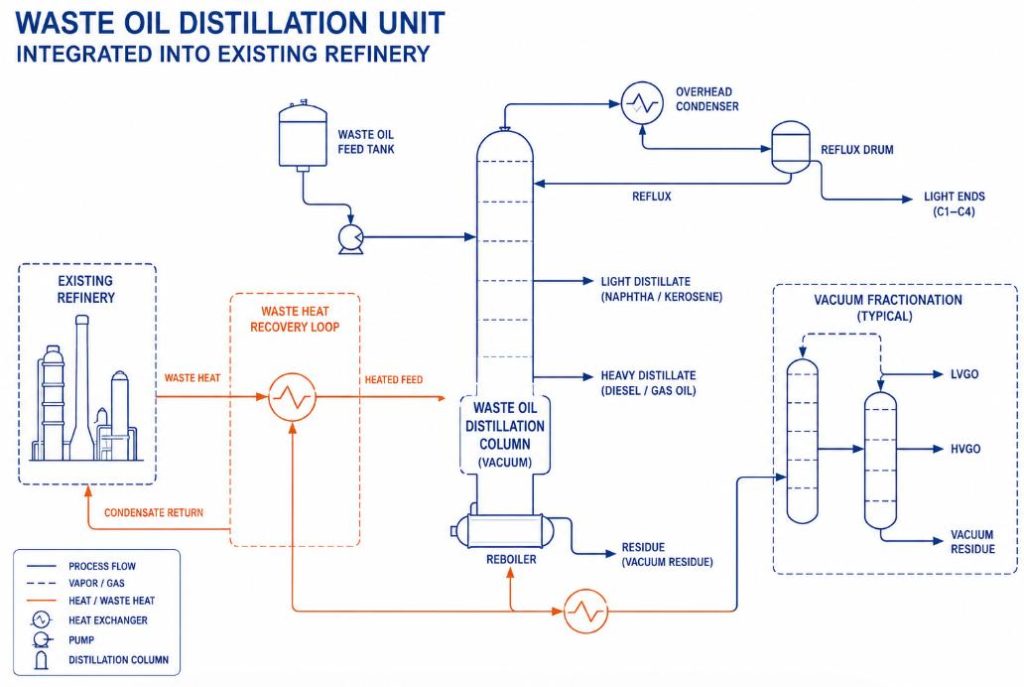
Thermal Fluid & Heat Exchanger Network Integration
To maximize energy efficiency, the heat load of the continuous distillation tower should be fully matched with the residual heat from the existing refinery furnaces or combined heat and power (CHP) systems. By optimizing the heat exchange network (HEN), efficient heat exchange of each process fluid can be achieved, thereby significantly reducing operating costs (OpEx) and maintaining the stability of the heavy feedstock heating process.
Vacuum System & Fractionation Synchronization
The vacuum distillation unit of the recycling system must be seamlessly integrated with the existing depressurized residue oil pipelines and tail gas scrubbing system of the refinery. This synchronization ensures a smooth distillation process, avoids pressure fluctuations or bottlenecks in the main plant’s depressurization system, and thus stabilizes the production of high-quality base oils (I/II/III grades) or ultra-low sulfur diesel (ULSD).
Catalytic Refining & Finishing Units
By integrating hydro-treating or clay refining processes, this device can directly upgrade the distillate oil into high-quality lubricant base oil that complies with API standards, avoiding the downgrade to low-value fuel oil. This downstream concurrent processing ensures that the final product meets strict commercial specifications in terms of sulfur content, color, and oxidation stability.
EPC Project Execution: Best Practices from Design to Commissioning
The multi-million-dollar upgrade project of the oil refinery, its successful implementation depends on a rigorous phased EPC (Engineering, Procurement, Construction) process:
Phase 1: FEED (Front-End Engineering Design) and Raw Material Analysis: Through rigorous laboratory analysis of the raw oil, precise determination of the fractionation cut points, flash point, and acid value is conducted, thereby determining the continuous processing capacity of the waste oil distillation unit.
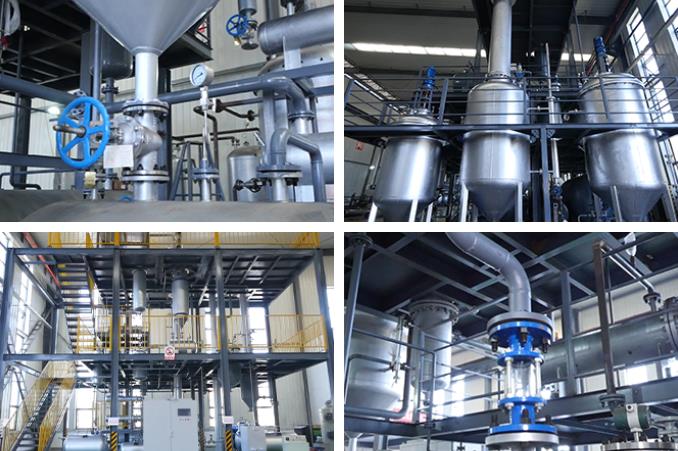
Phase 2: Modular Manufacturing and On-site Integration: For the renovation of old factories with limited sites, the pump units, heat exchangers, and distillation towers are designed in a modular skid-mounted format. This approach significantly shortens the on-site construction period and minimizes the downtime during equipment connection.
Phase 3: Environmental Safety and System Debugging: Install a closed-loop nitrogen sealing system, oil vapor recovery (VRU) system, and residue solidification system to safely dispose of asphalt and carbonaceous by-products. During the final cold and hot state commissioning phases, engineers need to verify the pressure limits, automated control loops, and emergency shutdown system (ESD) one by one to ensure a safe transition from project completion to commercial operation.
Closing Remarks: Maximizing Efficiency in Industrial Refining
Integrating the waste oil distillation unit into the existing industrial oil refinery can transform environmental risks into high-value revenue sources. By streamlining the processing path of complex raw materials, optimizing the thermal integration network, and strictly implementing EPC best practices, the factory operation and maintenance team can ensure the long-term stable operation and resilience of the system.
Are you planning to undertake large-scale industrial waste oil recovery or renovation projects? Please feel free to contact our engineering team to obtain customized feasibility study reports and factory layout plans.