
Why Does Re-Refined Base Oil Become Cloudy After Production?
Written By: Mr.Ran
Senior Petrochemical & Waste Oil Recycling Engineer
Deeply involved in the design, manufacturing, and optimization of various waste oil recycling and petrochemical equipment, delivering practical and efficient solutions for clients worldwide.
The base oil, after being processed and re-refined, should be clear and uniform. However, some manufacturers report that the oil has a hazy, milky, or cloudy appearance after cooling, filtration, or transfer to storage tanks. Cloudiness in re-refined base oil does not necessarily indicate problems in the refining quality. Residual moisture, wax crystallisation, fine suspended particles, and air entrainment during handling of the product can cause it. Each cause has a different diagnosis.
Before making any changes to the process, waste oil re-refining plant operators need to identify the actual cause of the cloudiness. In this article, we will discuss some of the common causes, inspection techniques, and engineering techniques used to maintain the clarity of the finished base oil.
What Does Cloudiness in Re-Refined Base Oil Look Like?
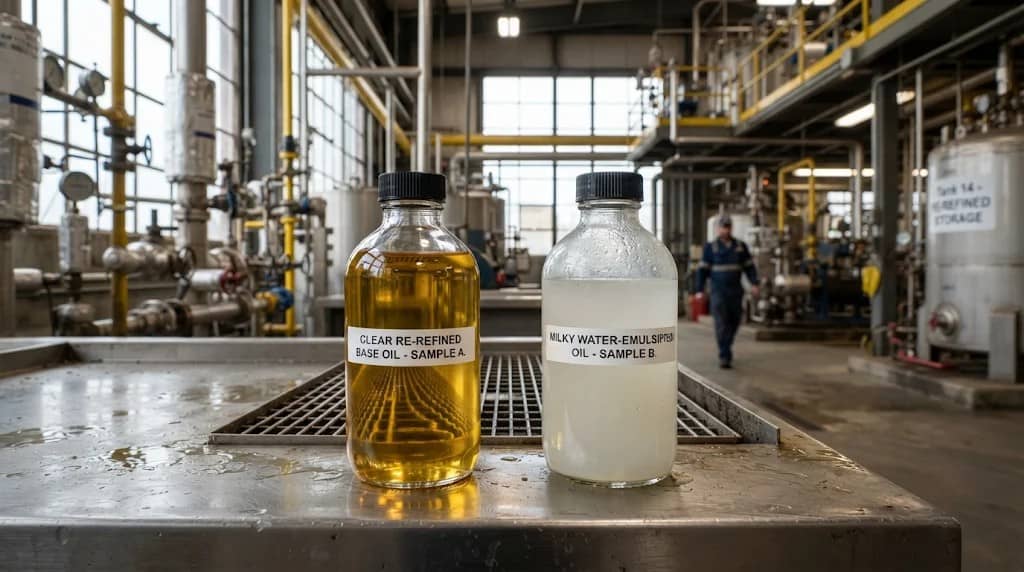
Cloudiness describes a loss of transparency in oil. The appearance may vary depending on the material causing it.
Three common conditions can be observed:
- Milky or emulsified appearance: The oil looks white or uniformly hazy, which may indicate dispersed water droplets.
- Hazy appearance after cooling: Oil that looks clear when warm becomes cloudy as its temperature decreases. This may be associated with wax crystallization or other components separating from the oil.
- Cloudiness with visible particles: Small suspended particles or sediment can make the oil look dirty or uneven.
These conditions should not be treated as the same problem. For example, water emulsification requires a different response from wax precipitation or solid contamination.
What Causes Re-Refined Base Oil to Become Cloudy?
Some of the factors that can cause finished re-refined base oils to be transparent. These include: residual moisture, solids, temperature, and product transfer:
1. Residual Water and Water/Oil Emulsion
Water makes the base oil appear cloudy. The water is present in the oil as small droplets that scatter light, which gives the oil a hazy or milky appearance. This may happen when final dehydration is inadequate or when moisture is introduced into the product during cooling, transfer, or storage.
Even if the free water has settled, the water-in-oil emulsion may still be cloudy. Thus, visual inspection is not sufficient to determine if the oil is dry. Water content can be determined by Karl Fischer titration. ASTM D6304-25: Standard Test Method for Determination of Water in Petroleum Products, Lubricating Oils, Additives, and Base Oils. Refer to ASTM D6304 standard for details on scope and testing method.
2. Wax crystallisation on cooling
Another cause of base oil cloudiness as it cools is wax crystallisation. As the oil is cooled, some of the high-melting components of the hydrocarbons may crystallise and form small crystals. These crystals scatter light, and the oil appears cloudy/hazy.
You will often see:
- Clear oil at high temperature.
- The oil becomes hazy when it cools.
- Hazing may decrease with slight warming of the oil.
This temperature dependence may help distinguish wax cloudiness from permanent water contamination.
The cloudiness temperature is a useful diagnostic clue. It can help operators identify whether the change in the oil composition and cooling is responsible. Unfortunately, not all haze due to cooling is wax. Additional tests should be performed prior to modifying the refining process.
3. Residue particles and fine suspended solids.
The last stage of filtration needs to be effective, as fine particles will be left in the final oil. Examples of sources include:
Residual solids from previous processing.
Filter media or equipment surface particles.
Buildup in transfer lines and storage tanks.
Contaminants introduced during maintenance or product handling.
Solids can be detected (microscopically) or retained by membrane filtration; water (dissolved or dispersed) can be disregarded. If cloudy due to sedimentation or particles (see Final Filtration), operators should look at final filtration and product handling rather than simply increasing refining temperature.
4. Entrained Air Added During Transfer to Pumping and Product
Air may also impact the appearance of the finished base oil. Air may be entrained into the oil due to pump suction leaks, turbulent return flow, poor transfer configurations, or over-agitation. The air gives a hazy appearance to the oil due to minute air bubbles, which themselves scatter light.
It helps to see if the haze clears up when the sample is left undisturbed. If the haze clears slowly with bubble formation, air entrainment may be involved.
Near-permanent emulsions and solid contamination should be differentiated from temporary cloudiness due to entrained air.

How to Identify the Actual Cause of Base Oil Cloudiness
The most effective troubleshooting approach is to compare the appearance of the oil with its temperature, water content, and particle condition.
| Observed condition | Possible cause | Suggested inspection |
| Uniform milky appearance | Water emulsion | Karl Fischer water analysis |
| Haze appears after cooling | Wax or component precipitation | Controlled cooling test |
| Visible suspended particles | Solid contamination | Microscopic and membrane examination |
| Cloudiness appears after pumping | Air entrainment | Compare immediately and after standing |
| Sediment collects at the bottom | Solids or precipitated components | Collect and analyze sediment |
There are a few ways to help narrow down the cause:
1. Karl Fischer Water Analysis: This will determine the water content of the oil and may help to determine if moisture is causing cloudiness.
2. Cooling Test: Cool a clear portion of the oil slowly and in a controlled manner, and observe the first sign of haze. Reheating may help in confirming if the change is reversible.
3. Microscopy: Identifies droplet/crystal/material particles in suspension.
4. Membrane Filtration Test: Collects insoluble matter for further analysis and can help differentiate particulate contamination from other sources.
Read more about finished-oil testing in How We Test Re-Refined Base Oil. There is no single test to determine everything that might cause cloudiness. But visual observations, coupled with lab tests, are more reliable for diagnosis.

How to Prevent Cloudiness in Re-Refined Base Oil Production
Once the cause has been identified, operators can select corrective measures based on the actual condition rather than making unnecessary adjustments to the entire production process.
1. Improve Final Dehydration When Water Is Confirmed
If testing confirms excessive moisture, review the final dehydration stage and its operating conditions. The system should also be checked for possible moisture re-entry during cooling, pipeline transfer, and storage.
Maintaining moisture control throughout the final processing and handling stages is more effective than relying on dehydration alone.
2. Control Product Cooling Conditions
If cloudiness is associated with wax crystallization, operators should evaluate the temperature at which haze develops. Cooling conditions should be considered alongside the intended product specification and storage environment. Where necessary, temperature management can help reduce unwanted precipitation during transfer and storage.
3. Optimize Final Filtration and Product Handling
When solid particles are responsible, inspect the final filtration system, filter media, seals, pipelines, and storage tanks.
The filtration arrangement should match the characteristics of the particles being removed. Simply installing a finer filter without identifying the contamination source may increase pressure drop and maintenance requirements without solving the underlying problem.
4. Reduce Air Entrapment During Oil Transfer
Check pump suction connections, flow conditions, return lines, and tank inlet arrangements. Reducing turbulence and preventing air from entering the pumping system can improve transfer stability. Where appropriate, allow the oil to settle before final inspection or packaging.
Why Is Cloudiness Control Important for Re-Refined Base Oil Production?
The appearance of the finished oil is an important aspect of product consistency and customer acceptance. Unexpected cloudiness can lead to extra inspection, reprocessing, delayed delivery, or disputes about product condition. While clear appearance is an important characteristic of base oil, it does not guarantee the performance specifications of the base oil. Again, cloudy oil does not equate to failure of refining.
Instead, producers should consider the appearance together with suitable properties such as water content, viscosity, and other quality requirements that the customers dictate.
It is also important to distinguish cloudiness from dark color. These are different quality concerns and should be investigated separately. For more information, see What Causes Dark Color in Re-Refined Base Oil?.

How Does PurePath Support Stable Re-Refined Base Oil Production?
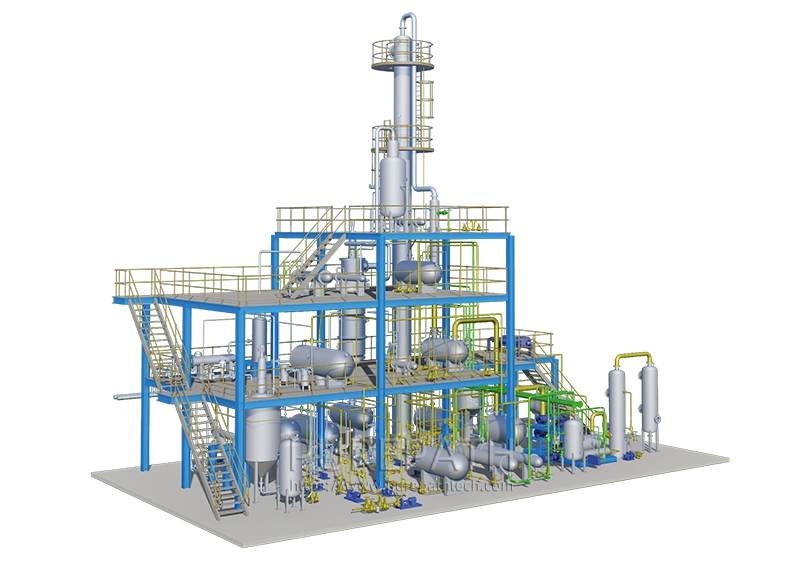
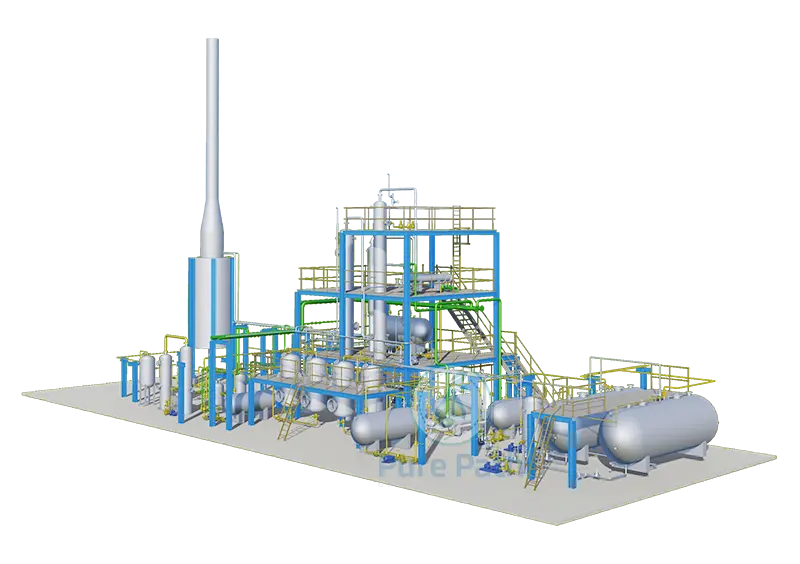
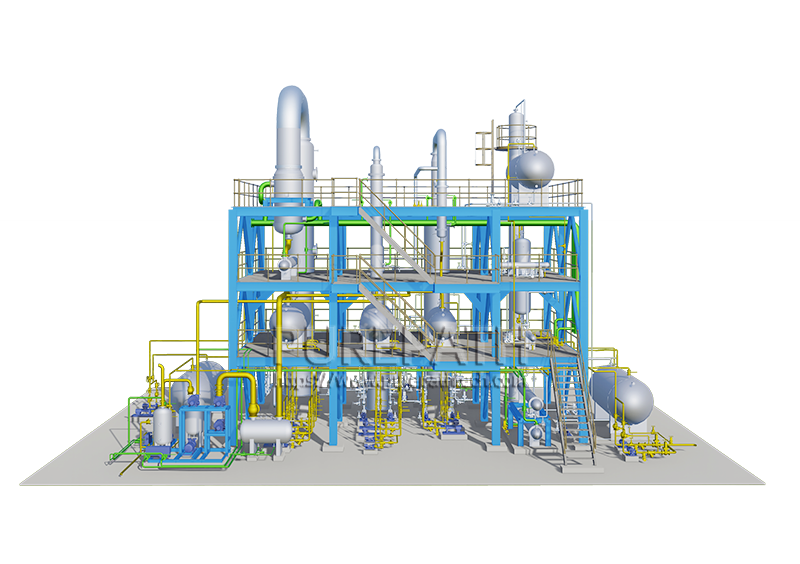
The waste oil re-refining process design at PurePath will emphasise oil recovery and the quality and consistency of the final product. Depending on the feedstock, target base oil specifications, and capacities of the plant, different combinations of dehydration, distillation, filtration, and post-treatment equipment may be needed.
Our engineering solutions include:
- Waste Oil to Base Oil Plant: Integrated process configurations for converting used lubricating oil into recovered base oil.
- Base Oil Solvent Extraction Plant: Post-treatment solutions designed around the separation of undesirable oil components.
- Lube Oil Blending Plant: Equipment for blending base oils and selected additives according to finished lubricant requirements.
The appropriate equipment configuration depends on the actual source of cloudiness and the required product specifications. A single filtration or dehydration unit cannot solve every type of cloudiness problem. Process evaluation should come before equipment selection.
Explore our Waste Oil Recycling Plant solutions to learn more about industrial waste oil re-refining systems.
Frequently Asked Questions
Q1: What causes the re-refined base oil to cloud at low temperature?
When the oil is cooled, components that have a higher melting point (wax, etc.) may crystallise out of the oil and form fine particles that scatter light. Controlled cooling/heating may verify this.
Q2: Can the water contamination cause the re-refined base oil to appear milky?
Yes. Fine oil dispersion in milk. A Karl Fischer titration will tell you if there are significant quantities of water.
Q3: Does cloudiness in the base oil mean the oil is poorly refined?
It is not necessarily so. The cloudy appearance may be due to air, particles, precipitation, or water suspended in the fluid. Determine the cause before evaluating the overall product quality.
Q4: What should a waste oil re-refining plant do to ensure the finished base oil lacks cloudiness?
Proper dehydration, cooling, filtration, and product transfer are necessary for the plant. Procedures are specific to the cause of clouding and to base oil standards.