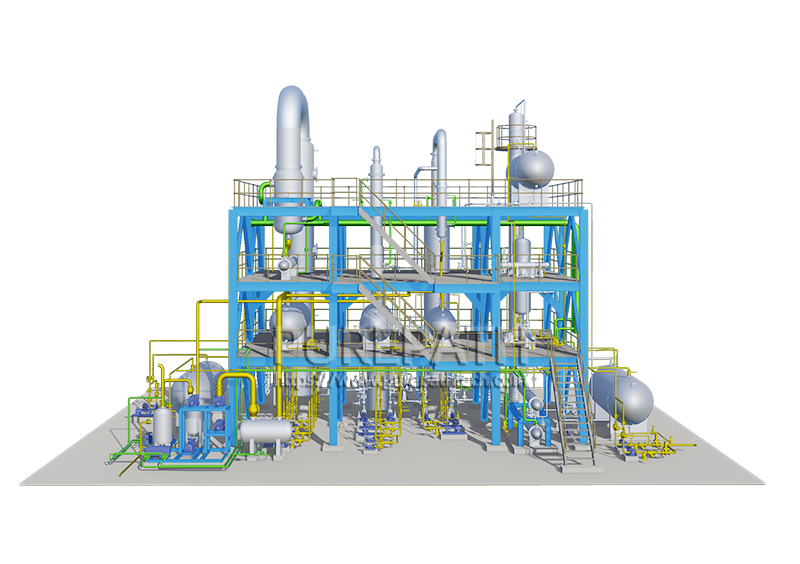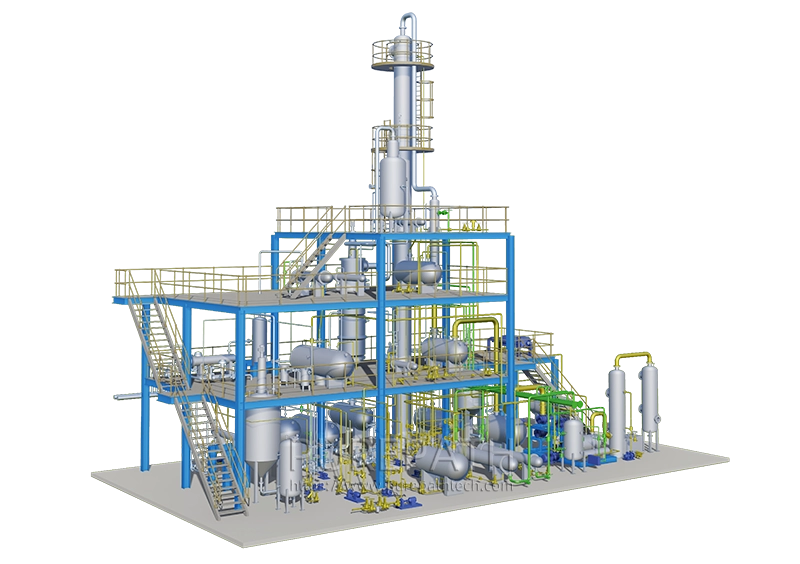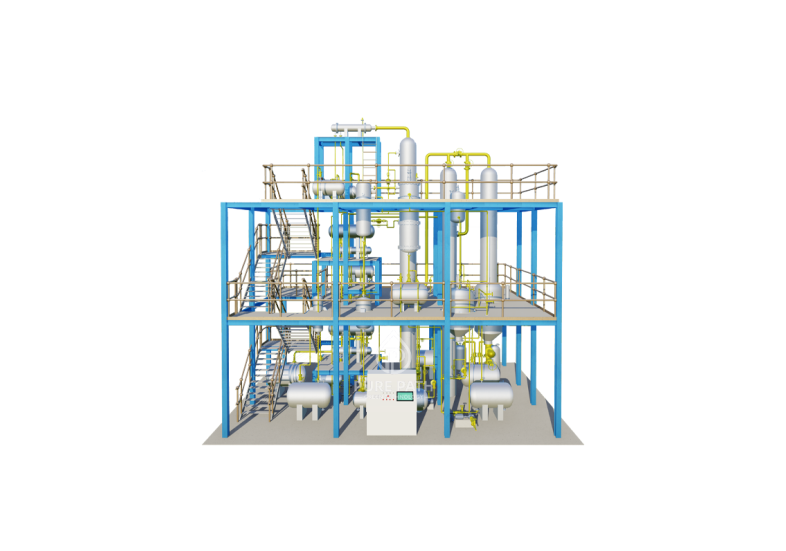

Why a Solvent Extraction Plant is the Real Deal for Transforming Black Waste Oil into Gold
Written By: Mr.Ran
Senior Petrochemical & Waste Oil Recycling Engineer
Deeply involved in the design, manufacturing, and optimization of various waste oil recycling and petrochemical equipment, delivering practical and efficient solutions for clients worldwide.
Look, if you have been running a waste oil recycling plant or managing a lube oil purification system for as long as I have, you already know the hard truth. The waste oil recycling business is getting tougher every single day. Environmental agencies are breathing down your neck, and buyers are rejecting base oil if it looks slightly dark or smells funky. If your recycled product looks like low-grade sludge, you cannot command premium prices. You are stuck at the bottom of the food chain. To survive and actually thrive today, you need a high-performance solvent extraction plant. There is no way around it.
For decades, folks in our industry relied on acid-clay treatment or straight-up thermal distillation. Let us be honest: acid-clay produces an environmental nightmare of acid sludge that nobody wants to touch, and basic distillation often leaves you with oil that turns dark again within weeks due to unstable compounds. That is where a modern solvent extraction plant changes the whole game. It solves the color and stability problem at a molecular level, allowing you to produce water-white or light straw-colored group I and group II base oils that buyers actually fight over.
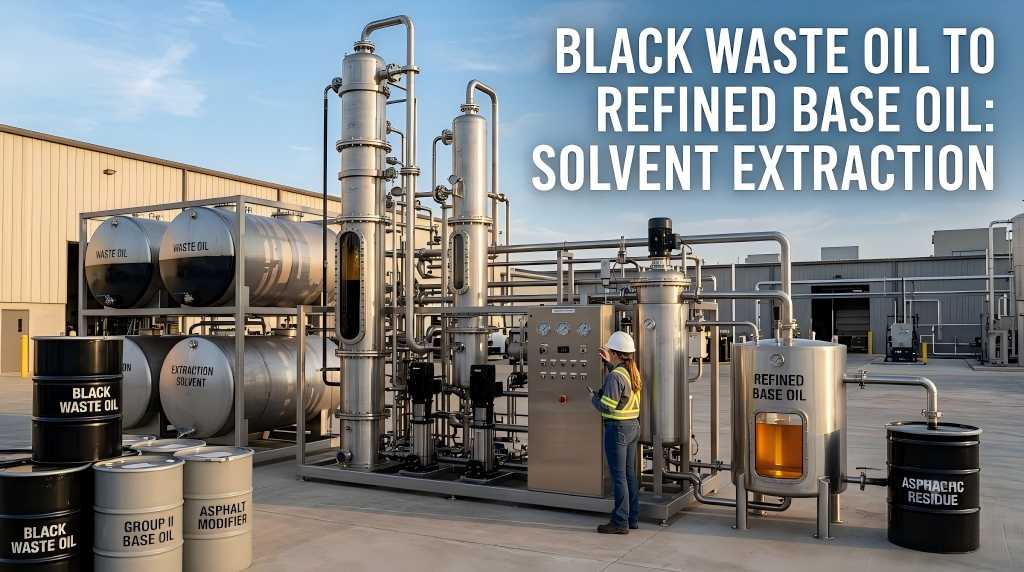
The Real Reason Used Motor Oil Turns Black
Before discussing how a solvent extraction plant works, we must break down why used motor oil becomes highly contaminated and dark in the first place.
While fresh lubrication oil enters an internal combustion engine or heavy industrial machinery as a clean, amber, and smooth fluid, mechanical systems present brutal environments. High temperatures and extreme pressures trigger a series of chemical and physical degradation processes.
1. The main pollutants that cause colour fading
Used oil is pitch black in color due to a highly stable colloidal suspension of several different sub-micron contaminants:
- Thermal Cracking & Severe Oxidation: In the presence of intense heat, hydrocarbons break down to form heavy polycyclic aromatic hydrocarbons (PAHs), reactive gums, and complex asphaltic compounds. These oxidized molecules are naturally dark brown or black as pitch.
- Carbon Soot Accumulation: Sub-micron carbon soot particles are blown directly into the oil sump by blow-by gases from incomplete fuel combustion.
- Metallic Wear Debris: Small metal particles that flake off pistons, bearings, and other moving parts and suspend in the oil matrix.
- Degraded Additive Packages: Depleted detergents, dispersants, and other spent chemical additives lose effectiveness and degrade in the mixture.
2. Why Normal Physical Filtration Doesn’t Work
This darkening is a deep chemical issue, not a surface cosmetic one:
- High Polarity: Asphaltic compounds and carbon soot particles are highly polar, which makes them bond with and trap heavy metals and harmful polycyclic structures.
- Particle Size Limitations: Standard mechanical filters or high-speed centrifuges will only catch large dirt particles and big metal chunks when running this contaminated oil.
- Molecular Stabilization: Physical filtration cannot remove sub-micron soot and dissolved chemical contaminants. The oil stays black because these dark, oxidized molecules are completely dissolved and stabilized in the liquid hydrocarbon matrix.
How a Solvent Extraction Plant Rescues the Base Oil
This is exactly where a dedicated solvent extraction plant comes into play. Instead of attempting to filter out microscopic particles or using harsh chemical treatments that destroy the oil molecules, this system relies on a non-destructive physical separation method.
1. The Core Principle: Selective Liquid-Liquid Extraction
- The Method: The system introduces a specialized extraction solvent into the pre-treated waste oil to separate components based on their chemical properties rather than their particle size.
- Common Industrial Solvents: The most frequent solvents deployed in a solvent extraction plant include furfural, phenol, N-methylpyrrolidone (NMP), or specialized proprietary green solvent formulations.
2. The Power of Chemical Affinity
The efficiency of a solvent extraction plant lies entirely in the selective affinity of the chosen solvent, which behaves differently toward the two main groups of molecules in the waste oil:
- High Affinity for Contaminants: The solvent is highly polar or specifically structured to easily dissolve and lock in undesirable components, including:
- Polycyclic aromatic hydrocarbons (PAHs)
- Asphaltic materials and oxidized resins
- Sulfur-nitrogen compounds and polar carbon soot
- Zero Affinity for High-Quality Base Oil: Conversely, the solvent has almost no affinity for saturated hydrocarbons. It completely rejects the highly valuable, clean paraffinic and naphthenic molecules that make up the core of high-quality lubricating base oil.
3. The Extraction Process and Molecular Preservation
When the waste oil and solvent are blended inside the extraction columns of the solvent extraction plant, the physical separation yields two distinct outcomes:
- Targeted Contaminant Removal: The solvent selectively pulls all the black, sticky, and chemically unstable contaminants out of the oil phase and traps them tightly within the solvent phase.
- Intact Molecular Integrity: The clean base oil molecules are left behind completely untouched and undamaged. Because this is a physical extraction rather than a harsh chemical reaction, the original molecular structure of your primary base oil remains perfectly intact—fully preserving its natural viscosity index and lubricating properties.
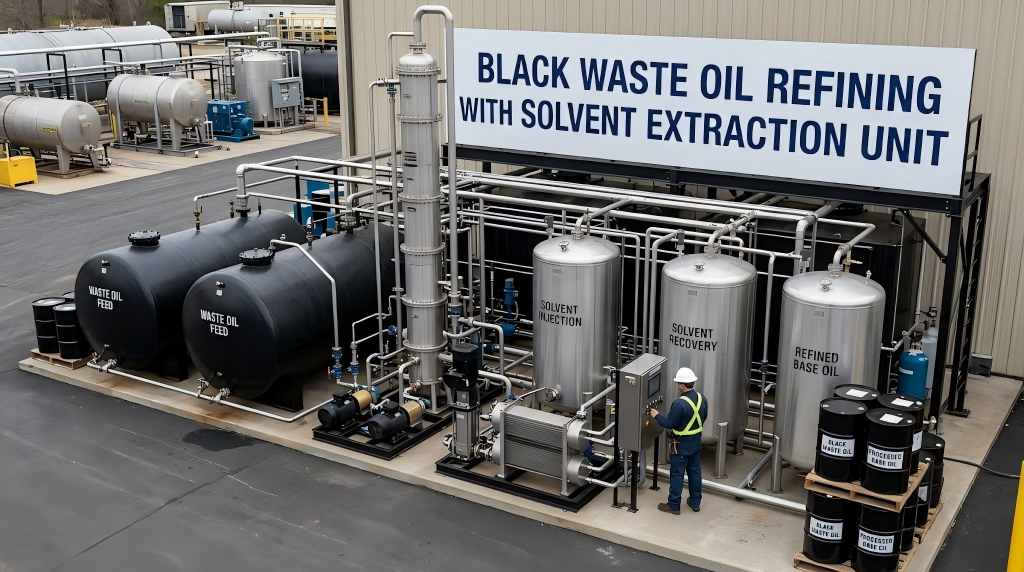
The 3-Step Industrial Process within the Plant
If you visit a well-designed solvent extraction plant, the whole operating flow can be split up into three major, continuous stages. This sequence is crucial if you want to optimize your daily yields and manage your utility costs efficiently.
Step One: High Intensity Mixing and Extraction
The feedstock, typically dehydrated and lightly distilled waste oil, is continuously pumped into a special liquid-liquid extraction column. The extraction solvent is also injected, often in a counter-current flow pattern to maximize interfacial contact. Within the column, mechanical agitators or structured packing elements cause the two immiscible liquids to mix well. This gives a huge surface area for the mass transfer. The solvent scrubs the black contaminants out of the oil droplets with maximum efficiency.
Phase Two: Settling and Phase Separation
After mixing, the emulsion is led into a quiescent settling zone or into a series of industrial decanters. The solvent phase is much denser than the hydrocarbon phase, causing the mixture to split into two distinct layers. The upper layer is the raffinate phase. In a lube oil refining solvent extraction plant, the raffinate phase is the clean, purified base oil with a very small trace of dissolved solvent. The bottom layer is the extract phase, a heavy, dark mixture that contains most of the solvent and all the concentrated asphaltic sludges, polycyclic aromatics, carbon soot, and heavy metals.
Phase Three: Solvent Recovery (Closed Loop)
Expensive solvents can’t be wasted. Therefore, a modern solvent extraction plant must have a highly efficient closed-loop recovery system. The top raffinate stream and the bottom extract stream are sent to separate distillation towers or vacuum flash evaporators. The boiling point of the solvent is much lower than the boiling point of the heavy base oil and the asphaltic residue, so it is quickly vaporized, condensed, and pumped right back to the fresh solvent storage tanks for immediate reuse.
The top recovery line provides a beautiful, clear, golden-colored base oil that meets the most stringent API Group I or Group II technical specifications. From the bottom recovery line, you get a thick, black, high viscosity residue. This residue can be sold directly as an asphalt modifier, a waterproofing agent, or a low-grade industrial fuel blend, thus making your plant truly zero-waste in its operational profile.
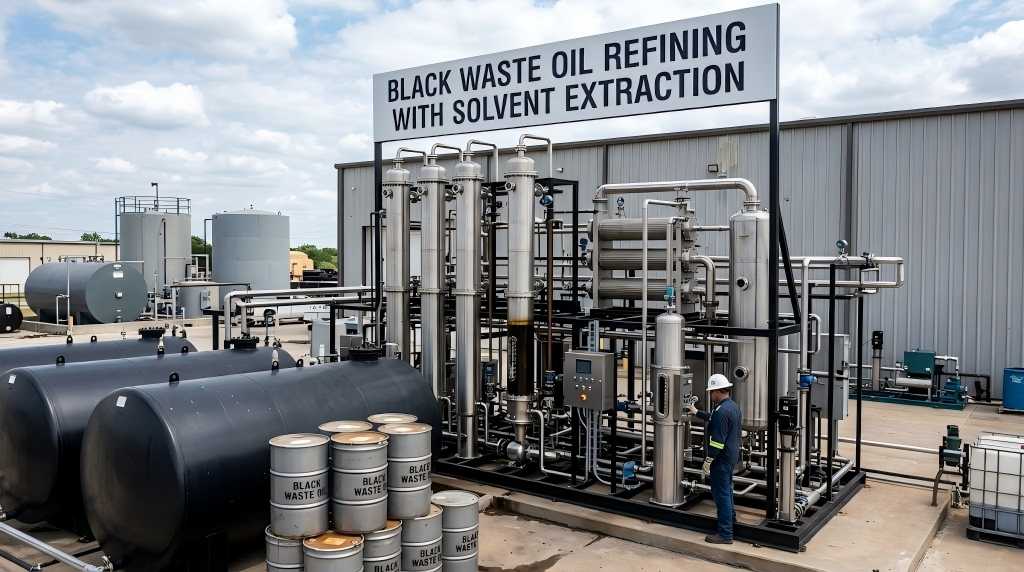
Key Pitfalls to Avoid When Purchasing Equipment
If you are currently looking at a solvent extraction plant for sale, do not just buy the cheapest option on the market. I have seen plenty of operators go broke because they bought poorly designed hardware from unverified manufacturers. Here is what you need to look for during your technical evaluation:
- Guaranteed Solvent Loss Rates: Every manufacturer will claim their system is efficient. You need to look at the engineering blueprints of the vacuum flash distillation towers. If the plant cannot consistently recover more than 99% of the solvent during continuous operation, the ongoing cost of purchasing replacement solvents will slowly eat away all your profit margins.
- Material Construction Quality: The mixture of high temperatures and particular industrial solvents can be hard on regular carbon steel. Extraction columns, mixing impellers, and heat exchangers must be made of high-quality stainless steel (e.g. 316L) to avoid early corrosion and expensive mechanical breakdowns.
- Explosion-Proof Safety Standards: Most industrial solvents consist of volatile organic compounds with specific flashpoints. A reliable solvent extraction plant has to be built with all-around explosion-proof engineering with ATEX or IECEx certified motors, intrinsically safe instrumentation, and rugged automated emergency shutdown valves. Never sacrifice safety to save a few dollars on capital spending.
Bottom line, numbers don’t lie. If you want to stop selling cheap black fuel oil and start producing premium, high-margin base oils, the single best investment you can make in your waste oil recycling business is a modern solvent extraction plant. It cleans up the colour, stabilizes the chemistry and secures your long term position in a very competitive market.