
What Determines Diesel Quality in Waste Oil To Diesel Systems?
Written By: Mr.Ran
Senior Petrochemical & Waste Oil Recycling Engineer
Deeply involved in the design, manufacturing, and optimization of various waste oil recycling and petrochemical equipment, delivering practical and efficient solutions for clients worldwide.
In waste oil to diesel projects, diesel quality is the real benchmark for success. You can have stable operation and decent throughput, but if the final diesel doesn’t meet the market or usage requirements, the project will be hard to keep profitable.
Many of them think diesel quality is mainly about feedstock. The fact: It’s the result of several connected decisions across the whole system, from pretreatment to reaction control and on to final polishing.
Feedstock Quality Sets the Upper Limit
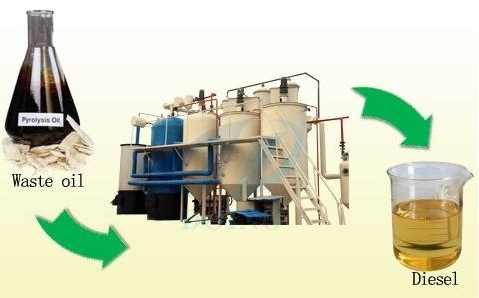
The quality of the diesel fuel cannot ever be any better than the source material will allow. This is the beginning premise, irrespective of whether the waste oil refinery plant is designed to handle used engine oil, industrial waste oil, or mixed waste oil.
High water content, sludge, metals, and additives will have a direct influence on stability and cleanliness. In other words, a system may be well-designed, but improper feedstock will cause darkness, instability, and/or increased sulfur and residue.
This doesn’t mean waste oil must be “clean,” but it does mean the feedstock range must match what the system is designed to handle. There are stable diesel runs that most often operate at specific limits.
Pre-Treatment Creates Stable Conditions for Conversion
The pre-treatment process serves to eliminate disruptive elements that harm diesel production operations.
When water and solids are properly removed before heating, the reaction environment becomes much easier to control. Temperature stays stable, cracking behavior becomes more uniform, and the diesel fraction forms more consistently.
Plants that attempt to skip or eliminate pre-treatment procedures may require the use of higher temperatures and make continuous changes to their operation parameters, which will result in lower diesel quality.
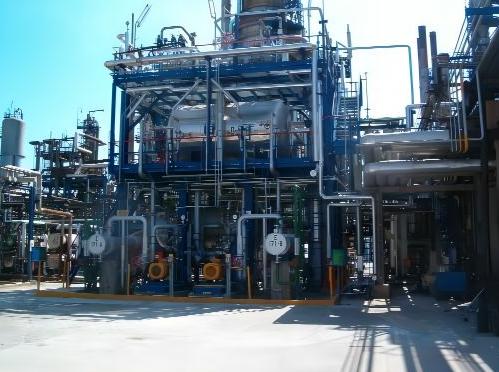
Core Process Design Shapes Diesel Characteristics
The thermal conversion stage is where the quality of diesel is essentially determined. Here, process design plays a more significant role than the terms used for marketing or theoretical explanations.
Stable temperature control and controlled residence time allow the hydrocarbons to crack and reform evenly. When these parameters fluctuate so does the diesel quality. Excessive severity often increases light fractions, while a lack of severity leaves heavy components in the diesel cut”
Systems designed for stable heat transfer and controlled reaction zones tend to produce diesel with greater uniformity in density, flash point, and combustion behavior over time.
Separation Control Directly Affects Diesel Usability
The definition of diesel fuel extends beyond its production methods to include its methods of separation. Diesel fails to meet practical usage expectations because fraction control systems experience operational difficulties, which represent one of their most frequent failure points.
Actual operations experience separation issues, which demonstrate themselves through the following problems:
- The presence of excessive light ends results in decreased flash point, whereas
- The production of heavy residues increases the material’s viscosity and
- The combination of different fractions creates both odor problems and instability during storage
Good separation doesn’t require extreme complexity, but it does require accuracy. The diesel cut maintenance at stable levels enables smoother downstream processes for blending and usage. Most quality problems that people attribute to “process technology” actually stem from issues related to separation.
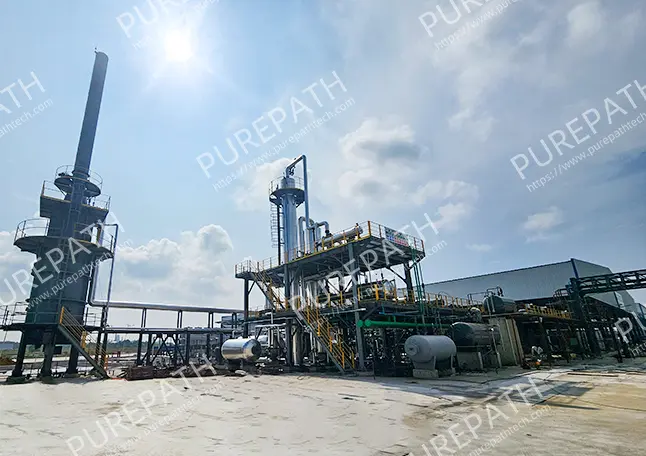
Post-Treatment Defines Whether Diesel Is Usable
The diesel fuel requires additional treatment after conversion and separation processes because it does not meet practical usage requirements.
This stage usually focuses on removing fine solids, stabilizing the fuel, and improving appearance and smell. The process does not alter the fundamental chemical components, yet it determines whether users and blending partners will accept the diesel product.
Diesel projects that eliminate post-treatment processes to save money during the initial development phase will discover that their product appears acceptable at the facility but creates market-related delays after showing its actual appearance.
Operation Discipline Keeps Quality From Drifting

Diesel quality is not static. A plant that produces good diesel today can drift out of range if operation becomes inconsistent.
Feedstock changes, rushed throughput increases, irregular shutdowns, and delayed maintenance all show up first in diesel quality. Over time, these small deviations will accumulate and finally turn into visible instability.
Plants designed with reasonable operating margins help, but disciplined operation is still vital for long-term consistency.