
Vacuum Distillation vs Thin Film Evaporation for Used Oil Re-Refining
Written By: Mr.Ran
Senior Petrochemical & Waste Oil Recycling Engineer
Deeply involved in the design, manufacturing, and optimization of various waste oil recycling and petrochemical equipment, delivering practical and efficient solutions for clients worldwide.
Choosing the right separation technology is critical when designing a waste oil recycling plant. Vacuum distillation and thin film evaporation can both separate valuable oil fractions from used lubricating oil, but they are designed for different processing requirements. Vacuum distillation is generally suited to bulk fractionation, while thin film evaporation offers greater control when processing high-boiling or thermally sensitive fractions.
The better choice depends on more than equipment specifications. Feedstock characteristics, processing capacity, target base oil quality, thermal exposure, heavy-fraction recovery, maintenance requirements, and project economics should all be evaluated before selecting a used oil refining technology. In many industrial applications, vacuum distillation and thin film evaporation can also work together rather than serve as competing alternatives.
Vacuum Distillation vs Thin Film Evaporation: What Is the Difference?
The main difference between vacuum distillation and thin film evaporation is their role in the separation process.
Vacuum distillation is primarily used for bulk fractionation. It separates used oil into fractions according to differences in volatility under reduced pressure and is well suited to processing relatively large volumes.
Thin film evaporation is a more specialized evaporation technology. It spreads the feed into a thin liquid film over a heated surface, allowing efficient heat transfer and short thermal exposure. It is particularly useful when high-boiling or thermally sensitive fractions need to be processed under controlled conditions.
In simple terms: Vacuum distillation is generally suited to bulk fractionation, while thin film evaporation is better suited to controlled separation of difficult high-boiling fractions.
Neither technology is universally better. The appropriate choice depends on the feedstock, product target, plant capacity, and overall refining configuration.
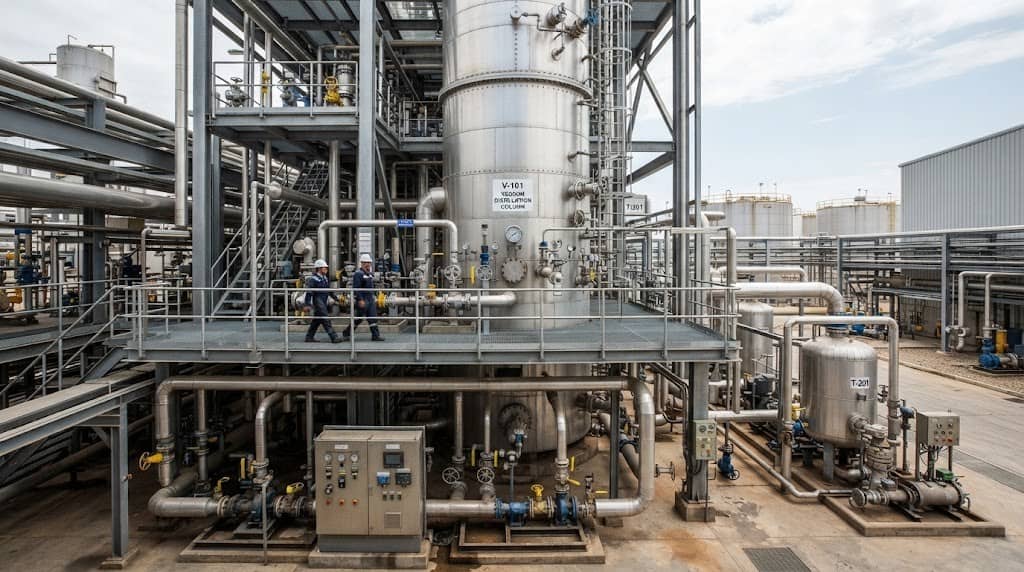
Different Roles of Vacuum Distillation and Thin Film Evaporation
Understanding the role of each technology is more useful than comparing them only by operating parameters.
What Is Vacuum Distillation Best Suited For?
In a waste oil to base oil plant, vacuum distillation is commonly used for primary or bulk fractionation. Its main advantages include:
- Processing relatively large liquid volumes
- Separating fractions according to boiling range
- Handling continuous industrial throughput
- Providing a practical basis for large-scale process design
- Integrating with upstream pretreatment and downstream refining
- Offering relatively straightforward equipment scaling
Vacuum distillation is therefore attractive when the primary requirement is to establish major oil fractions before additional purification or finishing.
Its actual performance depends on equipment design, heat-transfer characteristics, operating conditions, feed properties, and residence time. For this reason, selecting a vacuum distillation plant should involve more than comparing nominal vacuum or temperature specifications.
What Is Thin Film Evaporation Best Suited For?
Thin film evaporation is particularly useful when the process must handle high-boiling, viscous, or thermally sensitive fractions.
The feed is distributed as a thin layer across a heated surface, providing efficient heat transfer while limiting the time the material remains exposed to elevated temperatures. Potential advantages include:
- Short thermal exposure
- Efficient heat transfer
- Controlled evaporation of high-boiling fractions
- Better handling of viscous material
- Potentially improved recovery of valuable heavy oil components
- Greater control over difficult separation stages
This makes a thin film evaporator for waste oil particularly relevant when conventional bulk fractionation cannot provide the desired combination of recovery and thermal control.
Are Vacuum Distillation and Thin Film Evaporation Direct Substitutes?
Not necessarily. One of the most important considerations in used oil re-refining technology is that these systems can perform complementary functions.
A plant may use vacuum distillation for bulk separation and thin film evaporation for a selected heavy fraction. A simplified configuration could therefore be:
Used Oil → Pretreatment → Vacuum Distillation → Thin Film Evaporation → Base Oil Fractions → Finishing Treatment
The exact configuration should be determined by feedstock analysis, target product specifications, plant capacity, and economic evaluation.
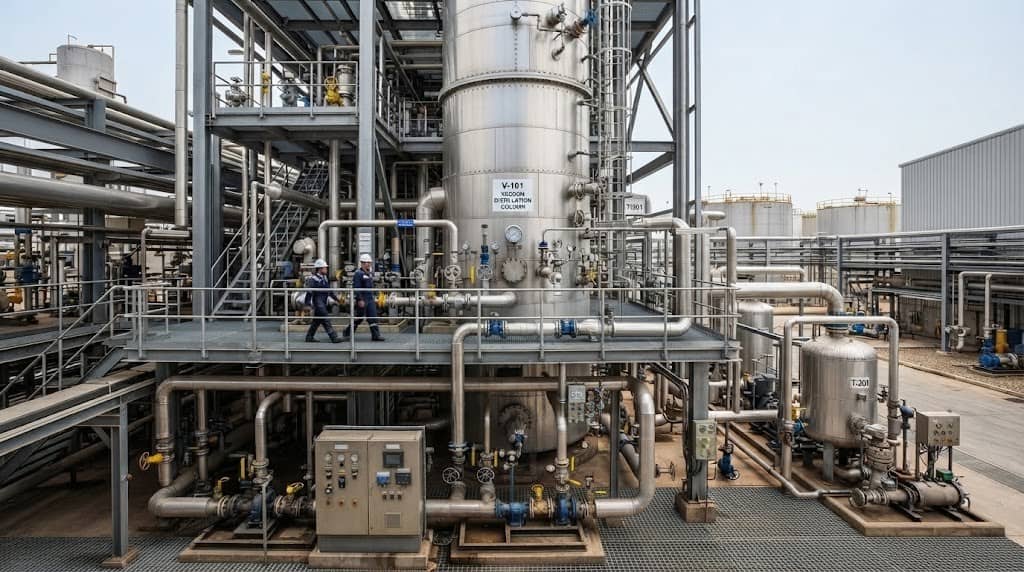
Vacuum Distillation vs Thin Film Evaporation: Key Engineering Differences
The following comparison summarizes the most important differences when evaluating these technologies for used oil refining equipment selection.
| Factor | Vacuum Distillation | Thin Film Evaporation |
| Primary role | Bulk fractionation | Specialized high-boiling separation |
| Feed handling | Large liquid volumes | Specialized or difficult fractions |
| Thermal exposure | Depends on system design and residence time | Generally short thermal exposure |
| Heat transfer | Bulk or indirect heating | Thin-film heat transfer |
| Heavy fraction recovery | Good when properly designed | Strong potential for difficult high-boiling fractions |
| Mechanical complexity | Generally lower | Generally higher |
| Maintenance | Relatively straightforward | More specialized |
| Process flexibility | Broad bulk separation | Specialized separation |
| Industrial application | Primary fractionation | Difficult or high-value fraction separation |
| Typical role in a plant | Main separation stage | Selected downstream separation stage |
The comparison shows why choosing a technology based only on purchase price or vacuum level can be misleading.
The correct question is: Which technology provides the required separation performance at an acceptable total project cost?
How Feedstock Characteristics Affect Technology Selection
The type and condition of the used oil should be evaluated before selecting a waste oil re-refining technology. Feedstock testing and preparation should therefore be completed before final process selection. See our guide to feedstock quality requirements for waste oil re-refining for the key parameters that should be evaluated before selecting refining technology.
Different used oil streams can have substantially different physical and chemical characteristics. The most appropriate separation configuration therefore depends on the actual feed rather than its general classification.
1. Relatively Consistent Used Lubricating Oil
If the feedstock has relatively predictable characteristics and has undergone appropriate pretreatment, vacuum distillation can provide an effective bulk fractionation stage.
Typical characteristics may include:
- Consistent feed composition
- Manageable water content after pretreatment
- Limited suspended solids
- Predictable boiling characteristics
- Stable feed supply
For these conditions, a conventional vacuum-based configuration may provide a good balance between processing capability, equipment complexity, and project cost. Adding thin film evaporation should be justified by a specific separation requirement rather than simply because it is a more specialized technology.
2. Heavy or Highly Degraded Used Oil
Highly degraded used oil can contain significant amounts of heavy hydrocarbons, degraded additives, oxidation products, and non-volatile residues. The process challenge is not simply removing heavy material. Some high-boiling components may still have commercial value and need to be recovered without unnecessary thermal exposure.
This is one situation where thin film evaporation may provide additional value. Its controlled film-based evaporation can be useful when the process needs to recover valuable high-boiling components while managing thermal exposure.
3. Used Oil with High Additive and Residue Content
The concentration of non-volatile material can also influence equipment selection. The process designer should evaluate:
- Feed viscosity
- Heavy fraction characteristics
- Residue concentration
- Heat-transfer requirements
- Expected product recovery
- Downstream treatment requirements
The objective is not to maximize evaporation at any cost. The objective is to separate valuable oil components from unwanted material efficiently and consistently.
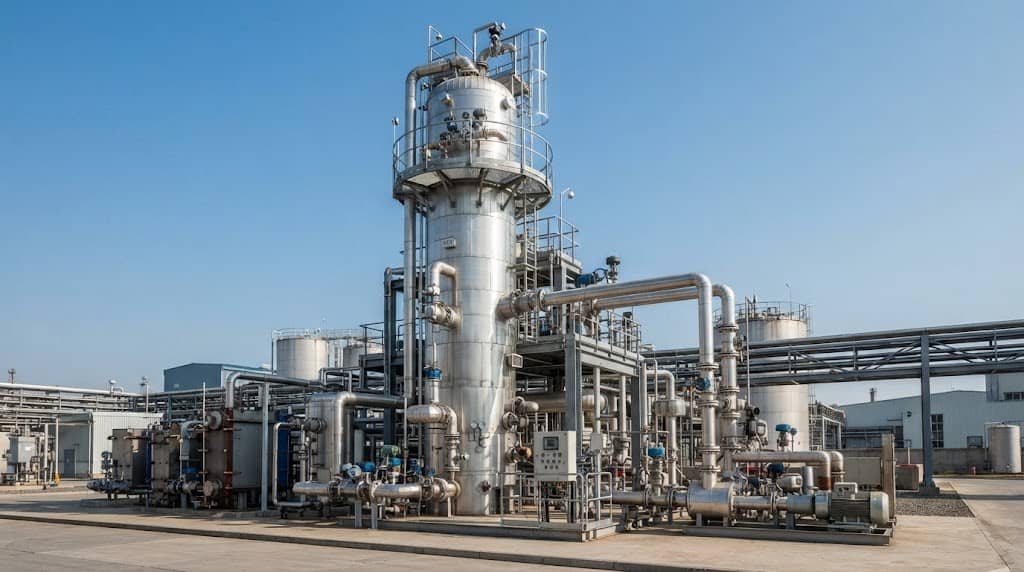
How Plant Capacity and Product Targets Affect the Choice
There is no universal best thin film evaporator or best vacuum distillation system for every project. Plant economics and product requirements must be considered together.
1. Small and Medium-Capacity Plants
For smaller projects, equipment simplicity can have significant value. Important considerations include:
- Initial capital investment
- Ease of operation
- Maintenance accessibility
- Operator requirements
- Feedstock flexibility
- Energy consumption
- Availability of spare parts
If the target product can be achieved through vacuum fractionation followed by suitable downstream treatment, a more complex thin-film system may not necessarily improve overall project economics.
2. Large-Scale Continuous Plants
Large used oil recycling plants generally place greater emphasis on:
- Continuous throughput
- Process stability
- Automation
- Heat integration
- Fraction consistency
- Equipment availability
- Long operating cycles
- Scalability
At this scale, different technologies may be combined so that each performs a specific separation function. However, high capacity alone does not automatically justify thin film evaporation. The feedstock and product specifications remain equally important.
3. Product Specification Matters
Technology selection should begin with the desired product rather than the equipment. For example, a plant producing standard re-refined base oil may require a different separation strategy from a plant targeting tighter product specifications.
The process should therefore be evaluated as an integrated system:
Feedstock → Separation → Purification → Finishing → Final Product
When higher-quality Group I+ base oil is required, downstream base oil solvent extraction can be considered as a separate upgrading stage rather than expecting distillation alone to achieve every product specification.
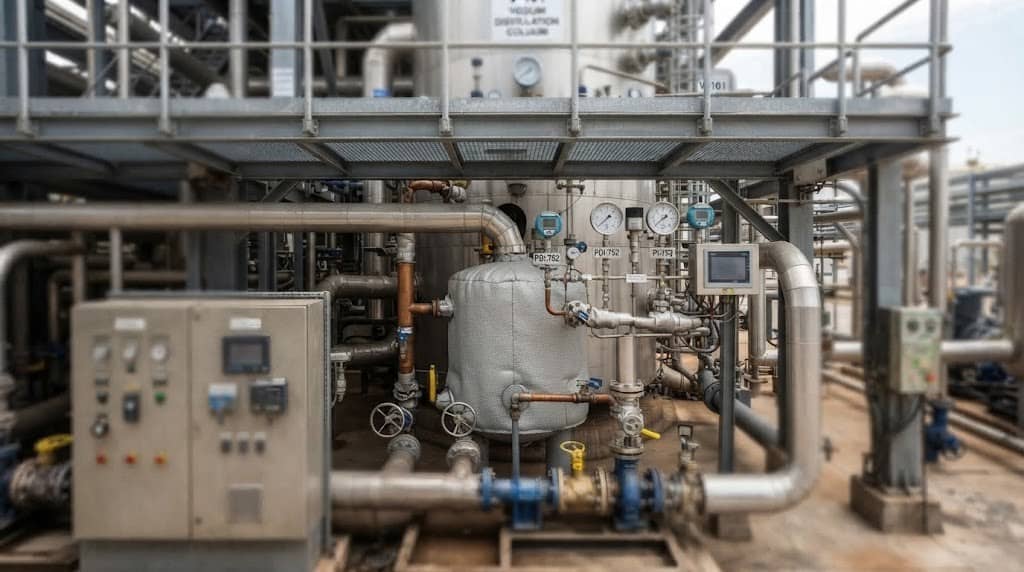
When Is Thin Film Evaporation Worth the Additional Complexity?
Thin film evaporation can provide valuable technical advantages, but those advantages must justify its additional capital and operating requirements.
1. High-Boiling Fraction Recovery
If valuable lubricating components remain in a high-boiling fraction, improved recovery may have a direct impact on product output and project economics. Thin film evaporation can be considered when recovery of these components is a significant project objective.
2. Thermal Exposure Is a Concern
When high-boiling material must be evaporated without prolonged exposure to elevated temperatures, thin film technology may provide an advantage. Its short liquid residence time characteristics can help reduce unnecessary thermal exposure.
3. The Recovered Product Has Commercial Value
Additional recovery is useful only when the recovered material can become a valuable product or feedstock.
Therefore, project evaluation should compare additional recovery value against additional equipment + energy + maintenance costs
4. The Feedstock Is Difficult to Process
Viscous or heavy fractions may benefit from specialized thin-film evaporation because efficient heat transfer becomes increasingly important as the separation becomes more demanding.
5. Product Specifications Are More Demanding
A more controlled separation stage may be useful when product specifications require tighter control over fractionation. However, thin film evaporation does not replace every downstream refining technology. Chemical impurities may require additional purification or finishing steps.
6. The Additional CAPEX Can Be Justified
The decision should ultimately be based on lifecycle economics rather than equipment price alone.
Consider CAPEX + OPEX + Maintenance versus Additional Recovery + Product Value + Process Flexibility + Quality Benefits
If the additional value generated by thin film evaporation does not offset its added cost, a simpler configuration may be the better investment.
When Can Vacuum Distillation Be the Better Choice?
Vacuum distillation remains an effective solution for many used oil re-refining plants. It may be preferable when:
- The feedstock is relatively predictable
- Bulk fractionation is the primary requirement
- Large volumes must be processed
- Product specifications can be achieved with downstream treatment
- A simpler mechanical configuration is preferred
- Maintenance simplicity is important
- Additional heavy-fraction recovery has limited economic value
- The project prioritizes straightforward scale-up
A common mistake is to assume that a more sophisticated technology is automatically better. For many projects, a properly designed vacuum distillation system can provide the required performance without adding unnecessary mechanical complexity.
The best used oil refining equipment is therefore not necessarily the most advanced equipment. It is the equipment that meets the actual technical and economic requirements of the project.
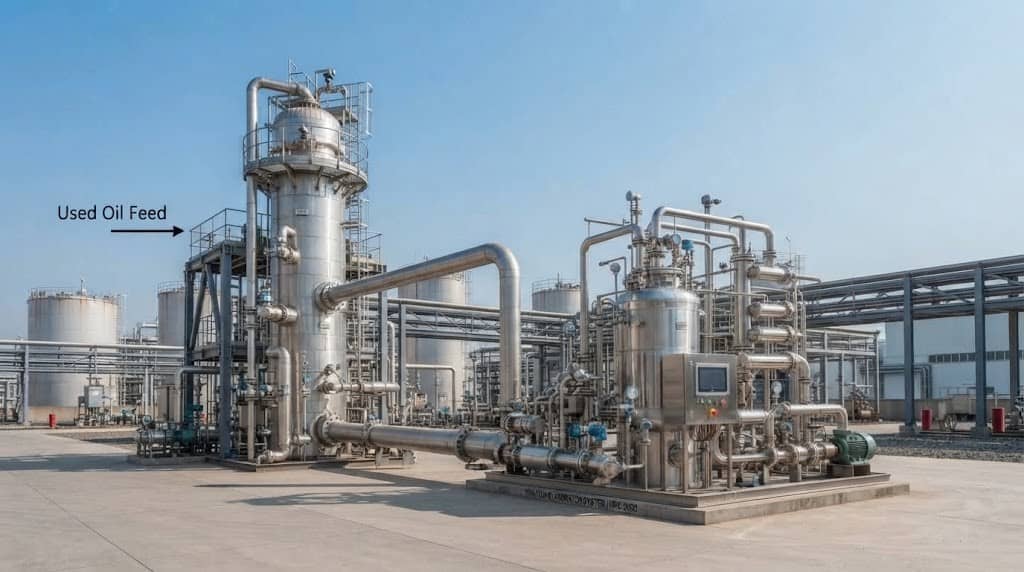
When Does a Vacuum Distillation + Thin Film Evaporation System Make Sense?
For more demanding applications, combining the two technologies can provide a practical solution. A conceptual process configuration may include:
Used Lubricating Oil
↓
Pretreatment
↓
Vacuum Distillation / Bulk Fractionation
↓
Thin Film Evaporation of Selected Heavy Fraction
↓
Base Oil Fractions
↓
Solvent Extraction and/or Hydrotreating
↓
Finished Re-Refined Base Oil
The purpose of a hybrid configuration is not simply to add equipment. It is to assign each separation task to the technology that can perform it most effectively.
Why Combine Vacuum Distillation and Thin Film Evaporation?
A hybrid system can potentially provide:
- Efficient bulk fractionation
- Better treatment of difficult high-boiling fractions
- Improved thermal control
- Greater process flexibility
- Better utilization of valuable feed components
- More options for adapting to feedstock variability
The actual configuration should be developed from feedstock testing and process engineering rather than copied from another refinery.
When Is a Hybrid System Unnecessary?
A hybrid system may not be economically justified when:
- Feedstock is relatively simple
- Product specifications are moderate
- Processing capacity is limited
- High-boiling recovery provides little additional value
- A conventional vacuum configuration already meets the required specification
In these cases, adding thin film evaporation may increase capital and maintenance requirements without providing a corresponding commercial benefit.
Practical Decision Framework for Used Oil Re-Refining
The following matrix provides a practical starting point for selecting between vacuum distillation and thin film evaporation.
| Project Requirement | Potentially Suitable Approach |
| Basic bulk fractionation | Vacuum distillation |
| Large-volume primary separation | Vacuum distillation |
| High-boiling fraction recovery | Thin film evaporation |
| Strong concern about thermal exposure | Thin film evaporation |
| Difficult heavy fractions | Thin film or hybrid configuration |
| Simple plant configuration | Vacuum distillation |
| High-value recovery target | Evaluate vacuum + thin film |
| Demanding product specification | Separation + appropriate downstream refining |
| Maximum process flexibility | Hybrid configuration |
| Cost-sensitive project | Evaluate vacuum distillation first |
Before selecting the final used oil recycling equipment, project owners should answer 7 questions:
- What types of used oil will be processed?
- How variable is the feedstock composition?
- What processing capacity is required?
- What base oil products need to be manufactured?
- How important is high-boiling fraction recovery?
- What downstream purification technologies will be used?
- Does thin film evaporation generate enough additional value to justify its cost?
These questions provide a stronger basis for equipment selection than comparing isolated technical specifications.
Common Mistakes When Comparing Vacuum Distillation and Thin Film Evaporation
1. Choosing Only by Equipment Price
The lowest purchase price does not necessarily result in the lowest total cost of ownership. Energy consumption, maintenance, product recovery, equipment lifetime, and operating requirements should also be considered.
2. Assuming Higher Vacuum Means Better Separation
Vacuum level is only one factor affecting separation performance. Equipment configuration, heat transfer, residence time, feed properties, and fractionation design also influence the final result.
3. Comparing Equipment Without Considering Feedstock
A technology that performs well with one used oil stream may not provide the same results with another. Feedstock testing should therefore be completed before final equipment selection.
4. Ignoring Downstream Purification
Distillation primarily separates components according to volatility. It should not be expected to replace every purification or finishing stage. The entire process must be considered when defining the role of each unit. The downstream upgrading route may include solvent extraction and hydrotreating, depending on the required base oil quality, contaminant profile and project economics.
5. Selecting Capacity Before Defining Product Specifications
A better engineering sequence is Feedstock → Product Specification → Process Route → Capacity → Equipment Configuration → Economics
This reduces the risk of over-designing or under-designing the plant.
FAQs
Q1. What is the main difference between vacuum distillation and thin film evaporation?
Vacuum distillation is generally used for bulk fractionation, while thin film evaporation is better suited to controlled separation of high-boiling or thermally sensitive fractions.
Q2. Is thin film evaporation better than vacuum distillation for used oil?
Not necessarily. The better option depends on feedstock, capacity, product specifications, thermal requirements, and project economics.
Q3. Can vacuum distillation and thin film evaporation be used together?
Yes. A hybrid configuration can use vacuum distillation for primary fractionation and thin film evaporation for selected difficult high-boiling fractions.
Q4. When should a used oil refinery use a thin film evaporator?
It is particularly worth evaluating when high-boiling fraction recovery, short thermal exposure, viscous feed handling, or demanding separation requirements are important.