
How to Choose the Right Waste Oil Recycling Process for Your Feedstock
Written By: Mr.Ran
Senior Petrochemical & Waste Oil Recycling Engineer
Deeply involved in the design, manufacturing, and optimization of various waste oil recycling and petrochemical equipment, delivering practical and efficient solutions for clients worldwide.
Choosing the right waste oil recycling process starts with the feedstock, not with a specific machine or refining technology. Used engine oil, hydraulic oil, gear oil, transmission oil and mixed industrial lubricants can behave differently during processing because their composition, contamination profile and consistency vary.
For a commercial waste oil recycling plant, the most suitable process should balance four factors: feedstock characteristics, target product, required product quality and processing capacity. A more complex process is not automatically a better solution.
This guide explains how to match waste oil feedstock with the appropriate process configuration and how to avoid selecting equipment that is either under-designed or unnecessarily complex.
Start with the Waste Oil Feedstock
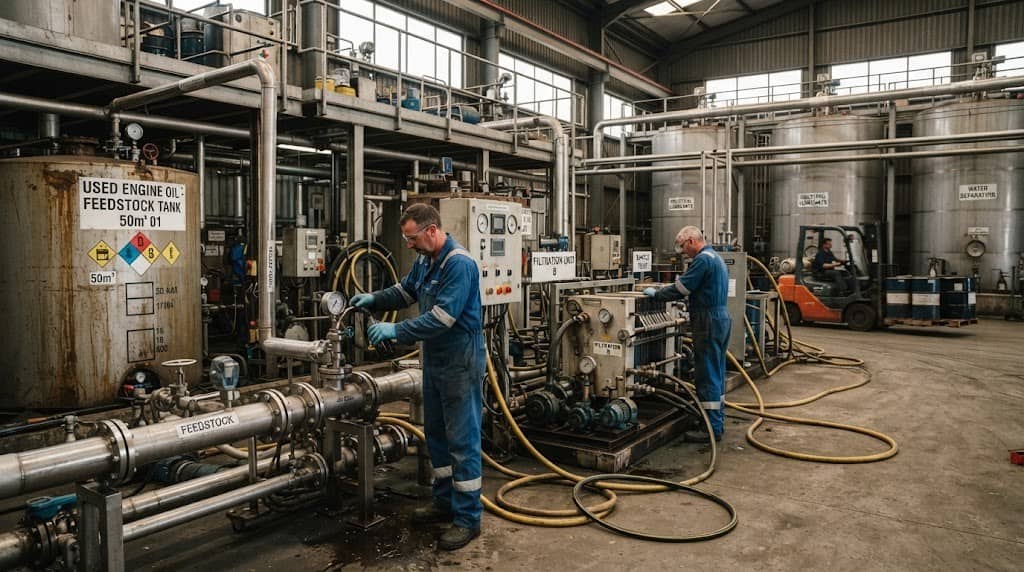
The first question in waste oil process selection should be: What waste oil feedstock will the plant actually process?
Common feedstocks include used engine oil, hydraulic oil, gear oil, transmission oil and mixed industrial lubricants. Each may contain different levels of water, solids, degraded additives, fuel dilution, wear metals and heavy residues.
However, the oil type alone does not determine the process. Feedstock consistency is equally important. A relatively stable waste oil stream allows the plant to operate within a predictable process window. Highly variable mixed waste oil may require greater process flexibility, segregation or blending to maintain stable operation.
Before selecting a recycling process, define:
- The main waste oil sources
- The expected variation between batches
- The major process-relevant contaminants
- The expected annual and daily feed volume
The goal is not simply to determine whether the oil can be recycled. It is to understand how the feedstock will influence process configuration and operating stability.
Match the Feedstock to the Target Product
The desired output should be defined before the final waste oil recycling process is selected. A plant designed to recover fuel fractions may have different requirements from one designed to produce re-refined base oil. A plant producing several controlled fractions may require a different separation configuration.
| Target Product | Main Process Objective | Typical Process Direction |
| Recovered fuel fractions | Separate usable hydrocarbon fractions | Separation and fractionation |
| Lubricant-range base oil | Recover suitable lubricant fractions | Vacuum separation and purification |
| Higher-quality base oil | Improve purity and product stability | Separation plus downstream upgrading |
| Multiple fractions | Control different product ranges | Fractional separation |
| Feedstock-specific products | Adapt processing to feed composition | Customized process configuration |
The important point is that the target product determines the required process performance. For example, a base oil project must focus on the quality and stability of the recovered lubricant-range fraction. A fuel-oriented project may place greater emphasis on fraction separation and fuel specifications.
Therefore, define the finished product first, then determine which process stages are required to produce it consistently.
Determine Which Process Stages Are Actually Required
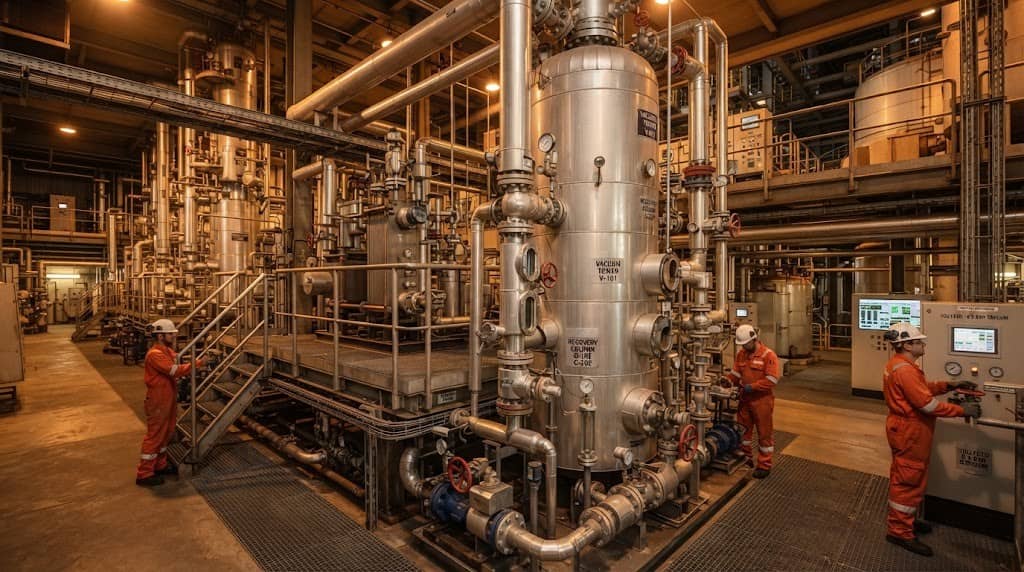
A waste oil recycling plant should be designed as a series of functional stages rather than selected as a single technology. This approach is central to modern used oil re-refining systems.
Depending on the feedstock and target product, the process may include:
- Feed Preparation: Feed preparation may address free water, sediment and coarse solids before the main processing stage.
- Primary Separation: Depending on the feedstock, light components, water or other unwanted fractions may need to be separated before the main oil recovery stage.
- Main Oil Recovery: The primary separation system should be selected according to the feedstock behavior and target product. Vacuum-based and fractional separation can be incorporated where controlled recovery of lubricant-range or other hydrocarbon fractions is required.
- Product Upgrading: Additional purification or upgrading may be required when the recovered fraction must meet tighter product specifications.
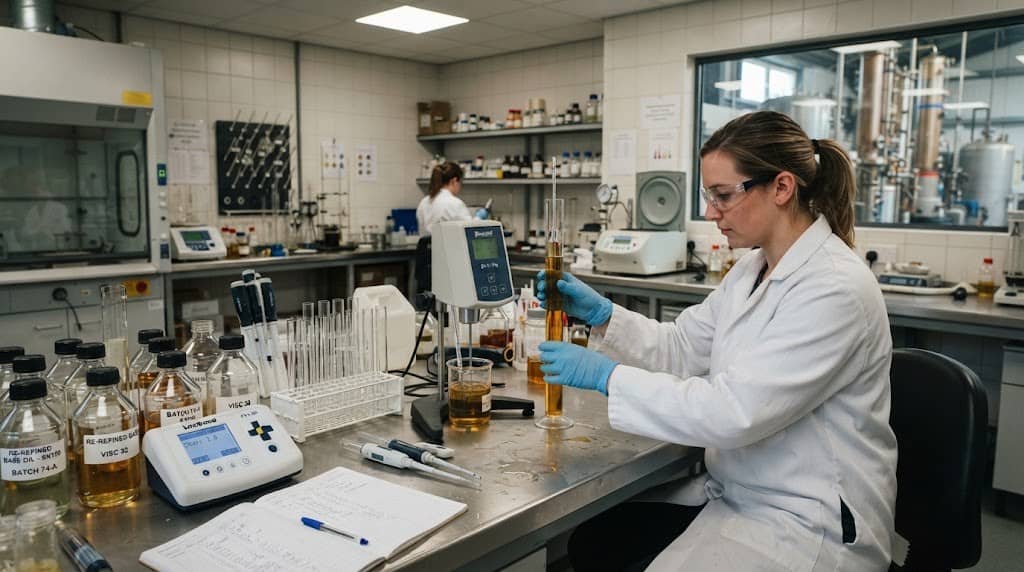
- Final Finishing and Quality Control: The finished product can then be evaluated against relevant parameters such as viscosity, flash point, water, sulfur, color and oxidation stability.
Not every waste oil recycling plant needs every process stage. The correct configuration is the one that provides sufficient treatment to meet the final product requirements without adding unnecessary complexity.
How Feedstock Characteristics Affect Process Selection
The same recycling process cannot necessarily be applied to every waste oil stream without adjustment. Certain feedstock characteristics can directly affect equipment loading, separation performance and product quality.
1. High Water Content
High water content can increase heating requirements and affect vaporization, vacuum stability and condensation. Feedstocks with significant water therefore require appropriate dehydration and water-management capability.
2. High Solids and Sludge
Sediment, soot and insoluble material can increase filter loading, pump wear and heat-transfer fouling. Effective front-end solids removal may be important before the main recovery stage.
3. High Light-End Content
Waste oil containing a significant light fraction may require controlled separation before recovery of the main product range.
4. High Viscosity
High-viscosity feedstock affects pumping, heating and heat transfer. The process should provide sufficient thermal control while avoiding unnecessary thermal stress.
5. Variable Mixed Feedstock
Highly variable feedstock can be more challenging than feedstock with a high level of one specific contaminant. When the composition changes substantially between batches, process conditions may need greater flexibility. Segregation, blending or adjustable operating parameters may help maintain more consistent output.
This leads to an important process-selection principle: Feedstock variability can be as important as feedstock contamination when designing a waste oil recycling system.
Choose the Appropriate Level of Process Complexity
Not every project requires the same level of process integration.
1. Simple Process Configuration
A simpler configuration may be suitable when the feedstock is relatively consistent, the product requirements are moderate and only a limited number of fractions are required. Its main advantages are straightforward operation, lower system complexity and easier maintenance.
2. Integrated Process Configuration
An integrated configuration can be more appropriate for commercial plants handling larger volumes, variable feedstock or multiple product fractions. Multiple process stages can work together to improve separation control and product consistency.
3. Advanced Process Configuration
An advanced configuration may be justified when the final product has tighter specifications, feedstock variability is significant or additional upgrading is required.
The objective should not be to install the most sophisticated used oil recycling technology available. Instead, choose the simplest process configuration that can consistently meet the required product specification.
This approach can help control both capital expenditure and long-term operating complexity.
A Practical Waste Oil Process Selection Workflow
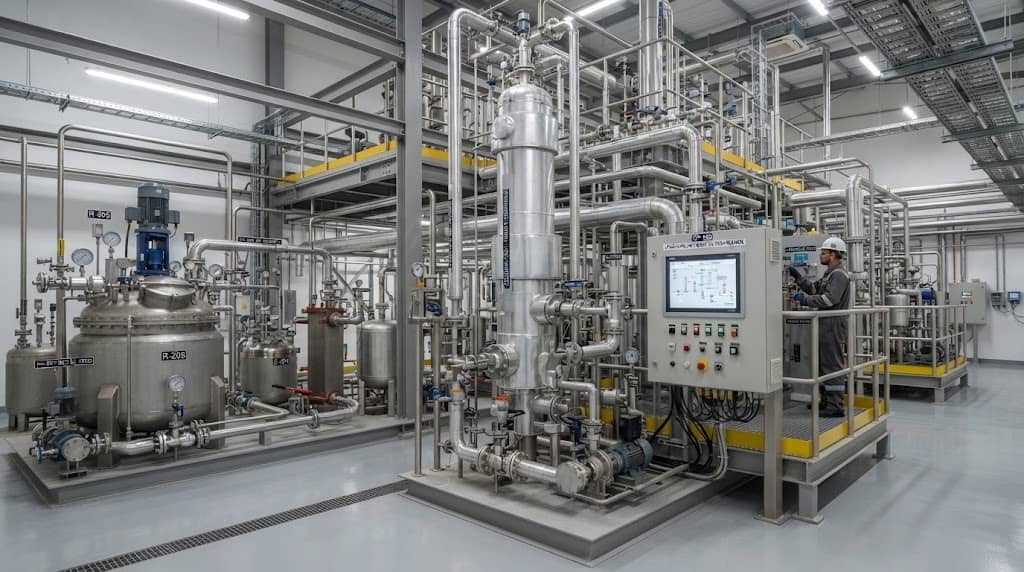
A practical approach to selecting a waste oil recycling process can be summarized in six steps.
Step 1: Define the Feedstock
Identify the primary waste oil sources and determine whether different oil types will be processed separately or together.
Step 2: Assess Feedstock Variability
Determine how much the composition changes between suppliers, batches or seasons.
Step 3: Define the Target Product
Specify whether the plant will produce recovered fuel fractions, base oil, multiple fractions or another defined product.
Step 4: Identify Process-Critical Characteristics
Focus on feed characteristics that can affect separation, equipment loading, operating stability and final product quality.
Step 5: Select the Necessary Process Stages
Build the process around the actual requirements for feed preparation, separation, oil recovery, upgrading and finishing.
Step 6: Validate the Configuration
Use representative feedstock to confirm the proposed configuration, expected throughput and product quality before final equipment selection.
A useful engineering principle is: Right Waste Oil Recycling Process = Feedstock Characteristics + Target Product + Required Quality + Processing Capacity
This approach is more reliable than selecting equipment first and attempting to adapt the feedstock to a predetermined process.
What to Confirm Before Selecting a Waste Oil Recycling Plant
Before requesting a final plant configuration, prepare clear information about the project.
- Feedstock Type and Variability: Specify the main oil sources and whether different waste oils will be mixed.
- Processing Capacity: Define the required daily throughput in TPD (tons per day) and expected operating schedule.
- Target Product: Clearly state whether the project targets recovered fuel, base oil, multiple fractions or another product.
- Product Quality Requirements: Identify the critical specifications that the finished product must meet.
- Representative Feedstock Information: Provide representative feedstock data so the process can be designed around actual material rather than assumptions.
- Utilities and Site Conditions: Consider available electricity, heating requirements, cooling, vacuum utilities, available space and local operating conditions.
- Environmental and Operating Requirements: Local regulations, residue handling and emission-control requirements should also be considered during plant design.
The final waste oil recycling plant should therefore be configured around the actual feedstock and product specification rather than selected from a generic equipment list.
Frequently Asked Questions
Q1: Can different types of waste oil be processed in the same recycling plant?
Yes, but feedstock compatibility and composition variability should be evaluated first. Mixed waste oil may require segregation, blending or a more flexible process configuration.
Q2: Does high water content affect waste oil recycling?
Yes. High water content can increase energy demand and affect heating, vacuum operation and condensation. The required water-removal stage should therefore be considered during process design.
Q3: Should the recycling process be selected before evaluating the feedstock?
No. Representative feedstock information should be available before finalizing the process configuration. The feedstock determines many of the required operating and separation conditions.
Q4: Is a more complex waste oil recycling process always better?
No. Process complexity should be justified by feedstock characteristics and target product specifications. Unnecessary treatment stages can increase capital cost, energy consumption and maintenance requirements.
Q5: Can one waste oil recycling plant produce both fuel and base oil?
Potentially, yes. The feasibility depends on feedstock characteristics, separation requirements, target specifications and the overall process configuration.