
How Re-refined Base Oil Can Help You Deal with Crude Oil Price Changes in 2026
Written By: Mr.Ran
Senior Petrochemical & Waste Oil Recycling Engineer
Deeply involved in the design, manufacturing, and optimization of various waste oil recycling and petrochemical equipment, delivering practical and efficient solutions for clients worldwide.
In 2026, the world energy scene is marked by an odd mix of lots of supply and unstable politics. The crude oil price keeps going up and down in unpredictable ways because of regional conflicts and changing trade alliances. This is happening while industries try to keep their operational margins. These changes directly affect the costs of buying lubricants for industries that depend on them heavily, like manufacturing, logistics, and heavy engineering. Because of this, recycling used oil and adding re-refined base oil to the supply chain have gone from being minor environmental projects to major economic strategies.
The Direct Effect of Crude Oil Prices on Industrial Lubricants
There is a direct link between the price of crude oil and the price of finished lubricants. About 80% of a lubricant’s volume comes from conventional base oils, which are made by fractional distilling crude oil. When international benchmarks go up sharply, the price of Group I, II, and III base oils goes up right away.
The old linear model of “extract, refine, use, and discard” is turning out to be a bad idea financially in 2026. Industrial users who only use virgin petroleum products are at risk of supply chain problems and currency devaluations. Used oil recycling, on the other hand, gives you a local source of raw materials. This localized approach protects businesses from the ups and downs of the global oil market. It also makes sure that a large part of their lubricant needs are met by a stable, domestic circular economy.
The Evolution of the Waste Oil Recycling Plant
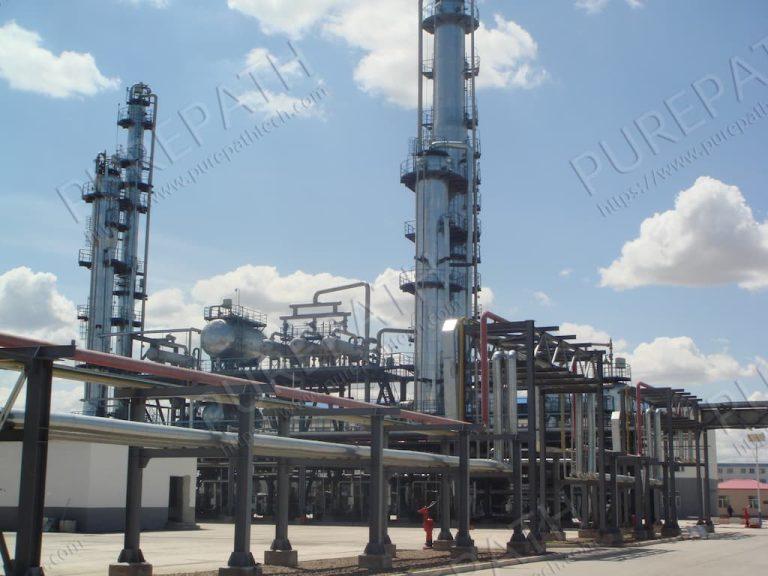
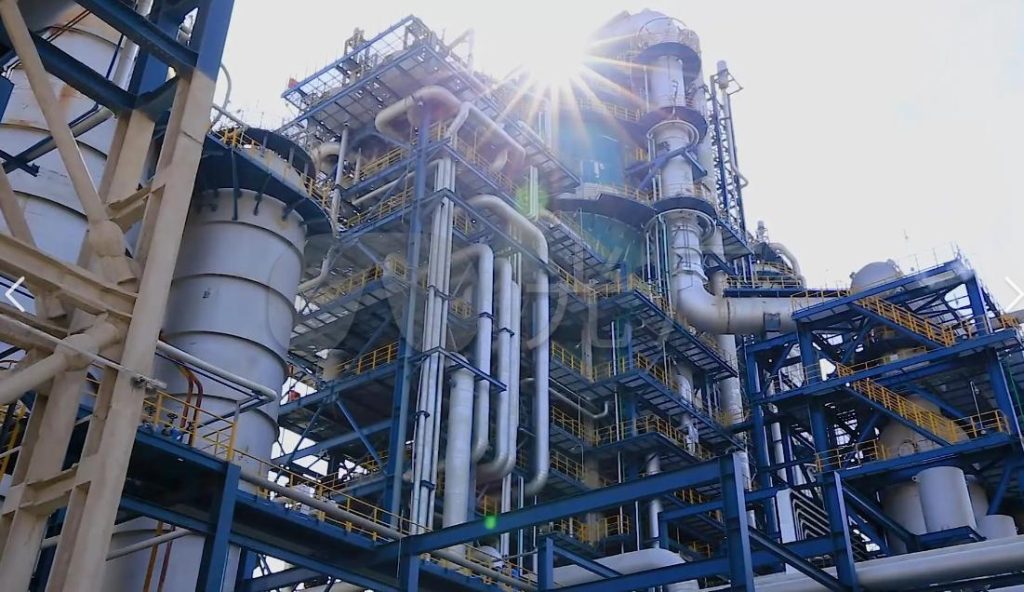
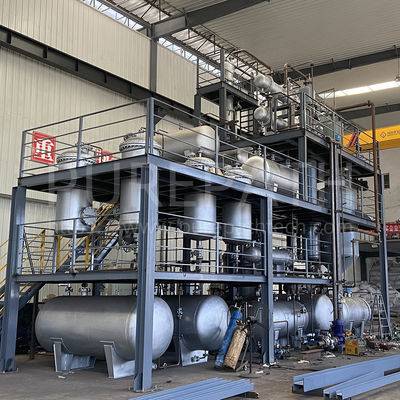
The perception of recycled oil has undergone a fundamental transformation due to technological advancements in the waste oil recycling plant. Ten years ago, recycled oil was often limited to low-grade applications such as burner fuel or basic chain lubricants. In 2026, modern facilities utilize sophisticated chemical engineering processes that allow for the production of high-quality re-refined base oil.
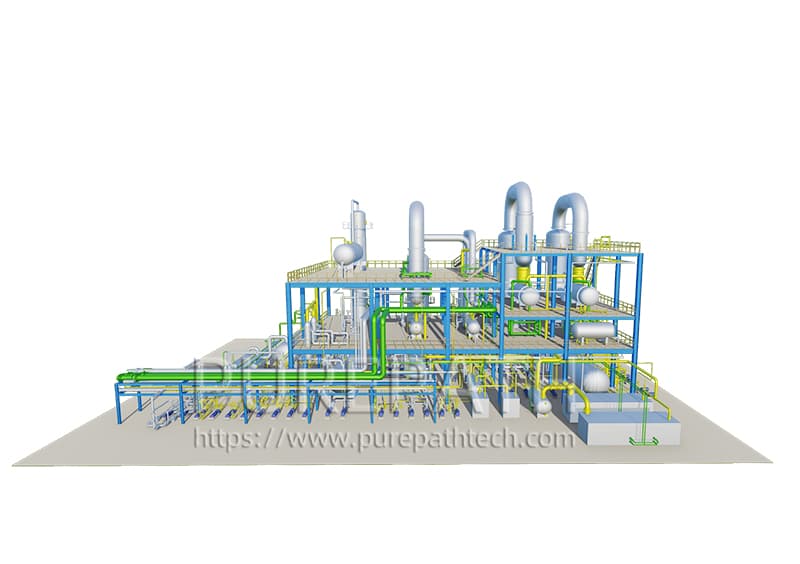
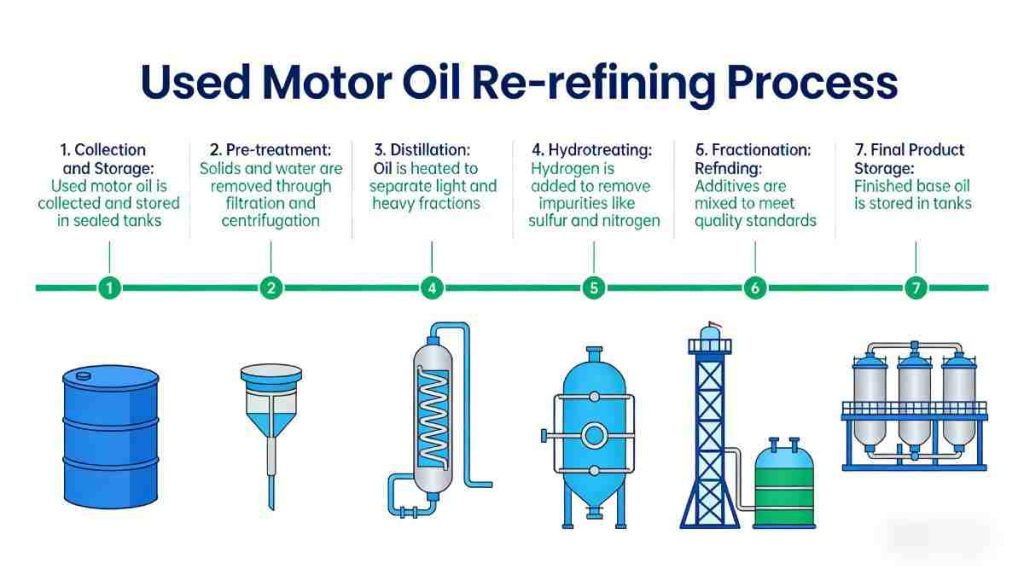
A contemporary waste oil recycling plant employs a multi-stage process to restore used lubricants to their original molecular state. This process typically includes:
- Dehydration and De-fueling: Removing water and light hydrocarbons.
- Fractional Vacuum Distillation: Separating the oil into different viscosity cuts while removing heavy metals and soot.
- Hydrotreating: This is the most critical stage. By reacting the distillate with hydrogen at high pressure and temperature in the presence of a catalyst, impurities such as sulfur, nitrogen, and chlorine are removed.
The result is a re-refined base oil that meets or exceeds the American Petroleum Institute (API) standards for virgin base oils. These products are now indistinguishable from their virgin counterparts in terms of oxidation stability, viscosity index, and pour point.
Economic Advantages of Used Oil Recycling
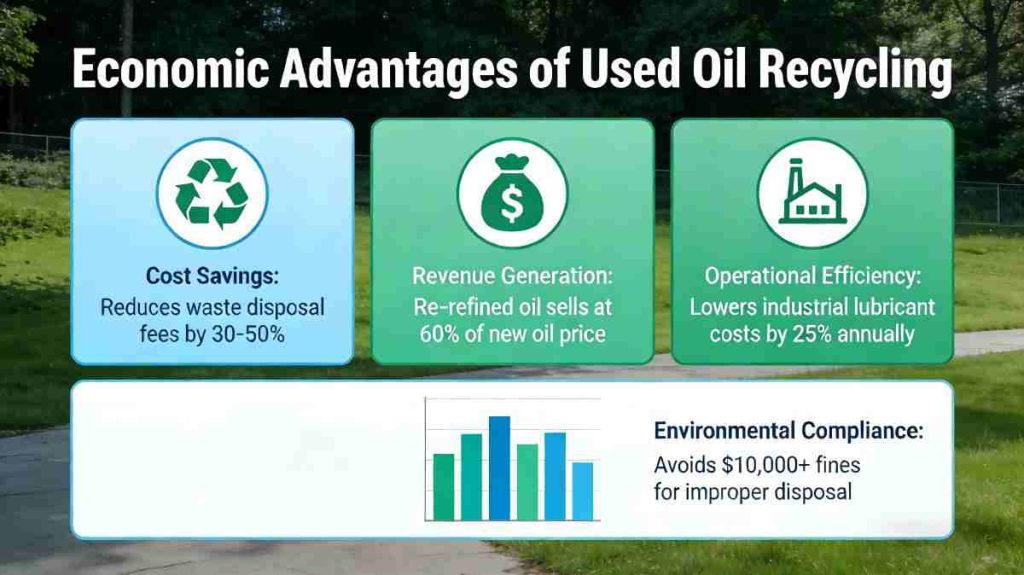
Putting money into or working with a waste oil recycling plant can bring in money. The main economic driver is the lower cost of raw materials. It takes a lot of energy to get virgin base oil out of the ground and move it long distances, but it takes much less energy to re-refine used oil.
Research from 2026 shows that making one gallon of re-refined base oil takes about 50% to 80% less energy than refining the same amount from crude oil. These savings on energy are passed down the value chain, which makes recycled lubricants cheaper than new ones. Also, a lot of governments have added carbon taxes and fees for getting rid of trash. Companies can avoid these taxes and even make money from their waste streams by setting up a strong used oil recycling program.
Environmental Compliance and Global Regulations in 2026
As countries try to reach their net-zero targets by 2030, rules and regulations have become stricter. Many places have strict rules about how to get rid of used engine oil and industrial fluids. Direct incineration to get energy back, which used to be a common practice, is being phased out in favor of high-value re-refining.
The “Circular Economy Directives” that go into effect in 2026 say that both the public and private sectors must put products with a lot of recycled content at the top of their lists. For a multinational company, using re-refined base oil is no longer a choice; it is a requirement for staying within the law and getting government contracts. This change has made a huge demand for high-quality recycled goods, which has made the used oil market even more stable.
Reducing Risk Through Localized Supply Chains
One of the best things about recycling used oil is that it makes the country’s and businesses’ energy security better. When a country has the right infrastructure for a waste oil recycling plant, it can make its own “renewable” oil well.
When the price of crude oil goes up because of maritime blockades or export bans, recycled lubricants make sure that important infrastructure like power plants and transportation fleets can keep running. This strength is an important part of corporate risk management in the middle of the 2020s.
Quality Assurance and Industrial Application
Modern industrial machines are made with very small tolerances. So, the lubricant must be very pure. Technical data from 2026 shows that re-refined base oil works with all standard additive packages. It is now being used in situations where there is a lot of stress, such as:
- Hydraulic Systems: Maintaining consistent pressure and protecting against wear in precision robotics.
- Internal Combustion Engines: Providing thermal stability and sludge control in heavy-duty truck engines.
- Metalworking Fluids: Ensuring cooling and lubrication in high-speed CNC machining centers.
Because the re-refining process removes the degraded additives and contaminants found in used oil, the final product is a “clean slate” that performs reliably over long service intervals.
Implementing a Closed-Loop Lubrication System with Re-refined Base Oil
The current economic and environmental trends point to a closed-loop system as the next step. In this model, an industrial facility buys high-quality lubricants, uses them in its machines, and then sends the used fluid back to a plant that recycles waste oil. The plant brings the oil back to its original specifications, and the facility buys the same oil again.
This cycle gets rid of waste, lowers the need for new crude oil extraction, and makes costs predictable, so they don’t change every day with the price of crude oil.
In 2026, the proof is clear: using re-refined base oil in factories is a necessary step for both the economy and the environment. Used oil recycling provides a lot of stability because the price of crude oil is still affected by outside factors.
Frequently Asked Questions (FAQ)
Q1. Is re-refined base oil just as good as virgin base oil?
Yes. Hydrotreating technology is used by modern waste oil recycling plants to get rid of all impurities and broken-down additives. The re-refined base oil that comes out meets the same API Group I, II, or III standards as virgin oil and works perfectly with standard industrial additive packages.
Q2. How does the price of crude oil affect the cost of recycled oil?
The price of crude oil sets the market ceiling for all lubricants, but re-refined base oil is less volatile. It doesn’t have to pay for international shipping, carbon taxes on extraction, or geopolitical price premiums because it gets its feedstock from local networks that recycle used oil.
Q3: Is it worth it to invest in a plant that recycles waste oil in 2026?
Yes. The need for re-refined base oil has grown because carbon taxes are going up and recycling quotas are required in 2026. Changing the way we think about used oil from “waste” to “strategic asset” gives us a high return on investment by lowering the cost of raw materials and making sure we follow the rules.