
How Used Oil Feedstock Quality Affects Base Oil Yield
Written By: Mr.Ran
Senior Petrochemical & Waste Oil Recycling Engineer
Deeply involved in the design, manufacturing, and optimization of various waste oil recycling and petrochemical equipment, delivering practical and efficient solutions for clients worldwide.
Used oil feedstock quality is one of the most important variables affecting the used oil base oil yield. The same amount of waste oil collected can yield varying amounts of re-refined base oil as the composition of the waste oil may contain different percentages of recoverable lubricating hydrocarbons, water, fuel dilution, sludge, solids, degraded additives, metals and heavy contaminants.
Used oil re-refining yield for commercial re-refining plants should therefore not be treated as a fixed percentage. A more accurate assessment starts with the feedstock quality and composition, followed by a process-specific mass balance.
Used Oil Feedstock Quality and Base Oil Yield: Key Takeaways
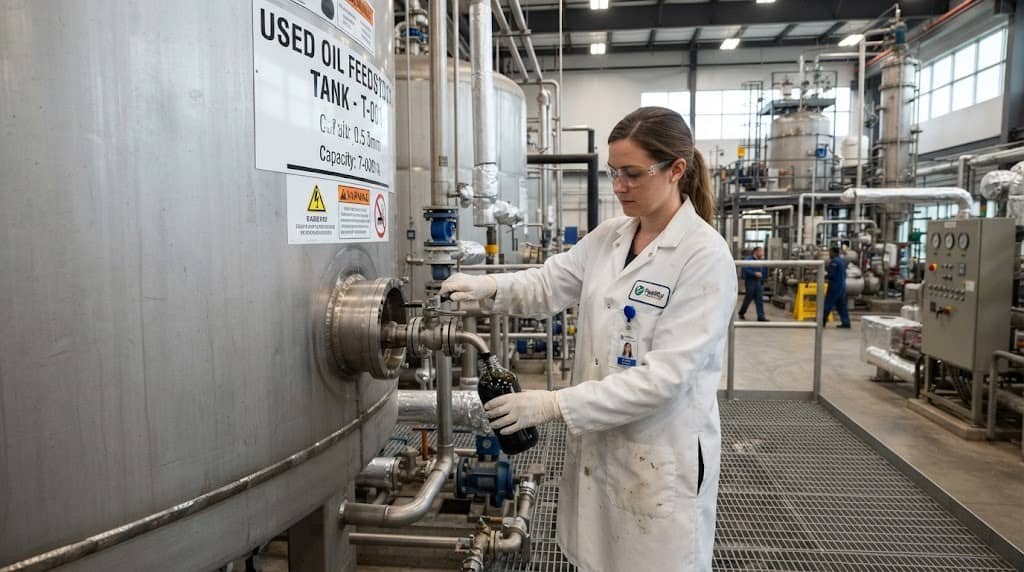
Used oil feedstock quality affects base oil yield as not all incoming feedstock is recoverable lubricating oil. The recoverable oil fraction can be reduced by water, light hydrocarbons, sludge, solids, degraded additives and heavy contaminants, and inconsistent feedstock can make the final base oil recovery rate less predictable.
Feedstock Factor → Yield Impact
| Feedstock Factor | Impact on Recoverable Fraction | Impact on Base Oil Yield |
| High water content | Reduces oil fraction per incoming ton | Lower apparent yield and higher dehydration load |
| Fuel dilution | Increases light/volatile fraction | Less material available as finished base oil |
| High sludge | Increases heavy non-recoverable fraction | Lower base oil recovery and more residue |
| High sediment/solids | Adds non-oil material | Lower recoverable fraction and higher pretreatment load |
| High ash/metals | Concentrates inorganic/heavy contaminants | Greater residue and treatment requirements |
| Degraded additives | Increases non-distillable material | Can reduce recoverable lubricating fraction |
| Variable mixed feedstock | Makes composition less predictable | Less predictable waste oil recycling yield |
| High-quality lubricating oil fraction | Increases recoverable hydrocarbons | Higher and more stable base oil yield |
This distinction is important when evaluating suppliers. The cheapest feedstock per ton is not necessarily the feedstock with the lowest cost per ton of recoverable base oil.
What Determines the Recoverable Base Oil Fraction?
Used lubricating oil is a complex mixture rather than pure base oil. During service, lubricants accumulate water, fuel, combustion products, wear metals, degraded additives, oxidation products, and other contaminants.
A simplified base oil recovery rate can be expressed as:
Base Oil Recovery Rate (%) = Re-Refined Base Oil Output ÷ Used Oil Feedstock Input × 100
However, this calculation does not mean that every kilogram of incoming feedstock has the potential to become base oil.
The more useful engineering question is: What percentage of the feedstock represents recoverable lubricating hydrocarbons, and how efficiently can that fraction be separated and upgraded?
Therefore, the yield of used oil base oil should be evaluated based on the feedstock composition and not on a generic industry percentage. The PurePath used oil feedstock specification emphasizes the evaluation of water, sediment, ash, viscosity, chlorine, sulphur, metals and fuel dilution in conjunction, since these parameters affect processing requirements, recovery, residue generation, and operating economics.
Key Feedstock Factors Affecting Used Oil Re-Refining Yield
1. Water Content
Water contributes to the weight of incoming feedstock but is not converted into base oil. For example, if 1,000 kg of used oil contains 100 kg of water, only the remaining material can contribute to the recoverable hydrocarbon fraction before other contaminants and process losses are considered.
High water content can also increase dehydration requirements and energy consumption. Therefore, water should be considered when calculating the real value of a waste oil feedstock.
2. Fuel Dilution
Used engine oil may contain gasoline or diesel introduced during engine operation. Fuel dilution increases the volatile fraction of the feedstock. These lighter components may be separated during dehydration and distillation rather than becoming finished lubricating base oil.
Consequently, a high liquid volume does not necessarily represent a high base oil recovery potential.
3. Sludge and Insoluble Solids
Sludge can contain oxidized oil, soot, degraded additives, dirt, and other insoluble materials. A feedstock with high sludge content generally has a lower recoverable lubricating fraction. It can also increase filtration requirements, residue generation, fouling risk, and equipment cleaning requirements.
4. Ash and Metals
Ash and metals indicate the presence of inorganic or heavy contaminants. These materials generally do not form part of the desired base oil fraction and can become concentrated in heavy residues. High contamination can therefore influence both used oil re-refining yield and the cost of handling the residual streams.
5. Degraded Additives and Oxidation Products
Used lubricants contain additive packages designed to protect equipment during operation. After extended service, some additives and oxidation products are transformed or degraded.
These materials can increase the heavy fraction of the feedstock and affect separation behavior. The result is that two lubricants with similar viscosity or water content may still have different base oil recovery potential.
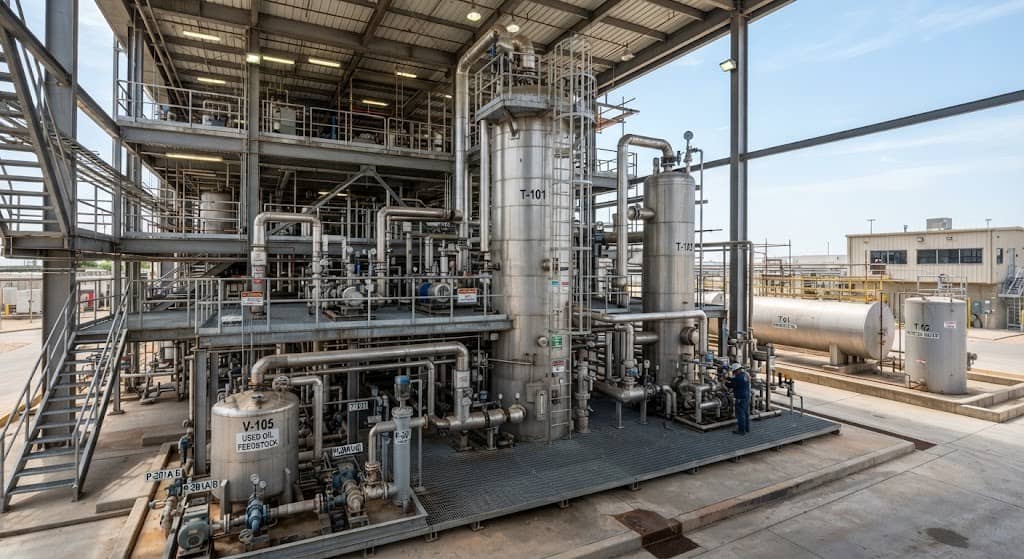
Why Similar Used Oils Can Produce Different Base Oil Yields
A single feedstock parameter cannot fully predict the waste oil recycling yield. Consider two hypothetical batches:
| Parameter | Feedstock A | Feedstock B |
| Water | Low | Low |
| Sediment | Low | High |
| Sludge | Low | High |
| Ash/metals | Low | High |
| Feedstock consistency | Stable | Variable |
| Recoverable oil fraction | Higher | Lower |
| Expected yield predictability | Higher | Lower |
Although the moisture content of both batches may be similar, the final base oil recovery rate may be different due to different proportions of recoverable lubricating hydrocarbons. Therefore, the assessment of a feedstock should not be based on a single laboratory parameter, but on the overall composition.
How Feedstock Quality Interacts with the Re-Refining Process
Feedstock quality influences the load placed on each stage of a re-refining system.
Feedstock → Pretreatment → Dehydration → Vacuum Distillation → Thin-Film Evaporation → Upgrading → Re-Refined Base Oil
For example:
| Feedstock Condition | Main Process Consideration |
| High water | Dehydration load |
| High solids | Filtration and pretreatment |
| High volatile content | Light-end separation |
| High heavy contamination | Residue management |
| High sulfur | Potential upgrading requirement |
| Poor color/oxidation profile | Additional purification |
| Variable composition | Process control and yield consistency |
The relationship is not one-to-one. A particular contaminant does not necessarily imply a single processing technology. The final configuration is determined by feedstock properties, plant size, desired product quality, recovery goals and economics of operation. This distinction is important because the goal of maximising waste oil recycling yield is not necessarily the same as maximising the commercial value of the end product.
How to Estimate Used Oil Base Oil Yield Before Processing
A preliminary engineering model can use:
Estimated Base Oil Output = Feedstock × Recoverable Oil Fraction × Process Recovery Efficiency
For example, if a plant receives 1,000 kg of feedstock, the first step is to determine how much represents recoverable lubricating hydrocarbons. The process recovery factor is then applied to estimate the amount that can become finished base oil.
This approach is more useful than assuming that every plant will achieve the same used oil re-refining yield, because actual performance depends on:
- Feedstock composition
- Water and volatile content
- Sludge and heavy contaminants
- Process configuration
- Operating conditions
- Product specifications
- Recovery efficiency
The final commercial value should be confirmed through representative feedstock testing and a project-specific mass balance.
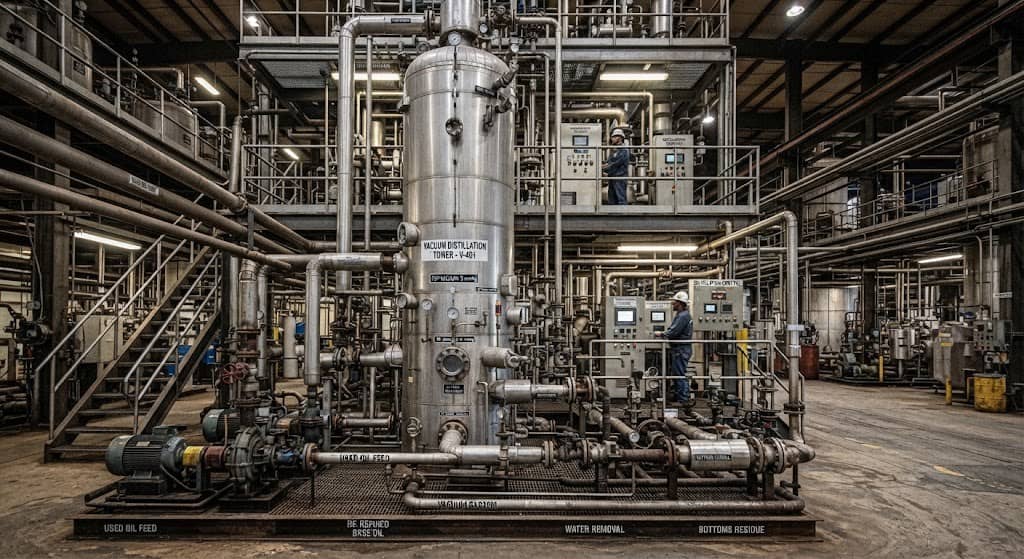
Feedstock Quality vs. Base Oil Recovery Rate
A useful way to understand the relationship is:
Higher Recoverable Oil Fraction
↓
Lower Non-Product Material
↓
Lower Residue Burden
↓
More Predictable Base Oil Recovery Rate
↓
More Reliable Production Forecast
This does not mean that the cleanest feedstock will always generate the highest economic return. Feedstock acquisition cost and the value of the final base oil must also be considered. The objective is to optimize recovery, quality, operating cost, and product value together.
How Feedstock Quality Affects Recycling Plant Economics
Price per tonne should not be the only factor in feedstock purchase decisions. A low-cost waste oil can contain significant amounts of water, sludge, fuel, or heavy contaminants. These components decrease the amount of valuable hydrocarbon available to base oil production and increase treatment and residue handling requirements.
A more useful indicator is: Effective Feedstock Cost = Feedstock Purchase Cost ÷ Recoverable Oil Fraction
For example, two suppliers may offer different prices:
| Item | Supplier A | Supplier B |
| Purchase price | Lower | Higher |
| Water/contamination | Higher | Lower |
| Recoverable oil fraction | Lower | Higher |
| Expected base oil output | Lower | Higher |
| Processing burden | Higher | Lower |
Therefore, the correct procurement question is not:“Which supplier offers the lowest price per ton?” It is: “Which feedstock provides the most recoverable base oil value for the total processing cost?”
How to Improve Feedstock Consistency
Better feedstock management is one way to improve the predictability of the used oil base oil yield before any change in the re-refining equipment.
- Separate Major Waste-Oil Streams: Where practical, keep engine oil, hydraulic oil, gear oil and other industrial lubricants in separate streams.
- Create Supplier Quality Records: Monitor the source, composition, historical test results, storage conditions and processing performance of each supplier.
- Test Representative Batches: Samples should be representative of the actual incoming batch, and not a small or convenient fraction of a storage tank.
- Classify Feedstock Before Processing: A practical system can categorize material as acceptable, conditional, or requiring further evaluation.
- Link Feedstock Data to Production Results: Record Supplier, Batch, Feedstock Analysis, Process Conditions, Base Oil Output, Residue, and Product Quality
Over time, this creates a plant-specific database that can reveal which feedstock sources consistently deliver better recovery and more stable operation.
Illustrative Feedstock-to-Yield Example
Consider two hypothetical 1,000 kg feedstock batches.
| Material Characteristic | Batch A | Batch B |
| Water | 3% | 10% |
| Sludge/solids | Low | High |
| Heavy contamination | Low | High |
| Recoverable oil fraction | Higher | Lower |
| Process consistency | Stable | Variable |
| Base oil yield potential | Higher | Lower |
Batch A does not necessarily produce more base oil simply because it contains less water. Its advantage comes from having a greater proportion of material that can potentially be recovered as a useful lubricating fraction. This illustrates why used oil feedstock quality should be evaluated as a complete composition rather than as an isolated laboratory number.

Feedstock Quality Should Come Before Yield Forecasting
For a commercial re-refining project, a reliable yield forecast should follow this sequence:
1. Identify Feedstock Source
2. Analyze Feedstock Composition
3. Estimate Recoverable Hydrocarbon Fraction
4. Select Appropriate Process Configuration
5. Establish Process Mass Balance
6. Validate Actual Base Oil Recovery Rate
This approach separates feedstock potential from equipment performance. It also helps prevent a common mistake: applying a published waste oil recycling yield percentage to a feedstock whose composition has not been properly characterized.
FAQ
Q1: What is the main factor affecting used oil base oil yield?
A1: The recoverable lubricating hydrocarbon fraction is one of the most important factors. Water, fuel dilution, sludge, solids, degraded additives, and heavy contaminants reduce the proportion of feedstock that can become finished base oil.
Q2: Does water reduce the waste oil recycling yield?
A2: Yes. Water adds weight to incoming feedstock without contributing to base oil production. High water content can also increase dehydration and energy requirements, reducing the effective recovery from each ton of feedstock.
Q3: What is the difference between base oil recovery rate and base oil quality?
A3: The base oil recovery rate measures how much finished base oil is recovered from feedstock. Base oil quality measures the properties and specifications of that product. A higher recovery rate does not automatically mean higher-value base oil.
Q4: Can mixed used oil produce consistent base oil yield?
A4: It can, but greater variation in feedstock composition generally makes yield and process control less predictable. Characterizing and managing mixed feedstock before processing can improve production forecasting.
Q5: How can used oil feedstock quality be improved?
A5: Feedstock consistency can be improved through source selection, separate collection of major oil streams, representative batch testing, supplier quality records, and traceability between incoming feedstock and actual processing results.